Honest, paywall-free news is rare. Please support our boldly independent journalism with a donation of any size.
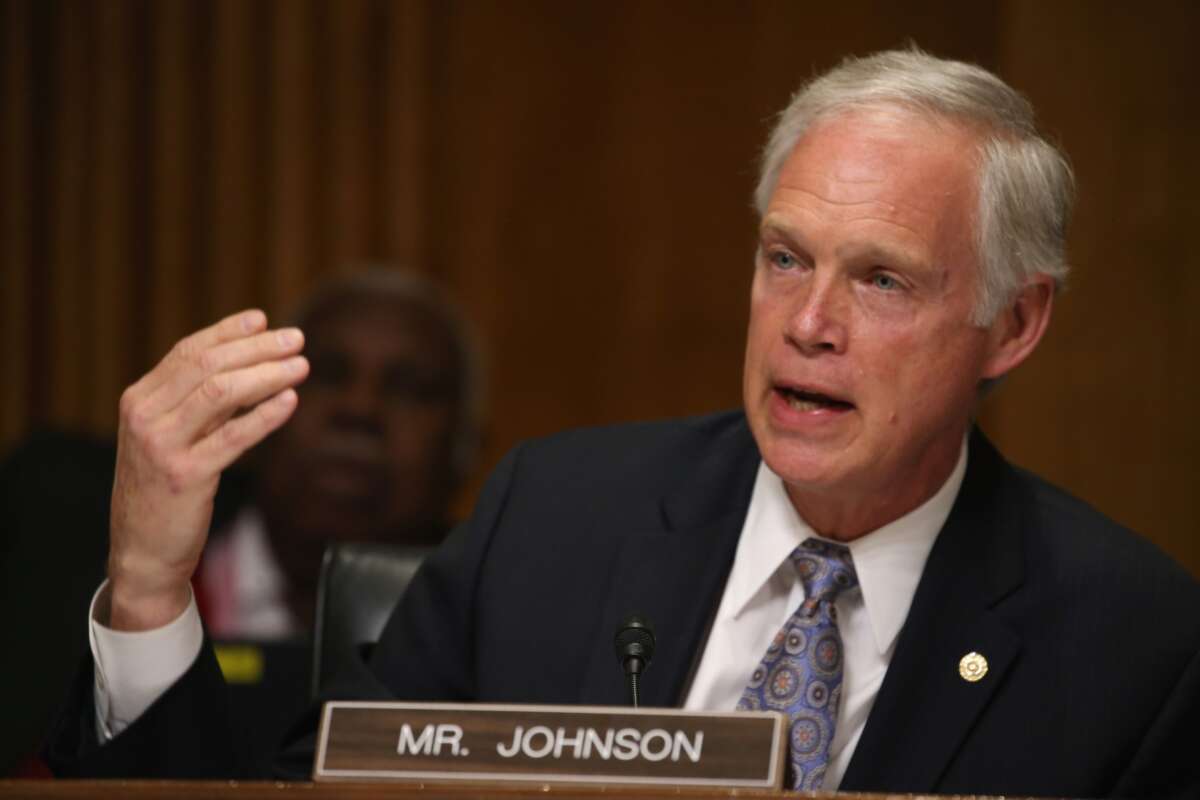
Sen. Ron Johnson (R-Wisconsin), one of the richest people in the Senate, said on Wednesday that Congress shouldn’t be banned from trading stocks because the basic anti-corruption rule would make it “unattractive” to run for office.
During debate on a congressional stock ban introduced by Sen. Josh Hawley (R-Missouri) on Wednesday, Johnson said that he was concerned about “unintended consequences” stemming from the legislation. He called the bill “demagoguery” and said that there are already financial disclosure laws in place — despite dozens of ethics groups, experts, and former members of Congress saying that these laws are wholly insufficient to prevent corruption.
The bill would “make it very unattractive for people to step up to the plate and run for office,” Johnson continued. “When we pass a tax law that lowers tax rates, we all benefit. It’s just an inherent issue.”
He also complained that it was difficult for him to find a chief financial officer after the passage of the Stop Trading on Congressional Knowledge, or STOCK, Act, which was passed in 2012 in hopes of barring corrupt trading within Congress. The STOCK Act has been heavily criticized for being ineffective, with lawmakers committing dozens of violations of the legislation each year and getting only a slap on the wrist.
Johnson is one of the richest people in Congress. According to OpenSecrets, Johnson had an estimated net worth of $39 million in 2018, the latest data the group has available; Quiver Quantitative, an investment company which tracks politicians’ stock trades, estimates that he is currently worth $55 million. In 2022, Johnson complained that his net worth has “only” doubled since he’s been in office, since 2011.
Hawley’s legislation advanced past the Senate Homeland Security and Governmental Affairs Committee on Wednesday, with all Republicans but Hawley in opposition, and all Democrats in support.
Sen. Rand Paul (R-Kentucky) attempted to peel away Democratic support from the legislation by pointing out that it carves out an exception for Donald Trump. Hawley, facing backlash from Trump himself, recently changed the legislation to ensure that its restrictions wouldn’t affect the president and vice president until after Trump’s current term was up.
Public scrutiny of Congress’s ability to own stocks has grown in recent years, with voters expressing concerns over insider trading and corruption as reports reveal that lawmakers have used confidential knowledge, like advance knowledge of the COVID-19 pandemic, to make advantageous trades. Members of Congress particularly benefit from stock trading, with reports finding 95 percent of Congress owns stocks, compared to just about 60 percent of Americans, and with many members of Congress regularly beating the market.
While members of Congress may be hesitant to bar themselves from stock trading, however, the public overwhelmingly favors the idea. Polls in recent years have found that the vast majority of voters, across all political affiliations, say that Congress should be barred from trading stocks.
Media that fights fascism
Truthout is funded almost entirely by readers — that’s why we can speak truth to power and cut against the mainstream narrative. But independent journalists at Truthout face mounting political repression under Trump.
We rely on your support to survive McCarthyist censorship. Please make a tax-deductible one-time or monthly donation.