Did you know that Truthout is a nonprofit and independently funded by readers like you? If you value what we do, please support our work with a donation.
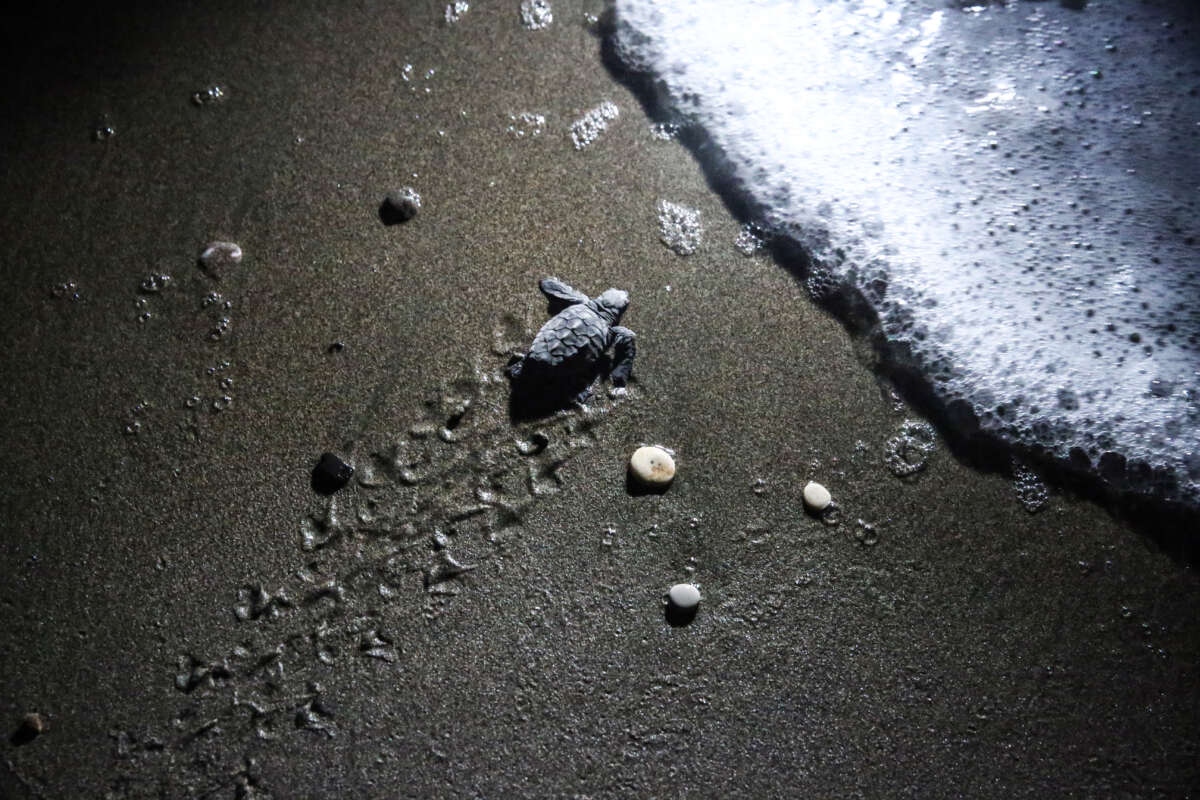
A new study found trace amounts of nuclear waste in sea turtles in the Marshall Islands and five locations in the continental United States, underscoring the enduring legacy of nuclear testing and weapons development.
The analysis, published in the journal PNAS Nexus, looked at turtle and tortoise shells at locations tied to nuclear testing including Southwestern Utah, the Oak Ridge Reservation in Tennessee, the Savannah River Site in South Carolina, and the Barry M. Goldwater Air Force Range in Arizona.
Cyler Conrad, an archaeologist at the University of New Mexico who led the study along with 22 other researchers, said the team found evidence of uranium radionuclides in the shells of turtles and tortoises at all five sites. He added that contamination amounts were so small that it’s doubtful the animals experienced health impacts.
“If you take a paperclip and divide it a million times, if you take a millionth piece of that and divide it another million times, that’s about the same quantity that we’re measuring in some of these shells,” Conrad said.
Still, Conrad says the findings are significant because they illustrate how turtles and tortoises, in part due to their long lives and metabolic processes, are able to retain nuclear contamination in their tissues. According to Conrad, turtle shells grow in a sequential style, similar to tree rings, and record isotopic elements such as uranium-236 from spent nuclear fuel.
The study is the first that Conrad knows of that identifies nuclear contamination in turtles in the Marshall Islands, but it’s far from the first to find evidence of historical, military-related pollution in wildlife there. In 2019, a U.S. Army study found dangerous levels of polychlorinated biphenyls, more commonly known as PCBs, and arsenic in fish around Kwajalein Island in the Marshalls, which has served as a U.S. military base for decades and is currently part of the Ronald Reagan Ballistic Missile Defense Test Site.
PCBs are synthetic organic chemicals that are long-lasting in the environment and can be harmful to human health. Another recent study found pollution in fish, including high levels of mercury and lead, surrounding several Marshallese atolls.
The paper also builds upon decades of research illustrating how nuclear waste bioaccumulates in sea creatures. Conrad said the study’s methodology of analyzing shells is new, but noted past studies have found previous evidence of radionuclides in turtles. A 2020 study of sea turtles in the Montebello Islands found contamination of turtle eggs and tissues.
The findings coincide with Japan’s decision to release treated, contaminated wastewater from the Fukushima Daiichi nuclear power plant into the Pacific Ocean. The move prompted China to ban seafood from Japan, inspired protests in Fiji and South Korea and has particularly frustrated Indigenous peoples in the Pacific who have spent decades fighting against the dumping of nuclear waste in the region. Between 1946 and 1958, the Marshall Islands were the site of 67 U.S. nuclear tests, leading to health and environmental harms that the Indigenous people of the islands continue to grapple with.
Conrad hopes the study inspires more research into turtles and tortoises and how they record nuclear history.
“They’re taking in all of this information, they’re depositing this, and they’re acting as a really critical library for us to be able to reconstruct the history of the world in different ways,” Conrad said. “They’re experiencing what humans are experiencing and they’re able to record this in a very unique way.”
Sign up for Grist’s weekly newsletter here.
25 Years of Truthout: An important fundraising appeal
This September, Truthout is celebrating 25 years of publication. For over two decades, we have been a trusted source for fiercely independent journalism thanks to readers like you.
As we look to the next 25 years, we have launched a special fundraising campaign. Looking to a sustainable future for our publication, we have a fundraising goal of $71,000 in the next 5 days.
We are asking for your support at this juncture because we face greater threats than ever before in our organizational history. Trump and his MAGA allies are determined to control the information ecosystem, and movement-based organizations are subject to dangerous censorship and scrutiny.
If you can support Truthout with a one-time or monthly donation, you will make a significant impact on our work and our legacy. Anything you can do makes a difference!