Truthout is a vital news source and a living history of political struggle. If you think our work is valuable, support us with a donation of any size.
On Monday evening, hundreds of protesters organized by the Poor People’s Campaign (PPC), a group that describes itself as “a moral fusion movement to build power, build moral activism, build voter participation” to “unite poor and impacted communities across the country,” marched on the constituent offices of Sen. Joe Manchin (D-West Virginia) in order to pressure him to change his views on a number of issues, including on a popular voting rights bill that he has opposed.
Descending on Manchin’s offices in Charleston, West Virginia, at least 300 protesters demanded that the senator voice support for a $15 federal minimum wage, and back President Joe Biden’s infrastructure bills that would help working families.
The group also said they wanted Manchin, a centrist, to reverse his position on the For the People Act, a voting rights bill that would expand voter registration, require nonpartisan redistricting commissions in every U.S. state, expose “dark money” being spent in campaigns, and implement other reforms as well.
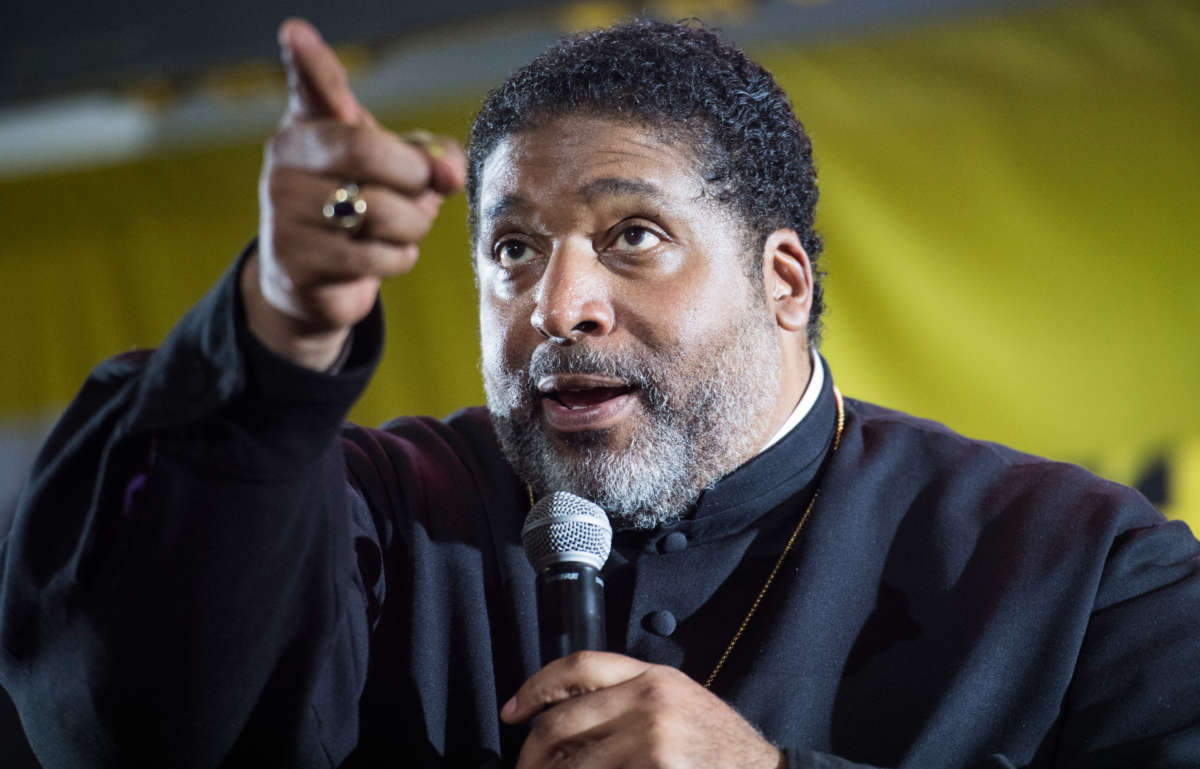
“There is no such thing as being moderate when it comes to protecting voting rights and lifting the poor and lifting low wealth people and providing health care, and providing living wages,” said Rev. William Barber, co-chair of the PPC.
In a recent op-ed regarding the For the People Act, Manchin said he would not support the bill, not because of its contents but because it couldn’t garner support from any Republicans in the Senate. Manchin has also long maintained that he would not back any legislation that would require dismantling the filibuster as well.
But while Republicans in Congress overwhelmingly oppose the measures found in the voting rights bill, Americans by and large are behind the bill and its intent. A Data for Progress poll from May shows that 59 percent of respondents support the bill, while just 27 percent said they didn’t want to see it passed into law.
Manchin’s wariness to back Biden’s infrastructure package also goes against what public opinion polling says about the issue. While the senator has expressed skepticism over raising corporate taxes as high as Biden has proposed to fund infrastructure projects, polling has shown that support for the bill actually goes up when such taxes are mentioned.
A spokesperson for Manchin’s office in Charleston said that Manchin himself wasn’t there at the time protesters arrived on Monday evening, as he was in Washington, D.C. during the current Senate session, but that staffers were on hand “to listen to these important voices and relay their concerns to him.”
Barber insisted that Manchin come to West Virginia to see for himself firsthand that his constituents wanted him to change his policy stances.
“Stop hijacking this. If you want to do something, get the senator out here,” Barber reportedly said to staffers holding comment cards.
Important Message: Please Read
For 25 years, Truthout has survived by publishing impactful investigative journalism and analysis; distributing full editions 365 days a year; and building a community of readers who support us with small, hard-earned donations.
Eighty percent of our $3 million yearly budget comes from small donors alone. Of those, 8,000 readers support us with monthly donations. Back in 2018, when Facebook decided to suppress the circulation of posts made by organizations, thereby cutting readers off from seeing many articles shared by the news organizations they had intentionally decided to follow, Truthout’s total traffic declined by 40 percent, as nearly all of our traffic from that platform disappeared.
Now, Google has recently rolled out its AI search bar, providing AI summaries instead of directing readers to our site. Google Search is our single largest source of traffic; it’s the route by which nearly one third of our readers find us. Much like in 2018, a shocking 40 percent of our Google traffic has disappeared overnight.
It will not be easy for Truthout to shoulder this blow. Nor will it be easy for our peers and collaborators — news sites that depend on traffic and aren’t bankrolled by large corporations.
If you can support Truthout with a donation today, you can help us resist the AI onslaught. Please give today.