Honest, paywall-free news is rare. Please support our boldly independent journalism with a donation of any size.
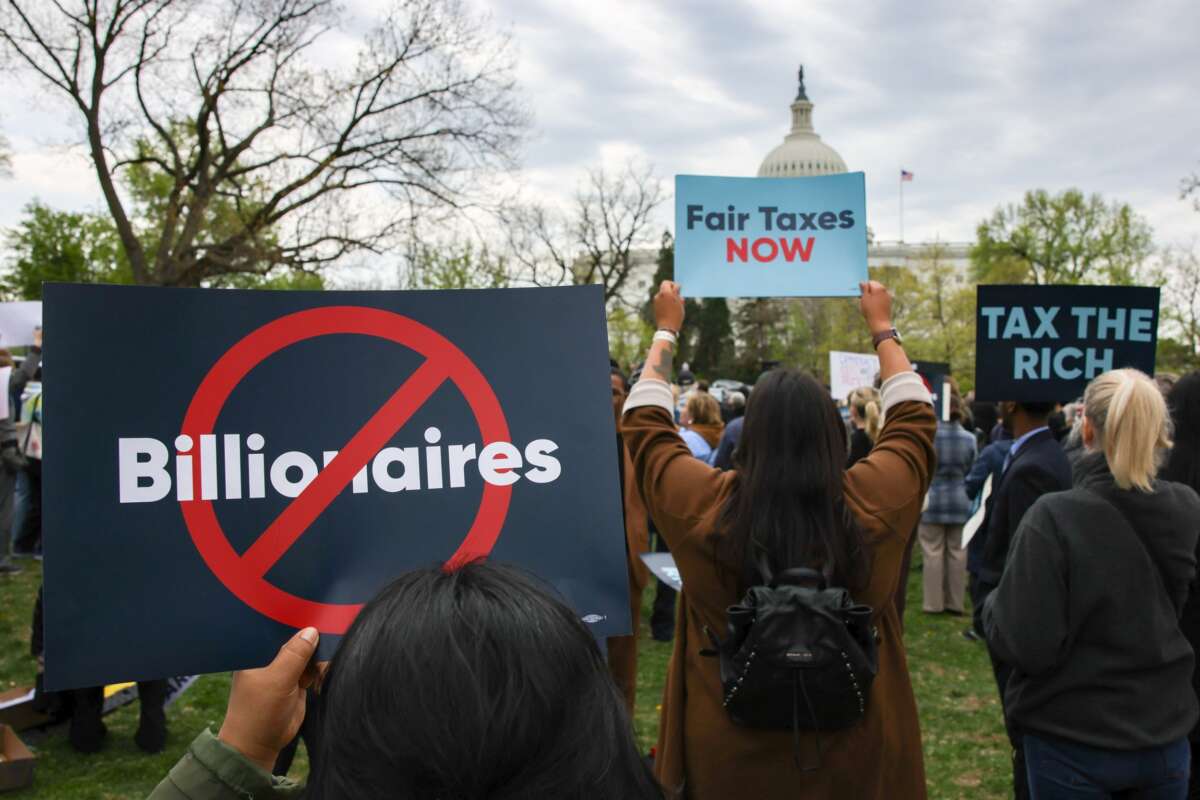
A new Economist/YouGov poll published this week indicates that a majority of Americans are supportive of higher taxes on the rich, and believe that the federal government has an obligation to address wealth inequality.
Asked whether they think billionaires in the U.S. are taxed either too much or too little, 61 percent said billionaires’ tax rates were either “somewhat too low” or “much too low.” Eighteen percent said they were happy with how billionaires are currently being taxed, while 14 percent expressed uncertainty. Just 6 percent said that billionaires were taxed “somewhat too high” or “much too high.”
Even among 2024 Trump voters, a plurality (34 percent) felt that taxes on billionaires were too low, while just 12 percent said that taxes on billionaires were too high.
A majority of the poll’s respondents, 80 percent, said they believe the rich have too much political power in the U.S. Only 8 percent said the rich do not have too much political power.
Only 6 percent said that the wealth gap wasn’t a problem at all. Eight in ten Americans expressed the opposing view, with a majority of Americans, 52 percent, saying that the gap is a “very big” problem and another 28 percent saying it was a “somewhat big” problem. Fourteen percent called it a “minor” issue.
Fifty-seven percent of voters said lawmakers in Washington, D.C. should pursue policies to reduce the wealth gap, while only 22 percent of voters said the federal government shouldn’t try to tackle the issue.
There are several reasons for the U.S.’s widening wealth gap. While the minimum wage has risen a few times since the 1970s, employee compensation, as a percentage of U.S. gross domestic product (GDP), has actually declined for most workers, down by 14 percent since that time. Meanwhile, corporate profits have increased by 193 percent since 1970, providing shareholders — who are generally wealthy to begin with — with an increase in dividends of 274 percent as a share of GDP.
Put another way, if working class Americans had kept all of the economic gains they had made from 1947 through 1970, and kept pace with those gains to the present day, they would have earned $1.7 trillion more in combined income in the year 2023 alone.
Racism also plays a role in wealth inequality, as systemic hurdles continue to make it difficult for nonwhite families to accumulate generational wealth. In 1980, the average wealth of a Black family was around $83,000, and for a Latinx family, it was about $78,000; a white family at that time had over $404,000 in wealth, on average.
All three groups have seen increases since that time, but white families much more so — the average family wealth for Black and Latinx families in 2022, for example, was around $211,000 and $227,000, respectively, while for white families, it was over $1.3 million, on average.
Despite actions by the Trump administration that could actually widen the wealth gap in the near future, the Economist/YouGov polling results from this week showcase an American voting public that is supportive of efforts to reduce wealth inequality, consistent with numbers from other polling sources. Indeed, recent polls on health care also demonstrate that voters are supportive of prioritizing ambitious government spending goals, with high support for the Affordable Care Act (57 percent approval for the program in a recent Gallup poll) and even higher backing for a Medicare for All approach (63 percent in a Data for Progress poll).
Providing more public funding for health care would likely correct some (though by no means all) of the problems associated with wealth inequality. Indeed, a study from the University of Washington School of Medicine in 2018 found that the way the U.S. funds health care today “exacerbates income inequality and impoverishes millions of Americans,” creating a “regressive financing pattern” that is only “improved minimally” by the ACA.
Speaking against the authoritarian crackdown
In the midst of a nationwide attack on civil liberties, Truthout urgently needs your help.
Journalism is a critical tool in the fight against Trump and his extremist agenda. The right wing knows this — that’s why they’ve taken over many legacy media publications.
But we won’t let truth be replaced by propaganda. As the Trump administration works to silence dissent, please support nonprofit independent journalism. Truthout is almost entirely funded by individual giving, so a one-time or monthly donation goes a long way. Click below to sustain our work.