Truthout is a vital news source and a living history of political struggle. If you think our work is valuable, support us with a donation of any size.
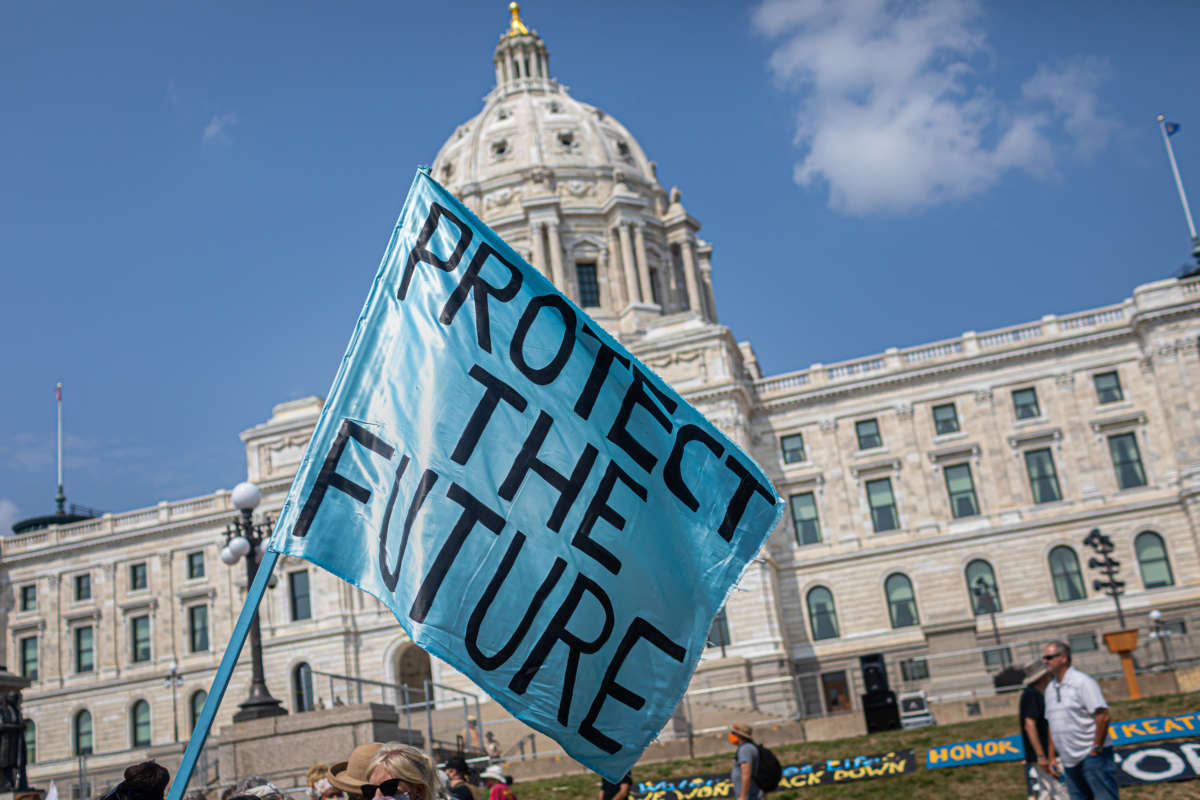
United Nations Secretary-General António Guterres warned Thursday that humanity’s “future is at stake” with governments’ climate commitments, as he marked the launch of a U.N.-backed report he called “an alarming appraisal of just how far off course we are.”
“This year has seen fossil fuel emissions bounce back, greenhouse gas concentrations continuing to rise, and severe human-enhanced weather events that have affected health, lives, and livelihoods on every continent,” wrote Guterres in a foreword to the report, United in Science 2021.
“Unless there are immediate, rapid, and large-scale reductions in greenhouse gas emissions,” he continued, “limiting warming to 1.5°C will be impossible, with catastrophic consequences for people and the planet on which we depend.”
The third edition of the multi-agency United in Science report was compiled by the World Meteorological Organization (WMO) and brings together assessments from partner organizations including the Global Carbon Project (GCP), Intergovernmental Panel on Climate Change (IPCC), and United Nations Environment Programme (UNEP).
Guterres also gave a video message alongside the launch in which he said that “we continue to destroy the things on which we depend for life on Earth.”
The U.N. chief noted in his remarks that developed nations aren’t immune from climate-related disasters, pointing to recent events like Hurricane Ida, which “cut power to over a million people in New Orleans” and left New York City “paralyzed by record-breaking rain that killed at least 50 people in the region.”
Key points noted in the report are that concentrations of key greenhouse gases — carbon dioxide (CO2), methane (CH4), and nitrous oxide (N2O) — continued to increase in 2020 and the first half of 2021.
CO2 emissions from the combustion of fossil fuels dropped in 2020 as a result of the pandemic-related economic slowdown. And while there remains “uncertainty about the global post-pandemic recovery,” the report warns that decline appears to be temporary, pointing to “initial estimates for 2021 [that] show a strong recovery in emissions with a possible return to pre-Covid levels within a year or two.”
The report also highlights the warming planet’s impact on Arctic sea ice.
“In every year from 2017 to 2021,” the report stated, “the Arctic average summer minimum and average winter maximum sea-ice extent were below the 1981–2010 long term average. In September 2020, the Arctic sea-ice extent reached its second lowest minimum on record.”
The publication further notes the climate crisis’ impacts on human health.
“The increased occurrence of wildfires leads to peaks in air pollution concentrations,” the publication states, and “long-term exposure to air pollution is linked to chronic diseases such as asthma, chronic obstructive pulmonary disease, lung cancer, heart diseases, effects on the nervous system and diabetes.” The study also cites increasing evidence related to how “the compound effects of air pollution and Covid-19 may lead to increased Covid-19 mortality.”
It’s also likely that the annual global mean temperature will be between 0.9°C and 1.8°C above pre-industrial conditions for the period of 2021–2025, with a 40% chance of a single year within that five-year span being 1.5°C above pre-industrial levels.
According to WMO Secretary-General Petteri Taalas, the report shows that global demands for governments to “build back better” from the pandemic have fallen on deaf ears. “We are not going in the right direction,” he wrote in a foreword to the report.
Joeri Rogelj, one of the authors of the report and the director of research and lecturer in climate change and the environment at the Grantham Institute at Imperial College London, said the publication is another call to action.
“The messages in this report provide a grim and alarming picture,” he said in a statement. “We are experiencing unprecedented climate change. We have caused it. And our actions to date are largely insufficient to avoid it from getting worse.”
“The combined evidence in this report should empower anyone to make sure the report’s messages are heard in places of power by those making decisions about our future,” said Rogelj, pointing to COP 26, the upcoming U.N. climate summit in Glasgow, as “a key date where the world will have to come together to take the decisions necessary to halt climate change within our lifetimes.”
An important fundraising appeal: 5 Days to raise $35,000
Truthout is one of only a few platforms for justice-oriented, grassroots journalism. Today, as political censorship from the right intensifies, we have no choice but to ask for your help.
We are fundraising right now to cover our basic operating expenses. If you can support Truthout with a one-time or monthly donation, you will make a significant impact on our work. Anything you can do makes a difference — we appreciate your support.