Honest, paywall-free news is rare. Please support our boldly independent journalism with a donation of any size.
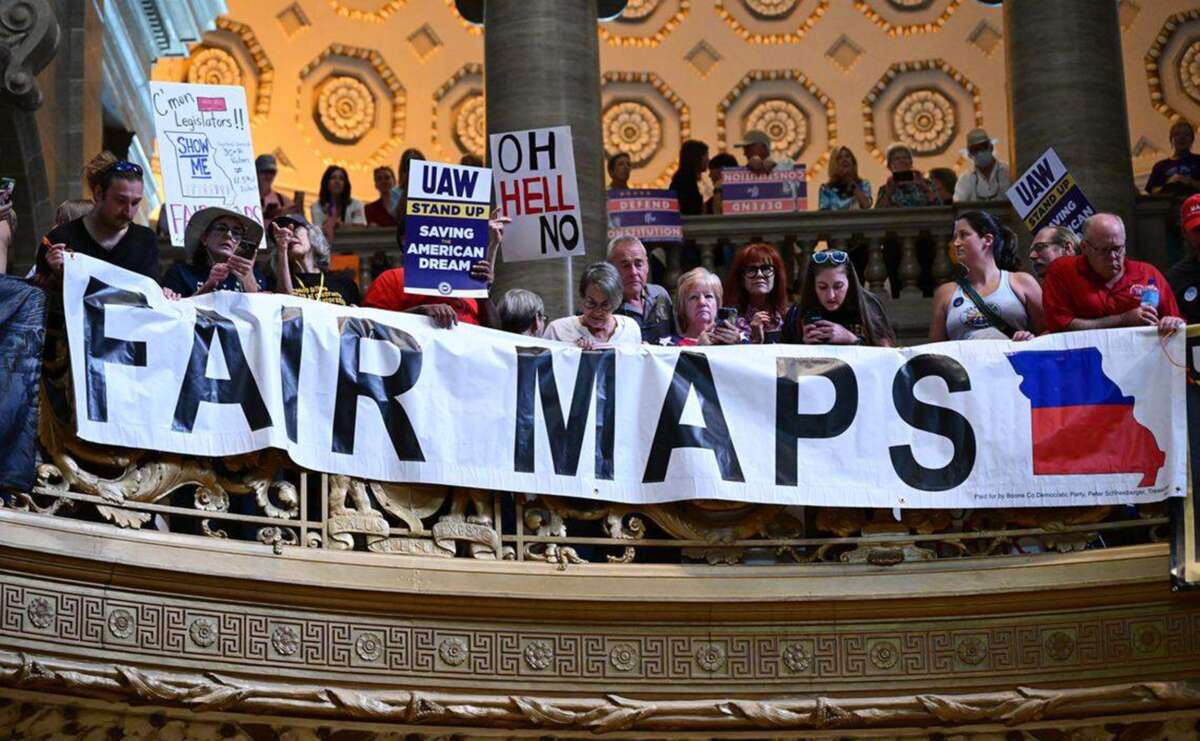
Missouri voters will be given the chance to weigh in on maps redrawn by the Republican-led state legislature last year, which created congressional boundaries many critics have said are both racial and political gerrymanders.
In a unanimous ruling on Thursday, the Missouri Supreme Court found that a “veto referendum” ballot initiative was unduly blocked by Missouri Secretary of State Denny Hoskins (R).
In 2025, as part of President Donald Trump’s push for Republican-led states to gerrymander congressional districts for political gain in the 2026 midterms, Missouri lawmakers split up a district in Kansas City, dividing the municipality into three other districts and diluting the Black vote in the area. The resulting maps meant that it was likely Republicans would gain a seat in Congress, while Democrats would lose one.
In response, a nonprofit group called People Not Politicians Missouri organized and gathered more than 300,000 signatures statewide to veto the law, sometimes referred to as HB 1. After the group submitted their signatures in December, Hoskins waited for the longest possible time permitted to him under state law to block the initiative, doing so in early August by deeming the measure unconstitutional, arguing that such ballot measures couldn’t be used to block redistricting bills.
People Not Politicians Missouri sued over the move. After a lower state court ruled in favor of Hoskins, the case went on to the Missouri Supreme Court, which heard arguments this week on the matter.
The state’s highest court disagreed with Hoskins’s interpretation of the state constitution.
“The plain language of Article III, Section 49 of the Missouri Constitution authorizes a referendum as to ‘any act of the general assembly,'” the court’s ruling stated, noting that “no exception applies,” making the petition by People Not Politicians Missouri “legal, sufficient, and timely.”
The Missouri Supreme Court determined that the measure must be put on November’s ballot. Furthermore, the court ruled that “HB 1 never took effect” due to state rules blocking measures from being implemented if they’re challenged by veto referenda.
The ruling means that the gerrymandered maps will be blocked, for now, with the state reverting to maps drawn after the last census for the fall races.
The Missouri Supreme Court’s decision will be appealed by Republican state lawmakers, who will likely argue that, because primary elections have already occurred using the new maps, the state cannot revert to the older boundaries.
Because the state’s highest court ruled on the matter, the only appellate option available is the U.S. Supreme Court.
“Our office will move immediately to seek relief from SCOTUS,” Missouri Attorney General Catherine Hanaway (R) said on X.
Still, advocates for the veto ballot measure praised the ruling.
“This is what democracy looks like,” said Richard von Glahn, executive director of People Not Politicians Missouri. “The people of Missouri demanded a voice, and the court just confirmed what we’ve been saying all along: People, not politicians, will have the final say.”
We lost 15 percent of our traffic overnight.
We now have three full months of data since Google changed its search to feature AI results. The numbers are worse than we anticipated. Overall readership that comes to Truthout through Google is down 54 percent against last year. The number of new readers who discover Truthout via Google searches is down 49 percent, and returning users from Google are down 51 percent.
We lost 15 percent of our readership overnight. This was a readership we painstakingly built over decades, and it vanished because Google chose corporate greed over a healthy democracy.
We anticipate a loss of roughly $500,000 in online revenue as a result of this massive traffic plunge in the next year alone.
The only way we can keep publishing is with strong reader support. We are asking you to start a monthly donation to Truthout today — anything you can do, whether $5 or $25, makes a difference.