Support justice-driven, accurate and transparent news — make a quick donation to Truthout today!
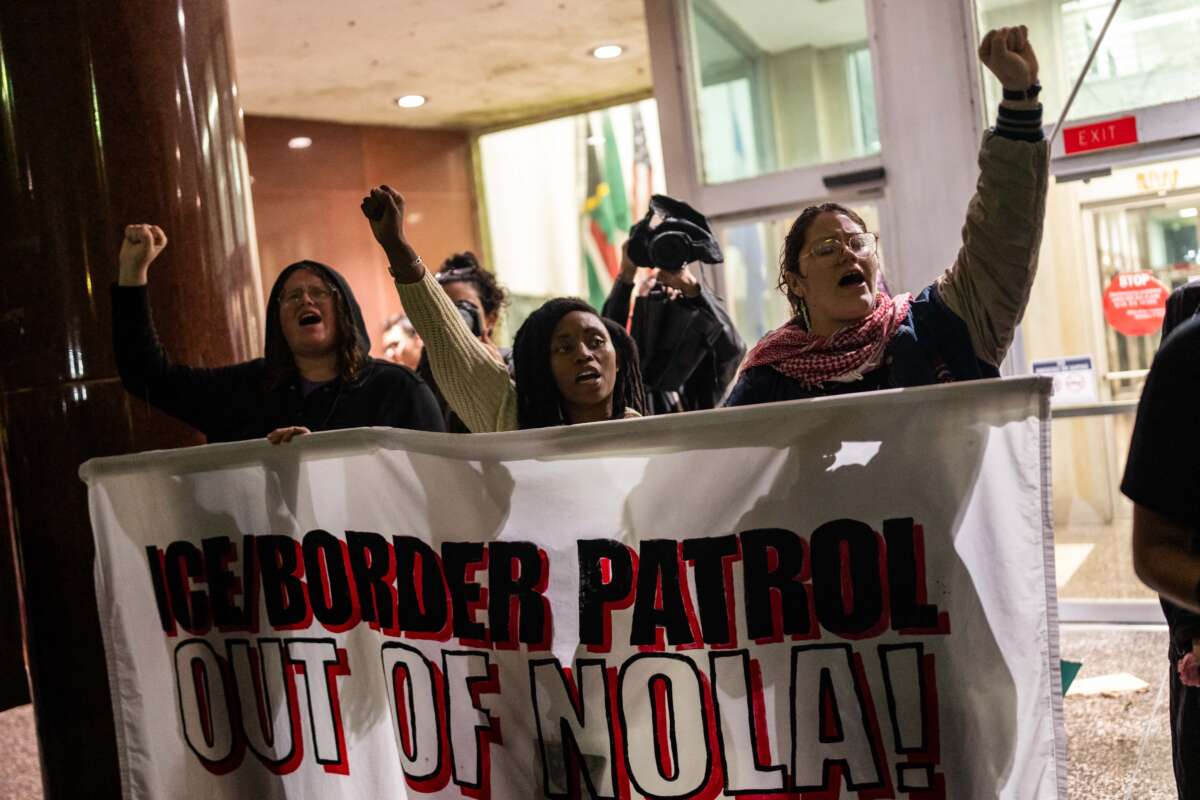
Hundreds of U.S. Border Patrol agents are reportedly set to begin a major immigration crackdown across much of southeast Louisiana and southern Mississippi this week as part of what has been dubbed operation “Swamp Sweep.”
The planned action follows similar surges in Chicago (operation “Midway Blitz”) and Charlotte, North Carolina (operation “Charlotte’s Web”), where agents have been accused of using overly aggressive tactics against both people suspected of being in the country illegally and those protesting the deployments.
In response to the impending surge around New Orleans, some area business owners and workers are staying home, rather than risking arrest for themselves or their customers. Several Hispanic-owned restaurants have temporarily closed. A Kenner priest, whose congregation includes a large number of immigrants, told Verite News in October that he has cancelled group activities other than mass. And on Monday, Verite News reporters found that gathering places in parking lots at several major home improvement stores in greater New Orleans — popular spots for day laborers to find work — were largely abandoned.
However, one group of about 10 men — the majority of whom said they were from Honduras — gathered on a 7th Ward street corner, eating breakfast and waiting to be offered work for the day.
Members of the group, who asked that they not be identified by name for fear of being targeted by immigration agents, acknowledged that being out there was risky. Federal immigration enforcement agents have previously targeted people looking for construction work during recent large-scale raids. And this weekend ICE arrested four people in front of a Home Depot in Gretna. But, they said, they still had to work.
“We need food,” one of the men said. “We all have families, we need to work to provide for them.”
When asked what they would do if federal agents showed up to the spot where they were posted, several of the men answered, almost in unison, in Spanish: “correr,” or “run.”
Previous Operations Could Provide a Preview
Immigrant rights activists in Louisiana say they are looking to other cities that have seen similar immigration crackdowns in recent months for what to expect when the operation goes into full swing. Immigration attorney Mich Gonzalez, who spoke on behalf of the Southeast Dignity Not Detention Coalition, said advocates in New Orleans have received information from advocates in North Carolina about tactics that federal agents have used to surveil, not only immigrant communities, but also people who are providing support through mutual aid. Despite these challenges, he said, one effort from advocates that seems to be improved upon with each operation is the ability to disseminate information to the most impacted people and to document ICE activity.
“One thing that’s been universally true is the benefits of having channels to live report what we’re seeing and … having people to immediately dispatch to confirm [what is] really happening,” Gonzalez said, “Each time another city is being attacked it seems like people are getting better and better at doing that.”
Gonzalez said having a record of federal agents’ activities serves a second purpose of being able to challenge actions that appear to be unlawful in court after the fact.
Throughout 2025 immigration enforcement forces have conducted large scale raids on workplaces and have operated major insurgencies in metropolitan areas. In June, U.S. Immigration and Customs Enforcement agents targeted day laborers in Home Depot parking lots in Los Angeles for arrests, sparking protests and controversy between President Donald Trump, who deployed National Guard troops to the city, and local and state elected officials, who said the deployment was unnecessary.
In August, when the federal government took control of the police department in Washington, D.C., Trump said the move was necessary to quell “out of control” crime and homelessness — though violent crime in D.C. hit a 30 year low in 2024, according to the U.S. Department of Justice. The takeover instead turned the city into a “testing ground for ICE,” The New York Times reported. The city went from just 85 immigration arrests in the between January and July to more than 1,200 such arrests from August through mid-September, The Times reported.
In May, U.S. Department of Homeland Security Advisor Stephen Miller voiced concerns that ICE was not being aggressive enough in its crackdown on immigrants, reportedly setting a quota of 3,000 immigration arrests per day for the agency.
Brandon Lee, director of communications at the Illinois Coalition for Immigrant and Refugee Rights, said his organization has consulted with local activists in Louisiana to share whatever insights they can based on the deployment in Chicago.
Lee said the Chicago area operation felt like a testing ground for immigration enforcement agents to figure out just how “brazen” they could be in stirring up fears among residents and allegedly pushing past legal limitations on how they could conduct themselves.
“They were certainly acting as though there would be no accountability and no recourse for their actions and so I think that type of putting it out in the open was surprising,” Lee said. “Every time there is an order from a federal judge they have sort of thumbed their noses at that ruling.”
Early on in the Chicago operation, agents from Border Patrol, ICE and the FBI raided a large apartment complex in the city’s South Shore neighborhood in the middle of the night, reportedly causing major property damage. Lee said although agents were present on Chicago’s southwest side, which is home to a lot of Hispanic residents, the operation did not stick to one specific zone.
“There was really no distinction between the city and suburbs. Any area that they perceived as having a concentration of immigrants or any place where they thought immigrants might gather or even be present outdoors is where they would go” Lee said.
Last month, the feds drew criticism when agents arrested a preschool teacher inside the day care center where she worked. Last month a review of “Midway Blitz” by a federal judge found Border Patrol agents deployed tear gas, rubber bullets, pepper balls and flashbangs indiscriminately and without proper warning. Lee said that agents initially exercised a “very low threshold for deploying these weapons and hurting people.” The judge also criticized agents’ maneuvers during vehicle pursuits, which led to dangerous crashes.
“Swamp Sweep” could differ greatly from operations in Illinois and North Carolina, where Democratic governors have pushed back against the Border Patrol’s style of immigration enforcement, which, they say, stokes fear and shows a disregard for the rule of law.
In contrast, Louisiana Gov. Jeff Landry appeared on Fox News on Monday to say he welcomes the agents, including the Border Patrol, particularly in New Orleans, which he described as “crime-ridden,” though crime in New Orleans — much like in other Democratic cities targeted by Trump — has been on the decline. (Landry has also encouraged a National Guard deployment to the city, and Trump this week approved the request, with a plan to send the troops in over the coming weeks, The Times-Picayune reported Tuesday.)
Tricia McLaughlin, a spokesperson for the U.S. The Department of Homeland Security, which oversees both Border Patrol and ICE, declined to provide details on the agency’s plans in New Orleans.
Louisiana Law Demands Cooperation From Local Law Enforcement
In Landry’s Fox News segment this week, the governor suggested that Democrats are going easy on undocumented immigrants suspected of violent crimes.
“Just because someone is committing crimes and is in the country illegally, they get a pass,” Landry said. “That’s what Democrats are saying.”
Despite these claims, numerous studies and reports have concluded that immigrants, including those who are undocumented, are less likely to commit crimes than people born in the U.S. In Illinois, 97% of the 614 immigrants that were arrested in “Midway Blitz” had no criminal convictions. In North Carolina more than two thirds of the 130 immigrants initially arrested in “Operation Charlotte’s Web” had no criminal records.
The Illinois TRUST Act, passed in 2017, prohibits state and local law enforcement from collaborating with federal immigration enforcement agencies. In contrast, Louisiana has some of the strictest immigration-related laws in the country, including one passed last year that requires local law enforcement agencies to cooperate with federal immigration forces and another passed this year that criminalizes jailers who refuse to hold arrested immigrants for a limited time until they can go into federal custody.
That law also includes a provision that criminalizes ordinary Louisianans who intentionally “hinder, delay, prevent or thwart” federal immigration enforcement investigations or arrests, with obstruction of justice. Attorney General Liz Murrill shared the penalties for interfering with immigration agents in a post on social media platform X last week: a fine of up to $5,000 and up to a year behind bars.
New Orleans Police Department Superintendent Anne Kirkpatrick has said her agency — which has a longstanding policy limiting how officers can interact with immigration enforcement agencies — would assist Border Patrol agents “if they need help because of safety” but would not directly participate in removal actions. Meanwhile, dozens of other Louisiana law enforcement agencies, including the Kenner Police Department and the Louisiana State Police, have signed 287g partnership agreements with ICE, essentially deputizing local and state law enforcement officers as immigration agents.
Kenner PD’s current agreement only allows agents to conduct ICE activities in its jail. In an interview in November, the city’s police chief, Keith Conley, said the department was looking at signing up for another, more full-throated partnership that would allow officers to investigate immigration violations and make ICE arrests while policing in the Kenner community.
“We do want to be able to have more resources and more tools to be a little more self-sufficient in that regard,” Conley said, adding that KPD would be available to assist federal immigration agents should they be called upon to help in the sweeps.
On Monday, employees inside a Home Depot in Kenner — a New Orleans suburb with the highest concentration of Hispanic residents in the metropolitan area — said they had not seen any day laborers near the store’s parking lot, looking for work, for several weeks.
In September, ICE agents arrested four people near Los Hondureños — a restaurant offering typical Honduran dishes, like baleadas and pollo con tajadas — which sits across from the large Home Depot parking lot.
Los Hondurenos closed for business temporarily as of Dec. 1. On its door, a handwritten sign reads: “Estimado Cliente, Le informamos que a partir del día unos 01 de Diciembre el restaurante está cerrado de manera temporal hasta nuevo aviso. Gracias, Los Hondureños”
“Dear Customers, We inform you that from December 1st the restaurant is temporarily closed until further notice. Thank you, Los Hondureños.”
An urgent appeal for your support: 48 Hours to raise $22,000
Truthout relies on individual donations to publish independent journalism, free from political and corporate influence. In fact, we’re almost entirely funded by readers like you.
Unfortunately, donations are down. At a moment when independent journalism is urgently needed, we are struggling to meet our operational costs due to increasing political censorship.
Truthout may end this month in the red without additional help, so we’ve launched a fundraiser. We have 48 hours to hit our $22,000 goal. Please make a tax-deductible one-time or monthly donation if you can.