Did you know that Truthout is a nonprofit and independently funded by readers like you? If you value what we do, please support our work with a donation.
A 24-year-old Nepali man queues by the boarding gate at Tribhuvan International Airport in Kathmandu. Along with his 30 kg suitcase, he carries a much heavier load – a $1,700 loan to be paid back to the recruitment agency, pending school fees for his children, promised gold bangles for his wife and hospital expenses for his aging parents. Doha, Qatar, is going to be his big break, his chance to put an end to generations of poverty his family has endured. Or so he thinks. Soon, his hopes of realizing his dreams among the bright lights of the booming foreign city are going to be replaced by the dark image of reality – a dusty sheetless mattress in a stuffy overcrowded bedroom, a cockroach-infested kitchen without clean drinking water, long hours of unpaid work under a deadly 50-degree sun (122 degrees fahrenheit) and a life of slavery. But he doesn’t know that yet. The agency did not tell him.
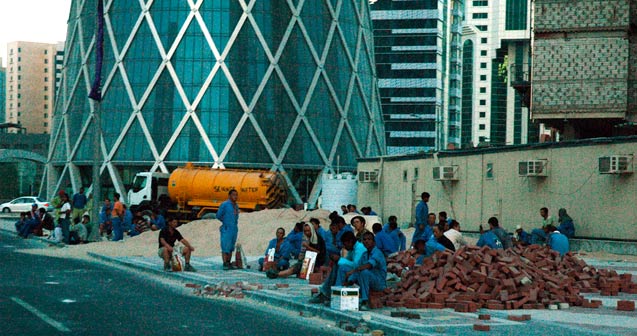
There are hundreds of others like him on the same queue, carrying identical baggage, shiny green passports in hand. Every year, a staggering 100,000 Nepali youth flock to Qatar in search of a better life in the Arab nation. Many of them are tricked by corrupt recruitment agencies that charge extremely high fees and make false promises of a better future for the workers and their families. In reality, most of these men and women are practically sold to a kafeel, a sponsor, under the traditional kafala system that binds workers to their employers. Their documents get confiscated; they do not receive their wages for months; they are not allowed to quit their jobs and are forced to live under appalling unhygienic conditions. If they so much as ask for their wages, they risk getting thrown into jail. Ultimately, these men and women end up being trapped in a life of slavery miles away from home, with no means of escape.
Some do get to return home – in coffins. Four hundred Nepali workers have died since the preparation for World Cup 2022 in Qatar started in 2010, with nearly 200 killed in the past year alone. Every day, 3 to 4 bodies of Nepali workers arrive at the Tribhuvan International Airport from the Middle East. While suspicious medical reports show heart failure or stroke as the cause of death, it is the substandard working conditions and the monstrous treatment of the workers by their employers that account for the overwhelming number of lost lives.
While the 2022 World Cup and cries from international human rights organizations have drawn international attention to the abuse of workers in Qatar, queues continue to get longer at TIA’s departure gates. Nepal does not need international sympathy right now. What it needs is to get the true picture of Qatar across to its poverty-stricken villages, and discourage its impoverished youth from leaving home to become slaves overseas. Until the issue gets resolved – and it is going to take years – Nepal needs to stop its men and women from taking that suicide plane to Doha.
Media that fights fascism
Truthout is funded almost entirely by readers — that’s why we can speak truth to power and cut against the mainstream narrative. But independent journalists at Truthout face mounting political repression under Trump.
We rely on your support to survive McCarthyist censorship. Please make a tax-deductible one-time or monthly donation.