Truthout is a vital news source and a living history of political struggle. If you think our work is valuable, support us with a donation of any size.
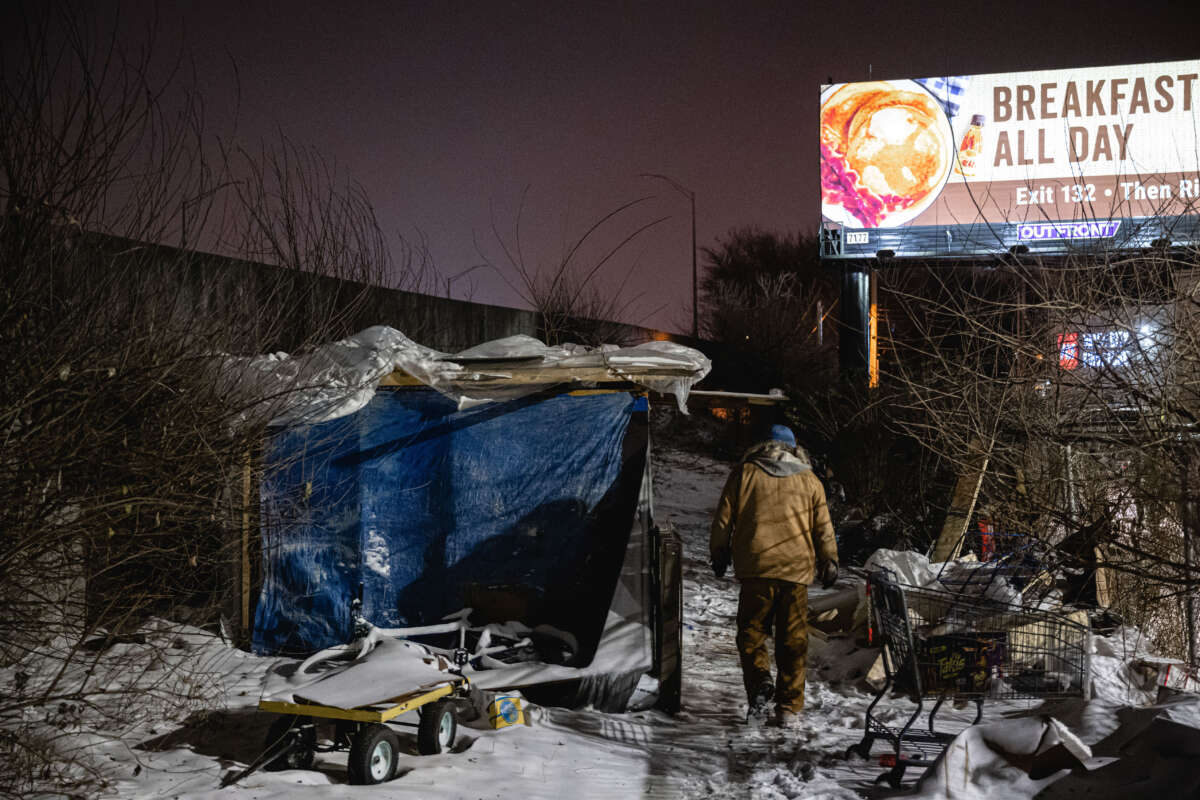
Republican lawmakers in Kentucky introduced a bill last Tuesday that would criminalize homeless encampments and expand the state’s Stand Your Ground law to allow property owners to confront unhoused people with a gun. The bill, dubbed the “Safer Kentucky Act,” already has received more than 45 Republican co-sponsors and the Kentucky State Fraternal Order of Police has committed to testify in support of the legislation when it has a committee hearing.
“I’m just ashamed that this bill even came into fruition and I’m asking people to call their legislators and say no,” Lexington council member Tayna Fogle of District 1 said.
The proposed legislation grants cities the authority to designate specific areas for unhoused individuals. If individuals are found outside of the designated area, residing in a tent, hut, temporary shelter, or vehicle with the intention to sleep, they may face misdemeanor charges, leading to a fine of $5,000 and a potential imprisonment of up to 90 days.
“Telling someone that they cannot sleep in their car or in an encampment does not end homelessness … certainly, taking money away from evidence-based successful housing programs does not end homelessness,” Catherine McGeeney, director of communications for a Louisville-based advocacy group, Coalition for the Homeless, said.
The bill also gives people the ability to justify use of “defensive force” upon an unhoused person in instances of criminal trespass, including “unlawful camping” on the owner’s property. This would allow property owners to use deadly force against unhoused people on their property without facing criminal consequences.
“We’re very opposed to the insinuation and the justification of a use of force against someone who is unsheltered or unhoused. We know that in those situations, de-escalating and getting that person help are what we should do,” McGeeney said.
The proposed legislation also includes a range of additional criminal charges, such as the introduction of a “Three Strike Law” targeting repeat violent felony offenders. It also proposes heightened penalties for fentanyl distribution leading to an overdose, classifies fleeing from law enforcement as a Class C felony, and authorizes the death penalty in cases involving the murder of a first responder.
These increased criminal charges will inevitably result in additional incarcerations in overcrowded prisons. A 2021 analysis by the Prison Policy Initiative found that if Kentucky were a country, it would have the 7th highest incarceration rate in the world as a result of criminal policy decisions. Moreover, a study by the Vera Institute of Justice found that Kentucky’s jail and prison rates more than tripled from 1985 to 2018, because of the state’s dependence on criminalization as a means to address issues such as poverty, homelessness and addiction. In 2022, the state’s heightened focus on criminalizing social issues resulted in overcrowding in Kentucky jails. By the end of April, there were over 21,000 individuals in jails, and an additional 9,835 people were incarcerated in state prisons.
“It’s easier to campaign on being tough on people, let’s clean up our streets and lock these people up,” Whitney Westerfield, the Republican chair of the Kentucky Senate Judiciary Committee said in September. “It’s far more difficult to do the hard work of recovery, of building people back up.”
On Tuesday, various advocacy groups, including the Kentucky Center for Economic Policy, the Coalition for the Homeless, the Louisville Urban League, the Kentucky Equal Justice Center, Kentucky Council of Churches, and others held a press conference condemning the bill.
“We cannot continue to incarcerate everyone. It is a purely remote emotional response,” Felicia Nu’Man, the director of policy for the Louisville Urban League, said. “We should only incarcerate people for long periods of time when we are terrified of the violent acts they might commit — not because we are angry that they’re making our lives inconvenient and have a mental health problem like addiction.”
Press freedom is under attack
As Trump cracks down on political speech, independent media is increasingly necessary.
Truthout produces reporting you won’t see in the mainstream: journalism from the frontlines of global conflict, interviews with grassroots movement leaders, high-quality legal analysis and more.
Our work is possible thanks to reader support. Help Truthout catalyze change and social justice — make a tax-deductible monthly or one-time donation today.