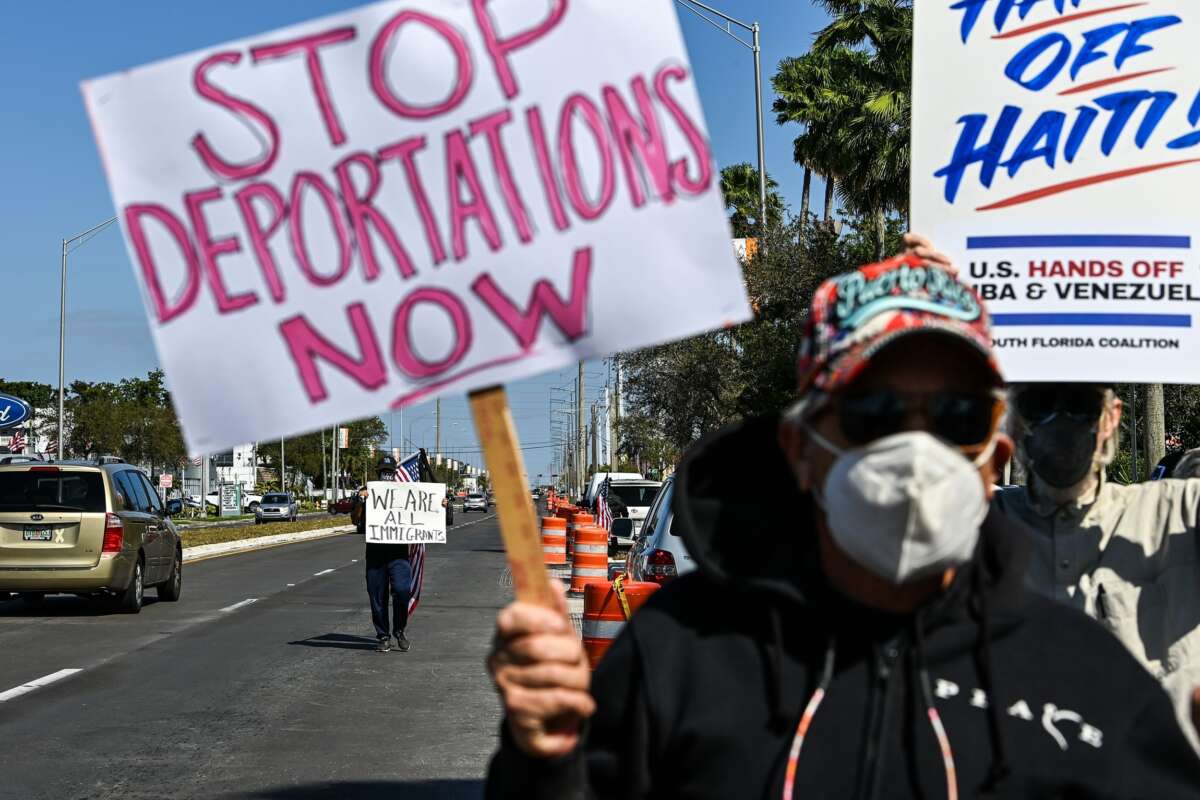
A federal judge is blocking the Trump administration from terminating Temporary Protected Status (TPS) for Haitian immigrants living in the U.S., finding that statements made by White House officials demonstrate that racial bias played a part in decision-making.
Last fall, the Department of Homeland Security (DHS) announced that Secretary Kristi Noem had made a final determination to end TPS status for Haitians after claiming to have consulted with multiple agencies about the idea, stipulating that she had “determined that Haiti no longer meets the conditions for the designation for Temporary Protected Status.”
“The Secretary, therefore, is newly terminating the Temporary Protected Status designation of Haiti as required by statute,” the statement explained, adding that the status would end on February 3, 2026.
On Monday, U.S. District Judge Ana C. Reyes placed an indefinite stay on Noem’s order, citing comments from Noem that made her question the DHS secretary’s motivations.
In a social media post late last year, for example, Noem said she was recommending travel bans on multiple countries, including Haiti, using abhorrent and bigoted language to describe immigrants from those countries.
“I am recommending a full travel ban on every damn country that’s been flooding our nation with killers, leeches, and entitlement junkies,” Noem said in her tweet, further describing those people as “foreign invaders” who “slaughter our heroes, suck dry our hard-earned tax dollars, or snatch the benefits owed to AMERICANS.”
“WE DON’T WANT THEM. NOT ONE,” Noem added.
Reyes included a screengrab of Noem’s social media post on the first page of her order.
The judge noted in her ruling that the five Haitian plaintiffs who brought the lawsuit forward “are not…’killers, leeches, or entitlement junkies,'” but respected members of their communities, including a neuroscientist, a toxicology lab assistant, a college student, and a registered nurse.
“Plaintiffs charge that Secretary Noem preordained her termination decision and did so because of hostility to nonwhite immigrants. This seems substantially likely,” Reyes said in her ruling.
Reyes recognized that Noem “has terminated every TPS country designation to have reached her desk — twelve countries up, twelve countries down.” Despite the department saying otherwise, the DHS head also failed to review the current conditions in Haiti, and to consult with federal agencies that could inform her decision, Reyes said — which Noem is required to do by law under statutes governing TPS changes.
Reyes also pointed out that, while Noem claims that Haiti is hospitable enough for immigrants under TPS to return, the U.S. government advises against Americans traveling to the country “for any reason.”
“Do not travel to Haiti due to kidnapping, crime, terrorist activity, civil unrest, and limited health care,” the State Department’s website currently reads.
That warning “does not exactly scream, as Secretary Noem concluded, suitable for return,” Reyes wrote.
Reyes noted in her ruling that President Donald Trump has made numerous racist comments about nonwhite immigrants, including those from Haiti, over the course of his two presidential terms. Noem’s decisions about Haitian immigrants over the past year have come in close proximity to some of Trump’s comments, the judge said, citing instances in February, June, and December of last year.
Reyes also cited previous rulings against removing the TPS designation for Haitians in Trump’s first term, showing that judges in those decisions had shown that his first administration was “motivated by the ‘discriminatory purpose of removing nonwhite immigrants from the United States.'”
Taken together, the record strongly suggests that Secretary Noem’s decision to terminate Haiti’s TPS designation was motivated, at least in part, by racial animus. The mismatch between what the Secretary said in the Termination and what the evidence shows confirms that the termination of Haiti’s TPS designation was not the product of reasoned decision-making, but of a preordained outcome justified by pretextual reasons.
Officials from the Trump administration promised to appeal the ruling.
“Supreme Court, here we come,” Department of Homeland Security spokesperson Tricia McLaughlin said after the ruling was issued, describing Reyes’s order as “lawless activism.”
Lawyers Geoff Pipoly and Andrew Tauber, who represented the Haitian plaintiffs in the case, called the ruling “a significant victory.”
“Haiti remains an extraordinarily dangerous place, marked by widespread gang violence, rampant disease, lack of access to clean drinking water, severe housing instability, and the absence of a functioning government,” they said in a statement.
Trump’s racism toward Haitian immigrants was perhaps most evident during his 2024 presidential campaign, when he peddled incendiary and dehumanizing lies about Haitian residents of Springfield, Ohio.
“They’re eating the dogs. They’re eating the cats. They’re eating the pets of the people that live there,” Trump claimed, without evidence, during a debate with Democratic candidate for president Kamala Harris.
Trump’s running mate, and now vice president, JD Vance, seemed to acknowledge that Trump’s racist tirade was a lie — but stated that he didn’t care if the claims were false as long as they advanced his anti-immigrant agenda.
“If I have to create stories so that the American media actually pays attention to the suffering of the American people, then that’s what I’m going to do,” Vance said on the campaign trail.
Media that fights fascism
Truthout is funded almost entirely by readers — that’s why we can speak truth to power and cut against the mainstream narrative. But independent journalists at Truthout face mounting political repression under Trump.
We rely on your support to survive McCarthyist censorship. Please make a tax-deductible one-time or monthly donation.