Did you know that Truthout is a nonprofit and independently funded by readers like you? If you value what we do, please support our work with a donation.
Just before midnight on June 13, 2025, a small group of activists gathered quietly outside the Residence Inn by Marriott in Long Beach, California. A few blocks away, the scene was louder and more charged: demonstrators with megaphones chanted outside the Holiday Inn near the Long Beach airport, while police officers stood guard near the front of the establishment.
Word had spread through social media that Immigration and Customs Enforcement (ICE) agents had reportedly checked into both hotels. Within the hour, a small contingent of local residents had arrived at both establishments. They were there to make sure ICE agents didn’t sleep.
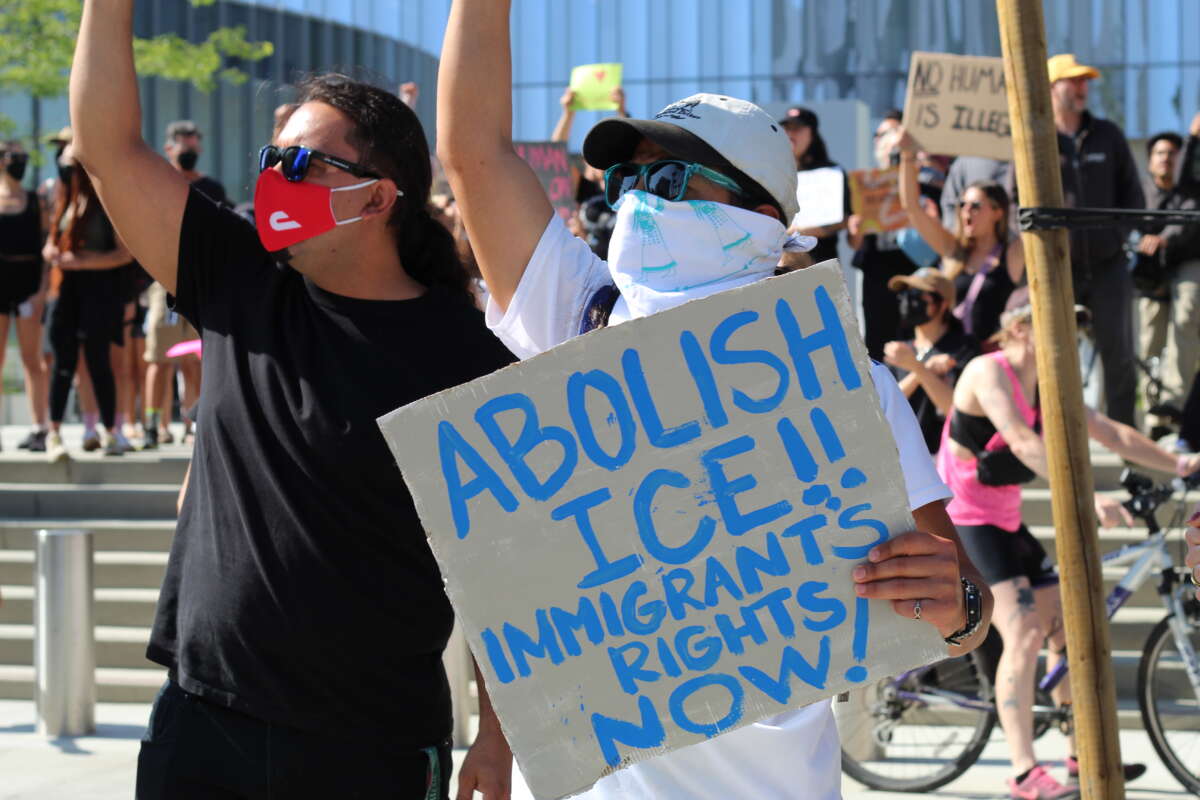
This was one of several “No Sleep for ICE” events that popped up during the month of June. In a time when large-scale protests often dominate headlines, a different kind of resistance is taking root across Southern California. Small, decentralized networks of community members are using stealthy tactics and real-time coordination to monitor, disrupt, and expose the movements of federal immigration officers.
Across L.A. County, the strategy of monitoring ICE movements and responding in real time has become one of the most effective tools in rapid-response activism.
“They shouldn’t be kidnapping people off the street,” said Michael Gearin, a local Long Beach resident, who spoke to Truthout during the anti-ICE mobilization efforts in June.
“If [ICE] wants to come back after a day of kidnapping landscapers and want to kick back and have a beer at the Residence Inn, I say no,” Gearin said, emphasizing his commitment to protecting his neighbors from immigration enforcement. “Why should they have an easy night when everybody else is scared?”
No Sleep For ICE is just one of several pop-up actions that have proliferated over the last several months throughout Southern California. As the immigration raids intensified from the start of June, leading into the late summer months, locals sought out increasingly creative ways to protect vulnerable community members. Many of these micro-movements rarely make the evening news, but they have become the core of mobilization efforts.
In the months leading up to President Donald Trump’s inauguration, grassroots organizers quietly prepared for an expected surge in immigration raids. Guadalupe Carrasco Cardona, an educator and member of Unión del Barrio, partook in community patrols that monitor and track the movements of immigration enforcement agents, alerting local residents in real time.
“[ICE] uses the element of surprise to their benefit,” Cardona told Truthout, noting that many ICE-spotting patrols go early in the morning and search neighborhoods looking for staging of potential agents. “We patrol to spot them, and then let them know we see them — go live on socials, announce to the whole community that they’re there.”
The efforts of local activists patrolling their neighborhoods have uncovered useful information. In June, local groups of organizers monitoring ICE activity discovered that Terminal Island in San Pedro is being used by ICE for early-morning staging and dispatching throughout LA County. This piece of critical information made it easier to monitor ICE activity and warn communities before a raid even begins.
Cardona also noted that community defense patrols have uncovered tactics used by immigration enforcement agents to evade detection. “We’ve uncovered that ICE is switching license plates, using incorrect ones, and sometimes coming out with no plates at all.”
Community patrol work has deep roots in Southern California, stemming back to the early 90s, mostly along the U.S.-Mexico border in San Diego. Many activists there were inspired by the Black Panther Party’s model of community patrols, and Unión del Barrio adapted the concept to monitor and protect immigrant communities from immigration enforcement.

The recent iterations of patrol efforts in Los Angeles were revived in 2020 as a response to raids occurring under the Biden administration. By the time the second Trump administration took office, Unión del Barrio had already built critical experience. Recognizing the magnitude of the task at hand, the group launched the Community Self-Defense Coalition in 2025. The coalition now includes over 60 organizations spanning Los Angeles, Riverside, San Diego, Santa Barbara, and even parts of Northern California.
Ron Gochez, another seasoned organizer with Unión del Barrio, said that in addition to conducting patrols, the coalition has developed a training program specifically for schools. The curriculum is designed to help educators protect their students, their students’ families, and themselves during potential encounters with immigration enforcement agents.
“We’ve really been focusing on educators, because we know schools are about to start again,” said Gochez. “Educators are on the frontlines of defending their students and families.”
Most recently, the coalition conducted a training with over 250 LAUSD educators at the United Teachers Los Angeles (UTLA) building in collaboration with the teachers’ union. “We did a training for 250 people … because we know what’s coming, and we’re preparing together,” Gochez stated.
Gochez says the effectiveness of localized organizing has forced immigration authorities to adapt. “The entire ICE apparatus had to change their tactics because of our work.”
Despite a wave of local support for grassroots mobilization, activists say federal authorities have responded with intimidation and threats aimed at curbing their ongoing efforts.
In June, Unión del Barrio received a letter addressed to Gochez from Senator Josh Hawley of Missouri, who identified himself as chair of the Senate Subcommittee on Crime and Counterterrorism. In the letter, Hawley accused the organization of providing “logistical support and financial resources to individuals engaged in these disruptive actions” during protests taking place in Los Angeles at the time. He further alleged that Unión del Barrio had bankrolled civil unrest and abetted criminal behavior, and demanded that the group cease all organized activity.
The letter also included a sweeping request for internal records, including communications, emails, chat logs, donor lists, travel and lodging documents, and any evidence of coordination with members of the media.

“We’re not going to let a neocolonial government like the United States intimidate us,” Gochez said in response to the letter. Both he and fellow member Cardona described the correspondence as a “veiled threat” and an effort to intimidate the collective. Still, they said the group remains undeterred, and that the letter has generated more interest and support for their work.
Other grassroots organizations have faced similar threats at the federal level, as was the case with Alejandro Orellana, a 29-year-old immigrant rights advocate with Centro CSO. Orellana was arrested by the FBI in June and charged with “conspiracy to commit civil disorder” after allegedly distributing face shields to protesters during a June 9 demonstration in downtown Los Angeles.
Although the Department of Justice later dismissed all charges, advocates view the arrest as part of a broader campaign to intimidate and suppress grassroots organizing, like the work being carried out by Centro CSO and Unión del Barrio.
Similarly, a member of Unión del Barrio was arrested recently at Terminal Island while monitoring the movement of federal vehicles alongside members of the Harbor Area Peace Patrol. Amanda Trebach, a U.S. citizen, was seized by several masked individuals who did not identify themselves as federal agents while on a morning peace patrol.

Video of the incident was shared widely online — Trebach was pinned face-down, with a knee on the back of her neck, before she was taken away in an unmarked van. She was held overnight in federal custody and released the following day without any charges filed.
While large protests still play a vital role in public awareness, these smaller, quieter efforts continue to shape what organizers see as a new front line. Whether it is the “disruptive work” of No Sleep for ICE, Know-Your-Rights Workshops, or patrolling neighborhoods, organizers are now two steps ahead. Rather than waiting to respond, locals are taking a proactive approach to defending their community.
“We don’t have the luxury to stop, because our people depend on our resistance,” said Gochez.
The shift reflects a broader recalibration in immigrant defense work, one that sends a clear message: we will not be intimidated.
Gochez describes the work of local organizing in Southern California as a sophisticated and efficient network of community members united by a deep commitment to defending one another.
“We’re not just a protest group … we’re not just a group that goes out and does marches,” he says. Rather, the group also engages in “organized resistance, coalitions, training people, tactics, and strategies that are proven to work.”
Press freedom is under attack
As Trump cracks down on political speech, independent media is increasingly necessary.
Truthout produces reporting you won’t see in the mainstream: journalism from the frontlines of global conflict, interviews with grassroots movement leaders, high-quality legal analysis and more.
Our work is possible thanks to reader support. Help Truthout catalyze change and social justice — make a tax-deductible monthly or one-time donation today.