Truthout is an indispensable resource for activists, movement leaders and workers everywhere. Please make this work possible with a quick donation.
In Memphis, Tennessee, questions about AI data centers are rising nearly as quickly as their price tags.
Recent reporting shows that Elon Musk’s artificial intelligence company xAI now has properties in Memphis appraised at roughly $3.4 billion, a staggering valuation that will shape how much the company contributes in property taxes and how local officials frame its economic impact. At first glance, that number sounds like a victory. It’s like the kind of headline elected leaders use to signal growth, innovation, and momentum. But beneath the billions lies a more urgent and unsettling question: Who is benefiting from this boom, and who is being asked to bear its costs?
xAI’s rapid expansion in Memphis (including a newly announced $659 million investment to grow its supercomputer facility) is being framed as a transformative economic opportunity. But that expansion is not confined to Memphis. It is part of a broader regional footprint that now stretches just across the state line into Southaven, Mississippi, where officials have approved the use of gas turbines to power xAI’s operations despite significant public opposition. What’s happening in Mississippi is not separate from Memphis — it is an extension of the same strategy. The corporation aims to scale production wherever regulation is flexible and resistance can be managed. Taken together, these developments reveal a pattern that is all too familiar in historically Black Memphis communities like Whitehaven and Westwood: Massive corporate investment is presented as progress, while the environmental, health, and long-term economic risks are minimized, obscured, or outright ignored.
Even the economic case deserves closer scrutiny. Proponents of Musk’s project point to projected tax revenues and the symbolic prestige of becoming an “AI hub.” But there hasn’t been enough transparent accounting of how those benefits will be distributed or whether they will meaningfully reach the communities most directly impacted. Data centers and AI infrastructure projects are notoriously capital-intensive but not labor-intensive. They generate headlines and valuations, not necessarily jobs. And the jobs that do exist often require specialized technical expertise that residents have not been systematically prepared for or positioned to access. This is abundantly true in Memphis, where years of handwringing about the labor market doesn’t match the demand of science, engineering, and technology.
In other words, billions can flow into a region without fundamentally transforming the economic realities of people who live there, especially when companies can secure major tax breaks while creating as few as 15 jobs. Those incentives don’t just limit employment, they also divert critical and crucial revenue away from local communities. It leaves residents bearing the environmental and economic burden without a fair return on the investment. Moreover, in a region where hundreds of workers have recently been laid off following the closure of a major facility in Southaven, the promise of economic stability tied to corporate investment is ringing very hollow.
At the same time, the costs are not hypothetical.
Recent findings from the Environmental Protection Agency indicate that the Memphis facility has been operating without required air pollution permits, raising serious concerns about air quality and regulatory compliance. When a corporation of this scale is found to be out of compliance with environmental protections, it is not simply a bureaucratic issue — it is a public health issue. It is about what people breathe, what children are exposed to, and what long-term risks are quietly accumulating in neighborhoods that already face disproportionate environmental burdens.
Moreover, if even a federal regulatory body operating under a deregulatory political climate is raising concerns, then it is reasonable to ask whether the full extent of the harm is being adequately measured or adequately disclosed.
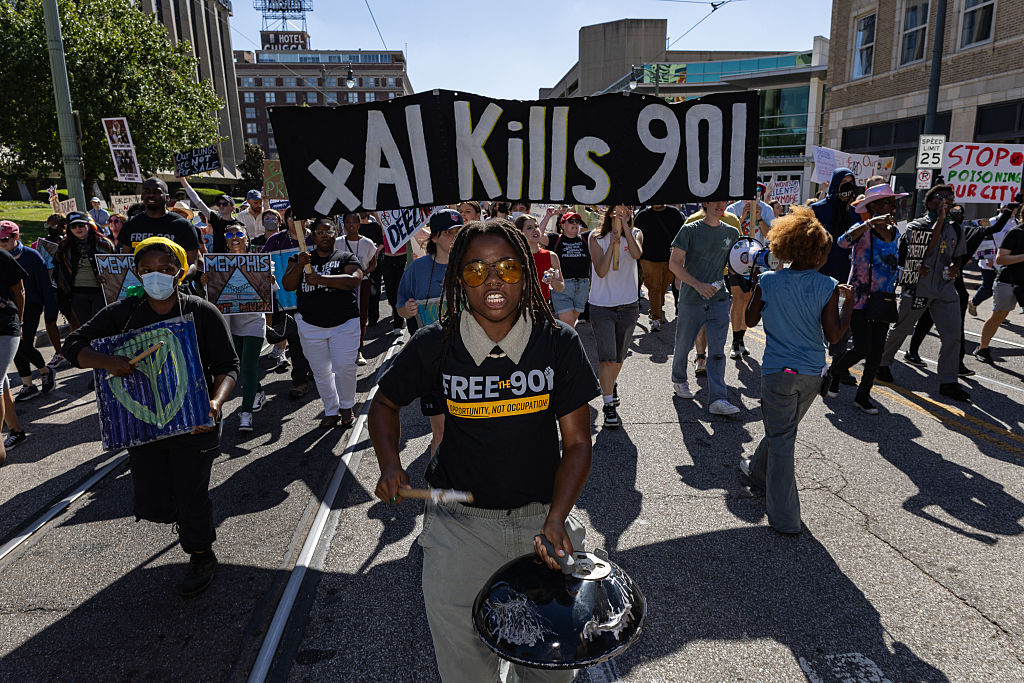
For residents of Whitehaven (where I live and pastor), Westwood, and surrounding communities, this is not an abstract policy debate. It is a question of proximity. It is a question of power. It is a question of whether the places people call home are being treated as communities to be protected or as sites to be leveraged.
Because one thing that has become increasingly clear is that the people most enthusiastic about these developments are often the least likely to live next to them.
That contradiction should give us pause.
If a project is truly beneficial, it should not require distancing its champions from its consequences. Yet time and again, we see the same formula: We see corporate leaders, investors, and political advocates promote large-scale industrial or technological developments as engines of opportunity, while the physical and environmental realities of those developments are concentrated in communities with the least political leverage to resist them.
This is not new. It is the modern iteration of an old story.
Economic development that does not center environmental protection, public health, and equitable access to opportunity is not development. It is extraction.
From industrial corridors to waste sites to energy infrastructure, Black communities in the U.S. South have long been positioned as expendable in the pursuit of economic growth. What is new is the language. Today, the rhetoric is not about factories or refineries but about data, innovation, and artificial intelligence. The branding has changed. The underlying pattern has not. We can literally follow the “red lines.”
Memphis is now being asked to believe that becoming a hub for artificial intelligence will secure its economic future. But economic development that does not center environmental protection, public health, and equitable access to opportunity is not development. It is extraction.
And extraction, by definition, leaves something depleted.
To be clear, this is not an argument against innovation in general. Memphis, like any city, should be able to participate in and benefit from emerging industries. The question is not whether development should happen, but how it happens — and who gets to shape its terms.
Right now, the balance is off.
Corporate expansion is moving faster than community engagement. Regulatory concerns are emerging after operations are already underway. Economic promises are being made without clear accountability mechanisms to ensure they are fulfilled. And communities are being asked to accept risk without having substantial enough power to negotiate benefit.
That is not partnership. That is imposition.
If Memphis is to pursue a future in AI and advanced technology, it must do so with a fundamentally different framework. That means rigorous enforcement of environmental standards, not retroactive compliance after violations occur. It means transparent agreements that guarantee local hiring, workforce development, and community investment, not vague assurances of economic uplift. It means giving residents a real voice in decisions that affect their neighborhoods, not treating public input as a procedural formality.
It also means asking a more honest question about what kind of future Memphis is trying to build.
Because if the pursuit of being seen as “innovative” requires sacrificing the health, stability, and dignity of its most vulnerable communities, then the cost is too high, no matter how large the valuation. And valuations, after all, are not neutral. They measure the worth of assets. They do not measure the worth of people.
The $3.4 billion figure attached to xAI’s Memphis properties tells us something about how the market values land, infrastructure, and technological capacity. It does not tell us whether the air is safer, whether the water is cleaner, whether families feel more secure, or whether communities are more empowered.
Do we value investment figures, or the lives and livelihoods of the people those investments affect?
Those are the metrics that matter. And right now, those metrics remain uncertain at best and alarming at worst.
Memphis stands at a crossroads. It can continue down a path where corporate expansion is pursued with minimal oversight and maximal optimism for investors, hoping that the promised benefits will eventually materialize. Or it can choose a more deliberate path. One that demands accountability, centers community voices, and refuses to treat environmental risk as the price of economic participation.
The difference between those paths is not simply policy. It is morality. Because at its core, this is a question about what and who we value.
Do we value the appearance of progress, or the reality of justice? Do we value investment figures, or the lives and livelihoods of the people those investments affect? Do we value being at the forefront of technological advancement, or ensuring that advancement does not come at the expense of those who have historically been pushed to the margins?
Memphis has an opportunity to answer those questions differently. And if we find the political courage and moral imagination to do so — as some local groups are already doing — we can lead the way in building a future that is both environmentally responsible and economically just.
It will require leadership willing to resist the temptation to auction off communities for the promise of corporate gain, leadership willing to say that economic development must be both profitable and principled, leadership willing to insist that the future cannot be built on the quiet erosion of the present.
Because whatever artificial intelligence may become, there is nothing artificial about the consequences communities are already facing.
And those consequences will outlast any headline, any valuation, and any corporate promise that fails to reckon with the full cost of doing business.
Press freedom is under attack
As Trump cracks down on political speech, independent media is increasingly necessary.
Truthout produces reporting you won’t see in the mainstream: journalism from the frontlines of global conflict, interviews with grassroots movement leaders, high-quality legal analysis and more.
Our work is possible thanks to reader support. Help Truthout catalyze change and social justice — make a tax-deductible monthly or one-time donation today.