Part of the Series
Struggle and Solidarity: Writing Toward Palestinian Liberation
Truthout is a vital news source and a living history of political struggle. If you think our work is valuable, support us with a donation of any size.
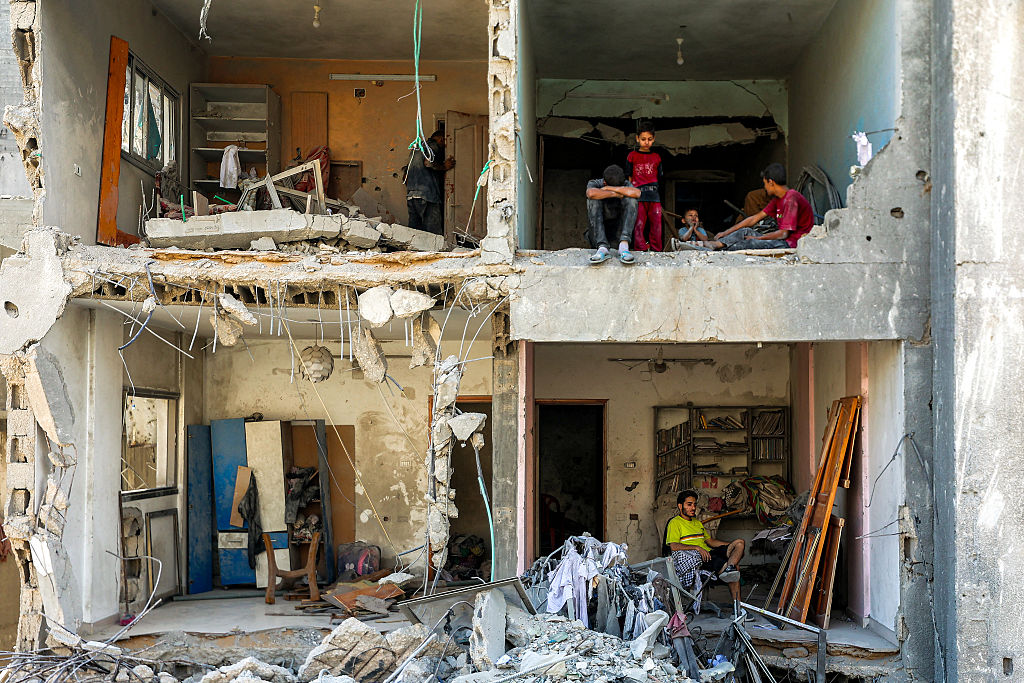
Had I remained one more day on the seventh floor of my apartment building in Gaza City, I would have died.
How am I to endure the feeling of being homeless in Al-Rimal, the neighborhood where I grew up — now reduced to a ghost city after so many apartment towers were destroyed? How can I be displaced in my own city, with no place left for me in the north or the south? I am homeless in my homeland.
On September 14, we received a sudden evacuation order. Soon after, Al-Jundi Tower — the high-rise apartment building beside us — was bombed, along with the building across the street, leaving half of the apartment building that I lived in destroyed. And yet, despite the devastation and the danger, we returned to the seventh floor to collect our mattresses — because in Gaza, you cannot simply buy new ones. There are no supplies, no mattresses, no tents, and if they exist, they are unbearably expensive; a single tent now costs as much as $1,500. We preserve what little we have, no matter the cost.
That night, at around 11 pm, after the occupation had carried out its threats, we came back to find our home half-destroyed, with only one room left intact. We gathered all our mattresses and went to my grandmother’s house, planning to return in the morning to decide where we could stay. Then came the mockery: The army told our neighbor from the Kollak family — after destroying the tower — “Now you can return to your homes, then you must evacuate to the south.” They knew perfectly well that our homes were already in ruins. It was not an order — it was humiliation.
Sleeping in our apartment felt like sleeping in a haunted house. Being there was like lying in the middle of the street, but on the seventh floor — a shattered home seven stories up.
We returned in the morning to a home unfit for life, trying to decide what to do despite the danger. My father decided to go south with my brother Mohammad and my cousin Kareem to search for a house to rent, while my mother, my sister, and I stayed in the north until they found us a place. Sleeping in our apartment felt like sleeping in a haunted house. Being there was like lying in the middle of the street, but on the seventh floor — a shattered home seven stories up. Suddenly, the sky turned red, and a massive blast shook the entire building. These were not ordinary strikes; they were a new kind of attack — explosive robots carrying enormous charges, capable of wiping out an entire neighborhood in an instant. The situation was unbearable: staying in that house meant death, and leaving it meant another kind of death.
My father called to check on us and told us he could hear the explosions in the south from their sheer intensity. He said to my mother, “Unfortunately, there is no place to stay in the south except a tent, and we cannot live in a tent.” My mother replied, “Return to the north, and let’s see what we can do.”
My father, my brother, and my cousin came back and told us that there was no shelter available due to the crushing concentration of people.
Father called a friend from the Al-Astal family, who told him: “There is no place for you, Emad, except a tent. You must choose: death or life in a tent — and even then, death is still possible. There is no safety in the north or the south, but the south is slightly better. You must move.”
It was an unbearably difficult choice, yet we decided to stay in the Al-Rimal neighborhood, as my father said, “until our last breath,” and only then would we walk south on foot. Staying until our “last breath” meant staying until the situation escalated, until the Israeli army entered our street, leaving us with no choice but to face it or flee.
As time passed, the situation became unbearable. The entire neighborhood had been evacuated, leaving only a handful of small families — about six in total. Explosions escalated wildly, while the quadcopters never stopped firing and dropping bombs in the streets.
My father decided to bring our mattresses to the south on the morning of September 22, while we remained in the north. If the Israeli forces came, we would leave quickly, but at least our mattresses would be waiting for us in the south. My father and my brother carried the mattresses to a tent, a journey that took them 10 hours. Normally, before the war, it would have taken only an hour, but due to the population density and lack of transportation, the journey was extremely difficult.
While waiting for them to return, my mother decided that we should move to the fourth floor, which was less exposed to danger than the upper floors, where shards of debris constantly fall during every explosion, bringing death.
Suddenly, we heard the sound of a ferocious bombing … The seventh and eighth floors of our building had been hit.
I had no idea that my mother’s decision would save our lives. At around 5 pm, we were terrified, waiting for my father and everyone else, who kept calling to tell us to leave the area as the danger escalated. Suddenly, we heard the sound of a ferocious bombing — it shocked us, and we screamed: “Where is this happening? What is going on?!” In an instant, the house was filled with dust. The seventh and eighth floors of our building had been hit.
We didn’t know what to do without my father and brother. Who could help us? Our remaining neighbors were shouting, and our neighbor Tawfiq Shaqoura said, “Hurry! Get out! This could be a warning missile for the tower!” We ran out, crying and terrified, and stood in the street, waiting. Then my uncle called: “Come to my place until your father arrives, hurry!”
We walked along the road while the bombing continued. People were running in the streets, preparing to evacuate. We rested briefly until my father arrived in the north. Then we decided to continue our evacuation south: we would settle for the tent, because we had no other choice.
Now, I write this at dawn while the ground shakes beneath my feet, and we search for transportation to take us south — but it is not an easy task. I wonder: what comes next? How long will I remain in a tent? How long will I be homeless in my homeland, the place that once held me? Do I not have the right to live safely in my own country, in my own home?
Media that fights fascism
Truthout is funded almost entirely by readers — that’s why we can speak truth to power and cut against the mainstream narrative. But independent journalists at Truthout face mounting political repression under Trump.
We rely on your support to survive McCarthyist censorship. Please make a tax-deductible one-time or monthly donation.