Did you know that Truthout is a nonprofit and independently funded by readers like you? If you value what we do, please support our work with a donation.
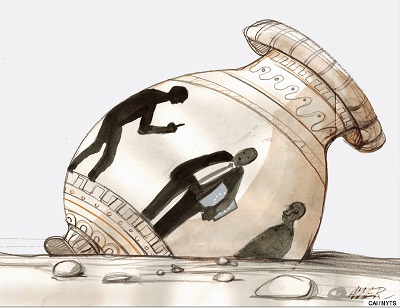
Now that the dust has settled a bit, we can look calmly at the Greece deal. It’s increasingly clear that the country came out in significantly better shape, at least for now.
The main action, as always, involves Greece’s primary surplus – how much more will the country need to raise in revenue than it can spend on things other than interest? The question these past few days was whether the Greeks would be forced into agreeing to aim for very high primary surpluses under the threat of being pushed into immediate crisis. And they weren’t.
One useful way to understand this is through careful parsing of the agreement’s language, as done here by the economist Norbert Häring.
But I’d argue that in an important sense we’re past that kind of word-chopping. Instead, we need to think about what happens substantively from here on out.
Right now, Greece has avoided a credit cutoff, and worse yet a move by the European Central Bank to pull the plug on the country’s banks. And Greece has done so while getting its 2015 primary surplus target effectively waived.
The next step will come four months from now, when Greece makes its serious pitch for lower surpluses in future years. We don’t know how that will go. But nothing that has happened so far is likely to weaken the Greek position in that future round. Suppose that the Germans claim that some ambiguously worded clause should be interpreted to mean that Greece must achieve a surplus of 4.5 percent of gross domestic product. Greece will say no, it doesn’t – and then what? A couple of years ago, when all the Very Serious People of Europe believed utterly in austerity, Greece might have faced retaliation thanks to wording issues; not now.
So Greece has won relaxed conditions for this year, and breathing room in the run-up to the bigger fight ahead. It could be worse.
Phantom Fiscal Crises
Matthew Klein at the Financial Times recently took on a subject that is dear to my heart – the mysterious, persistent fear that Japan and other countries that borrow in their own currencies could suddenly face a Greek-style fiscal crisis if bond investors lose confidence, and that this is a reason to raise taxes or cut benefits even in a depressed economy.
I devoted my Mundell-Fleming lecture at the International Monetary Fund to this topic in 2013, where I had this to say: “Remarkably, nobody seems to have laid out exactly how a Greek-style crisis is supposed to happen in a country like Britain, the United States or Japan – and I don’t believe that there is any plausible mechanism for such a crisis.”
That’s still true – but fear of such a crisis persists. It’s true even though the apparent relationship between debt levels and borrowing costs has vanished now that the E.C.B. is doing its job as lender of last resort.
So what is the basis for this fear?
The answer I seem to get is fear of a dramatic flip in circumstances – that Japan, say, could engage in a sort of macroeconomic quantum tunneling, suddenly transitioning from deflation to runaway inflation and a crashing currency. That’s not impossible. But it does seem an odd thing to be worrying about right now.
We lost 15 percent of our traffic overnight.
We now have three full months of data since Google changed its search to feature AI results. The numbers are worse than we anticipated. Overall readership that comes to Truthout through Google is down 54 percent against last year. The number of new readers who discover Truthout via Google searches is down 49 percent, and returning users from Google are down 51 percent.
We lost 15 percent of our readership overnight. This was a readership we painstakingly built over decades, and it vanished because Google chose corporate greed over a healthy democracy.
We anticipate a loss of roughly $500,000 in online revenue as a result of this massive traffic plunge in the next year alone.
The only way we can keep publishing is with strong reader support. We are asking you to start a monthly donation to Truthout today — anything you can do, whether $5 or $25, makes a difference.