Did you know that Truthout is a nonprofit and independently funded by readers like you? If you value what we do, please support our work with a donation.
In a primary election held in the state on Tuesday, two constitutional ballot questions in Wisconsin seeking to restrict the powers of the governor were quashed by voters, with many likely viewing them as attempted power grabs by legislative Republicans to impede Democratic Gov. Tony Evers’s work in the executive branch.
The GOP currently has a near-veto-proof majority in both houses of the Wisconsin state legislature, which has thwarted many of Evers’s proposals, including multiple legislative sessions he has called for regarding reproductive rights, gun regulation, and other issues. But as governor, Evers has the ability to use funds sent to the state by the federal government in more expansive ways, a power that Republicans said needed an additional “check,” despite most states in the U.S. operating in a similar fashion and party leaders having no problems with it when Republican Gov. Scott Walker was in office.
To successfully enact a constitutional amendment in the state, the legislature has to pass a measure in two separate but concurrent sessions, after which voters in the state must also approve it. Republicans did so regarding Evers’s powers as governor, pushing forward two measures that would restrict the legislature from granting any governor in the future the ability to have discretion over federal funds, as well as denying the governor from using legislative-granted powers that already exist.
Republican lawmakers passed these measures in response to Evers using federal funding to address the COVID-19 pandemic in the state. While those lawmakers have been critical of the way he did it, Wisconsinites have given the twice-elected Evers positive marks for his response to the pandemic, and he still enjoys a 51 percent approval rating right now, according to recent polling.
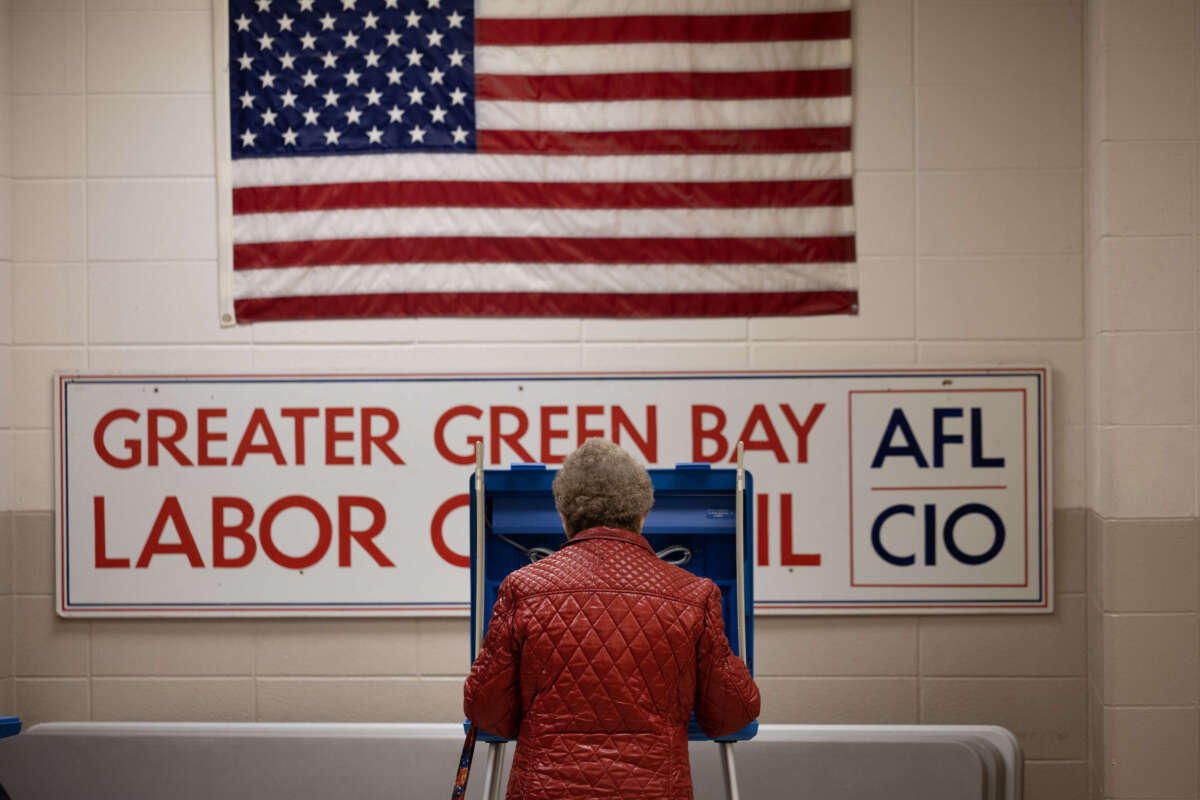
Voters on Tuesday largely rejected both amendment proposals, with nearly 6 in 10 voters in both races opposing them.
A coalition of 16 voting rights groups, alongside the Democratic Party of Wisconsin, campaigned against the measures, noting that they were attempts by Republican legislators to seize more power from the governor, similar to actions they took during a “lame duck” period after Evers was first elected in 2018. The amendments could also have far-reaching consequences, including the slowing down of the distribution of federal funds relating to future disaster relief.
The defeat of the two measures marks just the second time since 1996 that amendments proposed by the legislature weren’t backed by voters.
“Republican politicians in Madison pushed these amendments because they recognized their grip on power was waning with new, fair maps, and they were desperate to cement their extreme agenda into Wisconsin’s Constitution,” state Democratic Party chair Ben Wikler said, referring to the state Supreme Court’s recent decision to strike down political maps drawn by Republicans as illegal gerrymanders.
The amendments would have made state government “more difficult, more bureaucratic and less responsive to the needs of Wisconsinites,” said Debra Cronmiller, executive director of the League of Women Voters of Wisconsin.
The outcome of the ballot measure races in Wisconsin on Tuesday — held during an August primary election when it was expected that turnout would be low — could be a bellwether for the 2024 presidential election in the swing state. Indeed, an aggregate of polling data compiled by FiveThirtyEight indicates that Vice President Kamala Harris currently leads former President Donald Trump in the Badger state by an average of 3.2 points, with a recent New York Times/Siena College poll showing her lead was up by as much as 6 points among likely voters.
As it has been in past elections, turnout will be key to determining who will ultimately win the state’s 10 Electoral College votes in November. In Tuesday’s election, the liberal-leaning Dane County, which helps tip Wisconsin toward Democrats in statewide races that are close when voter participation is high, saw 45 percent turnout, a record for the county on an August primary election date.
Important Message: Please Read
For 25 years, Truthout has survived by publishing impactful investigative journalism and analysis; distributing full editions 365 days a year; and building a community of readers who support us with small, hard-earned donations.
Eighty percent of our $3 million yearly budget comes from small donors alone. Of those, 8,000 readers support us with monthly donations. Back in 2018, when Facebook decided to suppress the circulation of posts made by organizations, thereby cutting readers off from seeing many articles shared by the news organizations they had intentionally decided to follow, Truthout’s total traffic declined by 40 percent, as nearly all of our traffic from that platform disappeared.
Now, Google has recently rolled out its AI search bar, providing AI summaries instead of directing readers to our site. Google Search is our single largest source of traffic; it’s the route by which nearly one third of our readers find us. Much like in 2018, a shocking 40 percent of our Google traffic has disappeared overnight.
It will not be easy for Truthout to shoulder this blow. Nor will it be easy for our peers and collaborators — news sites that depend on traffic and aren’t bankrolled by large corporations.
If you can support Truthout with a donation today, you can help us resist the AI onslaught. Please give today.