Honest, paywall-free news is rare. Please support our boldly independent journalism with a donation of any size.
Until relatively recently in human history, most people had a sense of a living Earth. We understood trees, forests, rivers, mountains, humans, animals and plants as living, sentient neighbors and community members. This worldview promoted an authentic concern for the mutual well-being of all. As can be seen among today’s Indigenous peoples who act to save the Amazon rainforest, humans evolved to be deeply connected, relationally and responsibly attuned to the natural world around them — otherwise they perished. In his book, Beyond Nature and Culture, anthropologist Philippe Descola documents the unique integration of culture and nature around the world in non-industrialized societies not overtaken by unfettered capitalism’s globalization.
We honor Indigenous traditional cultures and peoples with a commitment to reclaim this legacy and way of understanding our symbiotic relationships and interconnectedness as members of a sacred and living Earth. In light of the recent United Nations report on extinction rates that reveals how Indigenous worldview, not technology, is the key to rebalancing our ecological systems, such a commitment is crucial. What can we do to reclaim our original worldview? What can we do to help today’s Indigenous peoples with their struggles to protect their land, language and sovereignty?
Author and educator C.A. (Chet) Bowers describes how the industrialized world takes for granted several root metaphors that act like a straitjacket on thought and action. As anthropologist Marshall Sahlins pointed out, individualism, self-interest, linear progress, centrality and superiority of human beings, positivism (the need for an experiment to know anything), and belief in an insensate natural world are all considered strange by human societies around the world. All indicate a human orientation disconnected from grounding in the Earth.
Why do these notions seem logical to industrialized humans? Contemporary industrialized nations by and large undermine the development of human capacities, toxically stressing children and adults, leading to disconnection. Our research shows the importance of humanity’s evolved nest (Evolved Developmental Niche), which matches up with the high immaturity and needs of human children in the first years of life when neurobiological systems are shaped by social experience. The nest includes responsive calming care by multiple adults, years of on-request breastfeeding, frequent affectionate touch, extensive play, relational connection and social support. All these foster health and well-being, sociality, and morality through epigenetics and other plasticity effects in early life. Nature connection and ecological intelligence are part of our heritage as well, and are critical for sustainable living. But parents in industrialized nations are encouraged (and often forced) to deny babies and children what they evolved to need, establishing neurobiologically aberrant trajectories and long-term ill-being, dysregulation and disconnection.
Nature connection is apparent in all “non-civilized” groups around the world and was integral throughout the existence of our species. The fact that “civilized” humans, a type of society around for only 1 percent of the human genus’s existence, are disconnected from nature shows the unsustainability of civilization as we know it. As First Nation peoples know, disconnection is at the root of destructive acts.
As researchers, we lament how ignorant Western scholarship and media generally are about this nature-connected history. Humanity spent over 90 percent of its history as small-band, hunter-gatherer societies, living close to and cooperatively with one another and the Earth, with concern for future generations. Humanity would have died off without what we can refer to as our “Indigenous worldview.” As mentioned above, recent United Nations extinction rate report refers to the disregard for this worldview as the major reason for current ecological disasters, and notes that where the Indigenous worldview is operating today, thriving biodiversity is maintained.
Scholars routinely pick out or sort societies of the past in ways that make them look primitive or violent. They call any positive descriptions of our non-civilized history “romantic.” But the real romanticism is apparent in our unquestioning support for the path we are on, the one that assumes we can continue to extract from the Earth without penalty or limit.
Western science does not promote ecological attachment, though some come to the sciences from an enchantment with nature. Instead, Western science and scholarship encourage detachment and “objectivity” (relational disconnection) with what is studied. In either case, the ecological crisis cannot be solved by continuing intellectual discussions. Even Western scientists are coming to realize that to act responsibly toward the natural world, one must care about it in a relational manner, as Indigenous science and worldview promotes. One must feel and act connected to the Earth. Efforts to restore nature connection and “rewild” human nature are spreading. Awareness of and respect for the intelligence of animals, plants and insects are increasing.
Importantly, societies who hold an Indigenous worldview, including American Indian/Alaskan Native societies, have long prioritized “the seventh generation” and have done so with both heart and mind. Those who, against all odds, still hold onto this wisdom continue to put their lives on the line for future generations, as occurred with the Standing Rock protests against the Dakota Access Pipeline.
Humanity’s future depends on re-embracing the Indigenous worldview, its grounding in connectedness and its foundational love for all diversity. This a human heritage that we can restore and live out. We can revive a “common memory” of our species on the Earth and reshape the foundations of our governments and institutions, as U.S. Independent presidential candidate and member of the Navajo Nation Mark Charles advises. Charles, who identifies also a Christian, articulates a decolonizing agenda as necessary for relearning how to take care of our common home, Planet Earth, as Pope Francis has advocated. In fact, the recent Pan-Amazon Synod of Bishops in Rome, guided by Indigenous wisdom, not only acknowledges the church’s historical role in colonizing lands, peoples and cultures of the Amazon, it also refers to the imposition of Western culture onto Indigenous worldviews.
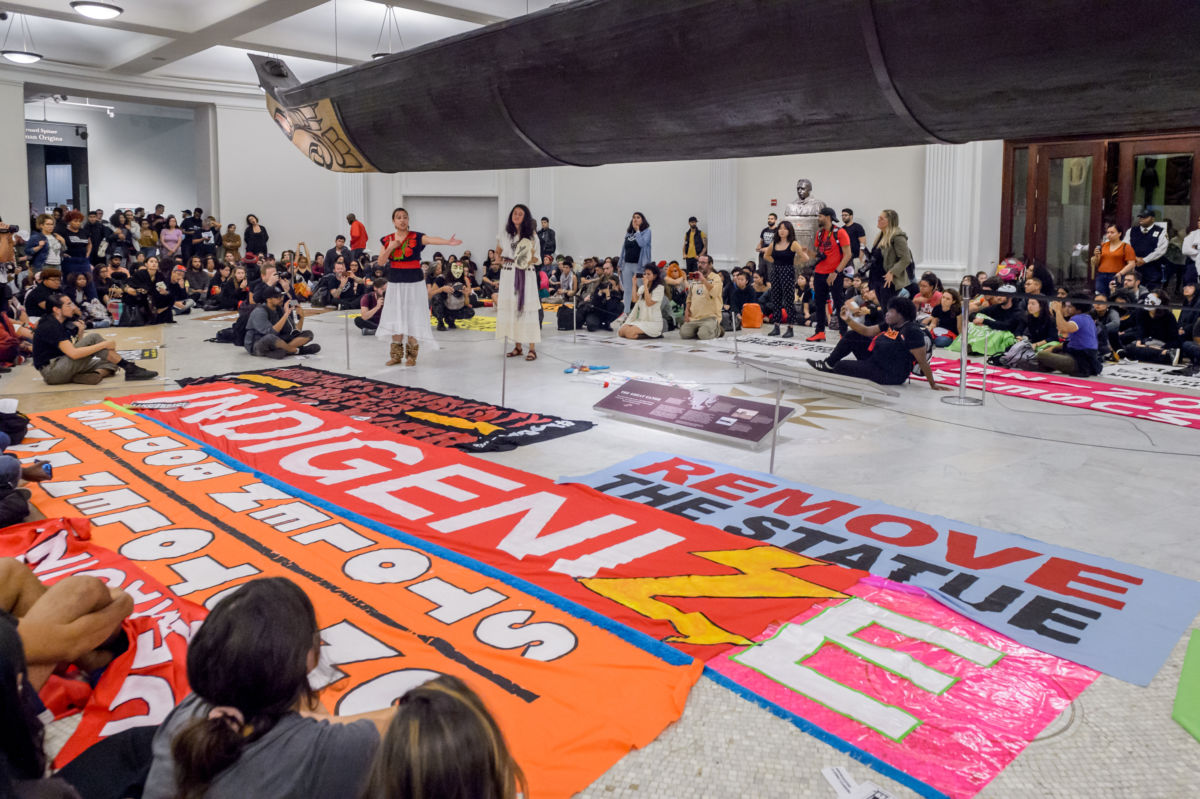
If we have come to a time when the Catholic Church — whose policies initiated the onslaught against our Indigenous way of being in the world — can now address decolonization and Indigenous worldview, perhaps we should make every day Indigenous Peoples’ Day. To remind us of who and where we are, we can begin to learn how to reclaim our more authentic worldview for education and survival.
Press freedom is under attack
As Trump cracks down on political speech, independent media is increasingly necessary.
Truthout produces reporting you won’t see in the mainstream: journalism from the frontlines of global conflict, interviews with grassroots movement leaders, high-quality legal analysis and more.
Our work is possible thanks to reader support. Help Truthout catalyze change and social justice — make a tax-deductible monthly or one-time donation today.