Truthout is a vital news source and a living history of political struggle. If you think our work is valuable, support us with a donation of any size.
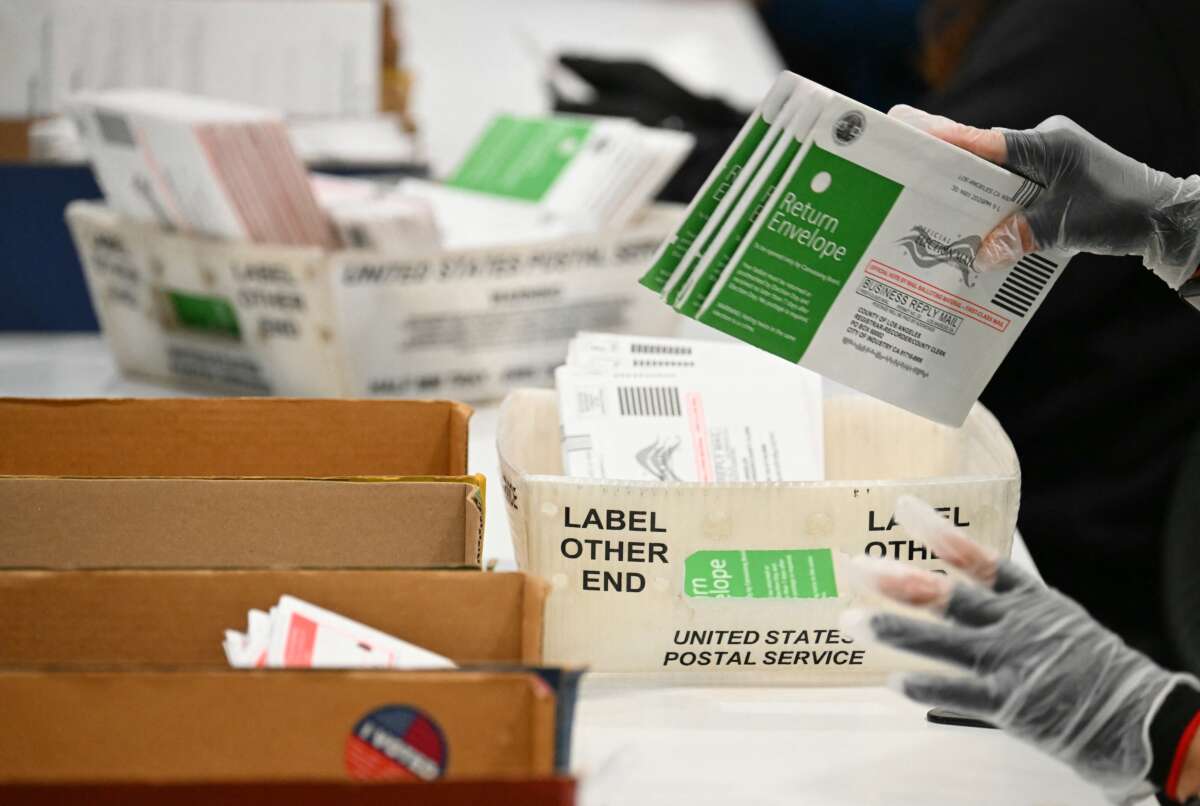
President Donald Trump’s executive order restricting the distribution of ballots by the US Postal Service could effectively end the ability to vote by mail if it isn’t struck down, experts told CNN on Wednesday.
The order, which was signed in March, instructs the USPS to not deliver ballots in any states that have not given the federal government access to its voter lists. It is being challenged by congressional Democrats and all 23 Democratic state attorneys general, who are urging courts to block the order before it potentially disenfranchises eligible voters.
Maine Secretary of State Shenna Bellows told CNN that, unless courts intervene quickly, “you will see a virtual elimination of mail-in voting.”
Oregon Secretary of State Tobias Read explained to CNN that he believes the Trump order is patently unlawful given that it usurps states’ powers outlined in the US Constitution to run their own elections.
“This is not in the president’s power,” Read said. “It’s absolutely clear in the Constitution — states run elections.”
Although Trump-appointed US District Court Judge Carl Nichols last month declined to block the president’s executive order, congressional Democrats are appealing the case at the DC US Circuit Court of Appeals, where they are seeking an expedited process that will result in a ruling before the fall.
The legal challenge brought by Democratic attorneys general is currently before a federal judge in Boston.
Without fast action, congressional Democrats warned in a Monday court filing, “millions of American voters’ sensitive personal data will be amassed into inaccurate and unlawful databases and USPS will engage in unprecedented interference with state mail voting programs.”
The executive order attacking mail-in voting is just one of many ways the Trump administration has been trying to meddle in the election process ahead of the 2026 midterms.
According to a report from Democracy Docket, a Tuesday court filing by the US Department of Justice argued that states have the power to purge voter rolls at any time ahead of an election and do not have to abide by the 90-day “quiet period” established in the National Voter Registration Act (NVRA).
As the law has been traditionally interpreted, states cannot trim voter rolls less than 90 days before elections so that people affected by the changes have sufficient time to file challenges and potentially restore their eligibility.
However, the Trump DOJ argued that the provision establishing the 90-day period “would not prevent a state like Georgia from investigating and removing ineligible people in an individualized fashion” close to an election “if the United States alerted the state of the possibility that particular individuals on their rolls were ineligible to vote.”
As explained by Democracy Docket, this interpretation of the law could let the federal government create lists of voters to be purged and then “pressure states to carry out the removals individually — potentially weakening one of the most important federal safeguards against last-minute disenfranchisement.”
Press freedom is under attack
As Trump cracks down on political speech, independent media is increasingly necessary.
Truthout produces reporting you won’t see in the mainstream: journalism from the frontlines of global conflict, interviews with grassroots movement leaders, high-quality legal analysis and more.
Our work is possible thanks to reader support. Help Truthout catalyze change and social justice — make a tax-deductible monthly or one-time donation today.