Truthout is an indispensable resource for activists, movement leaders and workers everywhere. Please make this work possible with a quick donation.
President Donald Trump announced early January 3 that the U.S. has captured Venezuelan President Nicolás Maduro after a series of late night airstrikes on Caracas, Venezuela’s capital, carried out by the U.S. military.
In a post on Truth Social, Trump boasted that the U.S. has “successfully carried out a large scale strike against Venezuela” and said that Maduro and his wife, Cilia Flores, have been “captured and flown out of the country.”
Attorney General Pam Bondi said that Maduro has been charged with “Narco-Terrorism Conspiracy,” among other charges, in the Southern District of New York. She posted a copy of the indictment on social media.
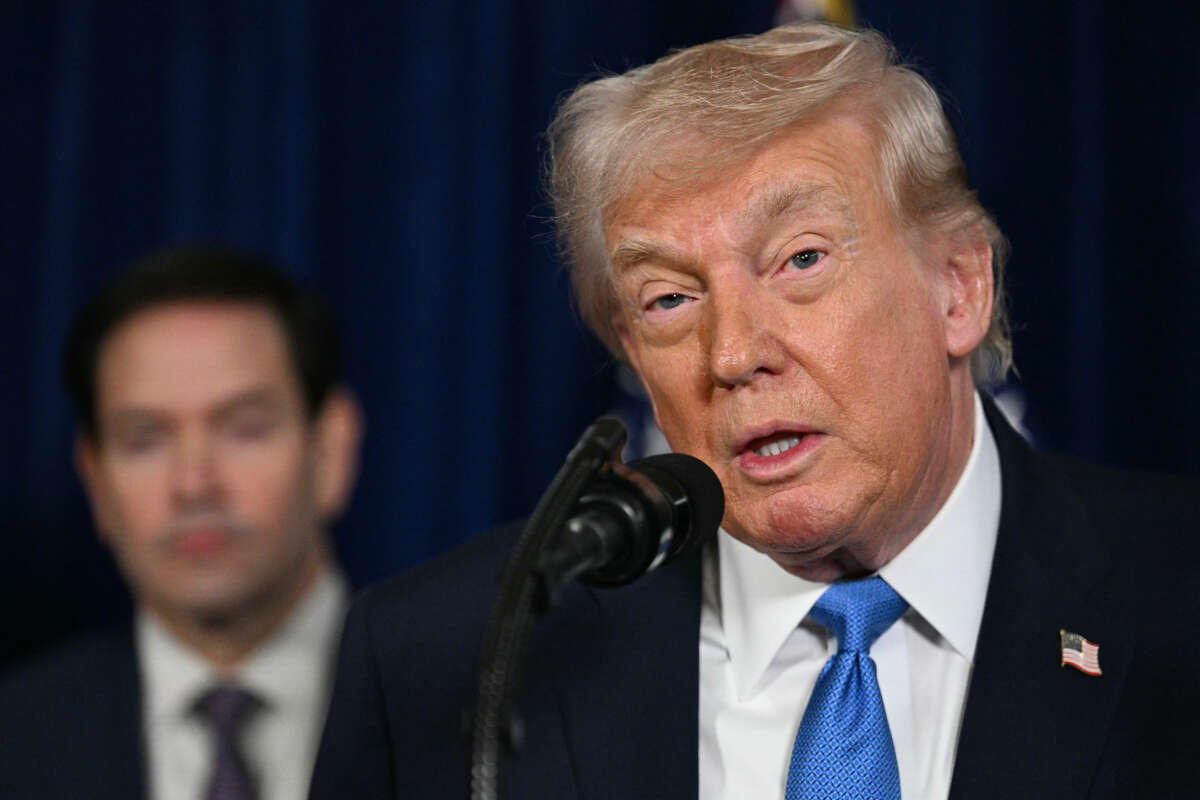
On Saturday morning, in his first speech after the invasion, Trump said, “We are going to run the country until such time as we can do a safe, proper, and judicious transition.” He offered few details and no timeline regarding the American occupation of the country, but later said he was “not afraid of boots on the ground.” When asked by reporters about the potential cost of occupying Venezuela for an undefined period of time, Trump said, “It won’t cost us anything because the money coming out of the ground is very substantial.”
Throughout his comments, Trump repeatedly referenced Venezuela’s vast oil reserves and said that U.S. oil interests would be heavily involved in the country’s future. “We’re going to have our very large United States oil companies — the biggest anywhere in the world — go in, spend billions of dollars, fix the badly broken infrastructure, the oil infrastructure, and start making money for the country.”
Trump’s comments were a sharp turn from the administration’s reasoning for its months-long boat strike campaign that has killed over 100 civilians. Comparatively, he also spoke very little about the indictment, despite administration officials touting its charges against Maduro as the reasoning for Saturday morning’s operation.
The reported kidnapping comes after the U.S. carried out late night airstrikes across Caracas, striking fear among the residents of the densely populated city. Reports say the strikes lasted about 30 minutes, and it’s unclear whether there were casualties.
In a speech aired on state television, Venezuela’s Vice President Delcy Rodriguez said the government has demanded proof of life from the U.S. Venezuelan officials have said that they aren’t aware of Maduro’s whereabouts.
The Associated Press reports that, according to Venezuelan ruling party leader Nahum Fernández, Maduro and his wife were captured from their home in the Fuerte Tiuna military installation, which was bombed in the wave of airstrikes.
“There, they carried out what we could call a kidnapping of the president and the first lady of the country,” said Fernández.
Sen. Mike Lee (R-Utah) said in a post on X that Secretary of State Marco Rubio claims the strikes were carried out to “protect” those carrying out the arrest, reported to be U.S. special operations forces. Lee said that the military action “likely falls within the president’s inherent authority under Article II of the Constitution to protect U.S. personnel from an actual or imminent attack” — a framing that experts and lawmakers have said is a farce, as there is no evidence of an “imminent” threat from Venezuela.
Lee added that Rubio told him he anticipates no further actions against Venezuela with Maduro in U.S. custody.
In an interview on Fox News on Saturday morning, however, Trump suggested that the U.S. may carry out more strikes if Venezuelan officials continue to side with Maduro. “If they stay loyal, the future is really bad, really bad for them,” he said.
The U.S. has a long history of capturing world leaders in relation to drug charges, but not quite in this manner. Just last month, Trump condemned President Joe Biden’s arrest of Juan Orlando Hernández, the former president of Honduras who was out of office when he was extradited to the U.S., on drug charges in 2022, saying: “If somebody sells drugs in that country, that doesn’t mean you arrest the president and put him in jail for the rest of his life.” The statement came as Trump pardoned Hernández, who had been sentenced to 45 years in prison.
Commentators noted that the capture most echoes the U.S. invasion of Panama, which began in December of 1989. Under President George H.W. Bush, U.S. forces captured the country’s leader, Manuel Antonio Noriega, exactly 36 years ago on January 3. Noriega had been indicted for drug charges by a grand jury in the U.S. in 1988.
World leaders, legal experts, and U.S. lawmakers have widely condemned the strikes and reported kidnapping as a violation of international law, coming as an escalation after a series of boat strikes and oil tanker seizures that experts have already long deemed illegal.
Mexican President Claudia Sheinbaum Pardo condemned the action in a statement and suggested that the U.S. has violated its obligations under the UN Charter to “refrain from the threat or use of force against the territorial integrity or political independence of any State.”
Brazil’s president, Luiz Inacio Lula da Silva, said that the U.S.’s actions crossed a line. “Attacking countries, in flagrant violation of international law, is the first step toward a world of violence, chaos, and instability, where the law of the strongest prevails over multilateralism,” he said.
Other countries, including Cuba, Iran, and Russia have similarly condemned the strikes and reported kidnapping.
By contrast, the response out of Europe has been relatively muted. Kaja Kallas, the EU’s top foreign affairs official, said that the EU is “closely monitoring the situation in Venezuela” but emphasized that the “EU has repeatedly stated that Mr. Maduro lacks legitimacy.” EU Commission President Ursula von der Leyen made a similar statement, and urged restraint in accordance with international law. “We stand by the people of Venezuela and support a peaceful and democratic transition,” she wrote.
U.K. Prime Minister Keir Starmer merely said that the U.K. was not involved in the action and declined to condemn the strikes when asked by reporters on Saturday.
While some Republican lawmakers celebrated the action, other members of Congress decried the bombardment and reported kidnapping.
“Secretaries Rubio and [Pete] Hegseth looked every Senator in the eye a few weeks ago and said this wasn’t about regime change. I didn’t trust them then and we see now that they blatantly lied to Congress,” said Sen. Andy Kim (D-New Jersey) in a post on social media.
Kim warned of potential blowback. “This strike doesn’t represent strength. It’s not sound foreign policy. It puts Americans at risk in Venezuela and the region, and it sends a horrible and disturbing signal to other powerful leaders across the globe that targeting a head of state is an acceptable policy for the U.S. government,” he said.
CNN reports that the Senate Armed Services Committee wasn’t notified of the strikes or Maduro’s reported kidnapping ahead of time. Some lawmakers have tried, in recent months, to assert Congress’s war power authority to prevent further military actions against Venezuela, but these attempts have failed in the Republican-controlled chambers. The campaign has otherwise been marked by an unusual level of secrecy from the administration, members of Congress have said.
Legal experts have condemned the strikes as illegal under domestic and international law.
“I condemn the U.S.’s illegal aggression against Venezuela & the illegal abduction of its leader & his wife,” said Ben Saul, UN special rapporteur on human rights and counterterrorism. “Every Venezuelan life lost is a violation of the right to life. President Trump should be impeached & investigated for the alleged killings.”
“Donald Trump has launched an illegal and reckless regime change operation in Venezuela,” said Matt Duss, executive vice president of the Center for International Policy, in a statement. He called on Congress to take action against further strikes and hostilities.
“Trump was elected on a promise to end wars, not start them,” Duss went on. “His illegal aggression against Venezuela once again breaks that promise, and threatens to repeat some of the worst moral and strategic failures of past U.S. military adventurism, for which the American people and communities around the world have paid enormous costs.”
The morning of the raid, the White House announced Trump would hold an address at 11 a.m. at Mar-a-Lago. However, he was more than half an hour late to make his first public address, instead posting a video of footage that appeared to be from the military strikes set to Creedence Clearwater Revival’s “Fortunate Son,” as well as a supposed picture of Maduro onboard the USS Iwo Jima, on Truth Social.
Press freedom is under attack
As Trump cracks down on political speech, independent media is increasingly necessary.
Truthout produces reporting you won’t see in the mainstream: journalism from the frontlines of global conflict, interviews with grassroots movement leaders, high-quality legal analysis and more.
Our work is possible thanks to reader support. Help Truthout catalyze change and social justice — make a tax-deductible monthly or one-time donation today.