Truthout is an indispensable resource for activists, movement leaders and workers everywhere. Please make this work possible with a quick donation.
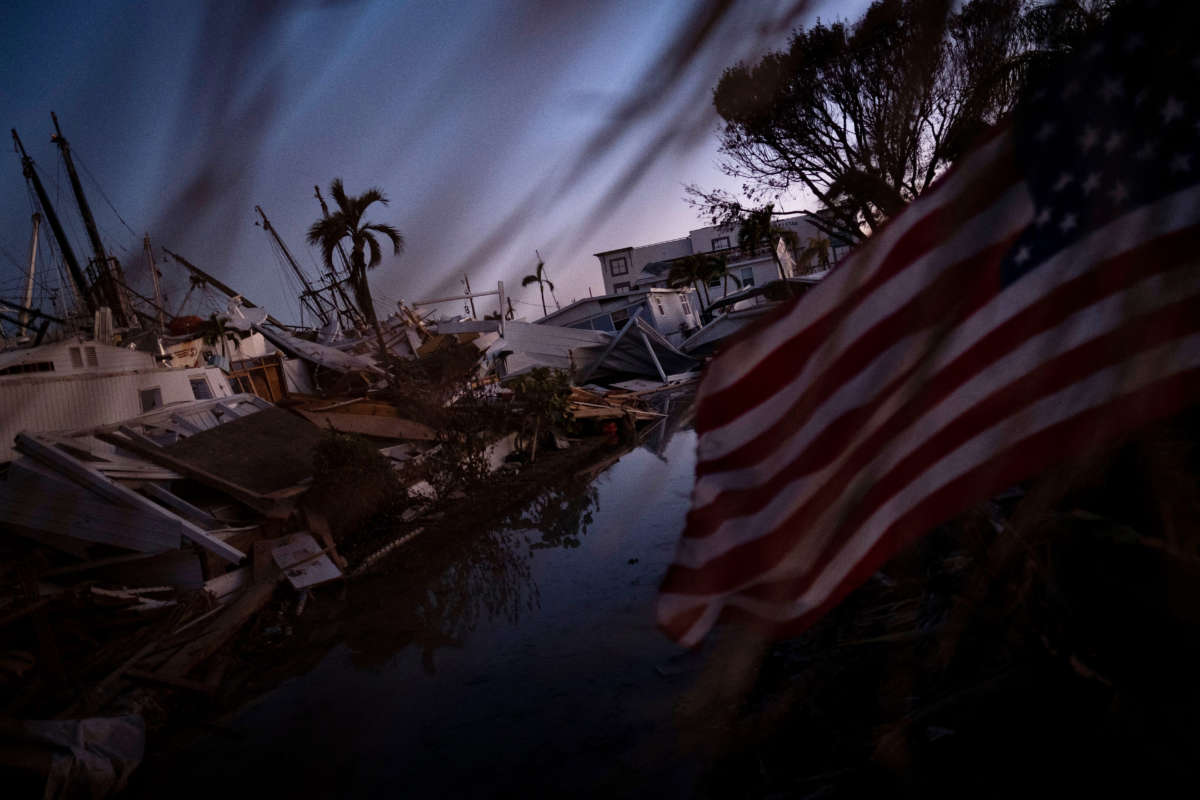
Just days after Category 4 Hurricane Ian devastated Florida, killing at least 88 people and leveling and flooding thousands of buildings, nearly every Florida Republican in U.S. Congress voted against a bill containing billions in funding for disaster relief that officials could have accessed to begin recovery after the storm.
Last week, Congress passed a stopgap government funding bill that contained $18.8 billion in Federal Emergency Management Agency (FEMA) funds to account for climate crisis-fueled, worsening natural disasters that Florida officials could use to speed recovery from Ian, according to the Daily Beast. The bill provided FEMA with a year’s worth of disaster funds, rather than just the next few months’ worth.
The bill passed despite widespread opposition from Republicans and the Floridians in the caucus. All 16 Republican House representatives from the state voted against the bill on Friday, including the two Republicans who represent constituents in Lee County, where much of the hurricane’s destruction was felt. In all, 201 Republicans voted against the bill to keep the government funded through December, while only 10 voted for it.
Floridian Republicans in the Senate weren’t on board with the bill either. Sen. Rick Scott voted “no” on the bill, while Sen. Marco Rubio wasn’t present for the vote on Thursday. Rubio said in interviews later that he didn’t vote for the bill because it contained “a bunch of things” unrelated to disaster relief, like additional funding for Ukraine, low-income heating assistance, and relief for Jackson, Mississippi, which is recovering from a historic water crisis.
Despite this, however, the two senators sent a letter to the Senate Appropriations Committee last week asking for a “robust and timely federal response” to the hurricane. “Hurricane Ian will be remembered and studied as one of the most devastating hurricanes to hit the United States,” they wrote.
The government funding bill ultimately passed 72 to 23 in the Senate and 230 to 201 in the House, averting a government shutdown that would have happened at the end of the week.
Even if the FEMA relief funds hadn’t been included in the bill, a government shutdown could have hampered FEMA’s ability to respond to the disaster. In the past, when the government has shut down due to lawmakers’ failure to pass a funding bill, FEMA has historically furloughed thousands of staff.
Democrats castigated Florida Republicans for refusing to support the funding, pointing out their hypocrisy in asking for emergency funding but still voting against or abstaining from voting for the bill.
“The same week that Hurricane Ian brought so much chaos and destruction to Florida, not a single Florida [U.S. House] Republican cared enough to vote in favor of Hurricane relief for the people in their own state hit hardest by the storm,” said Florida Democratic Party Chair Manny Diaz, per the Tallahassee Democrat. “That is a level of callous indifference and political opportunism that boggles the mind.”
Rep. Val Demings, a Democrat who is challenging Rubio in the 2022 election, wrote on Twitter on Sunday, “In the United States Senate, I’ll never put partisan politics over delivering disaster relief for Floridians.”
Congressional Republicans have come under fire in the past decade for voting against disaster relief in the wake of a hurricane. In 2012, for instance, dozens of Republicans voted against relief for Hurricane Sandy, including Florida’s far right Ron DeSantis, then a representative in the House.
In fact, opposing disaster relief funding appears to be supported by a large portion of the Republican caucus. As the Daily Beast notes, the largest internal GOP conference group, the Republican Study Committee, proposes slashing federal disaster relief funding in its latest annual budget proposal.
Important Message: Please Read
For 25 years, Truthout has survived by publishing impactful investigative journalism and analysis; distributing full editions 365 days a year; and building a community of readers who support us with small, hard-earned donations.
Eighty percent of our $3 million yearly budget comes from small donors alone. Of those, 8,000 readers support us with monthly donations. Back in 2018, when Facebook decided to suppress the circulation of posts made by organizations, thereby cutting readers off from seeing many articles shared by the news organizations they had intentionally decided to follow, Truthout’s total traffic declined by 40 percent, as nearly all of our traffic from that platform disappeared.
Now, Google has recently rolled out its AI search bar, providing AI summaries instead of directing readers to our site. Google Search is our single largest source of traffic; it’s the route by which nearly one third of our readers find us. Much like in 2018, a shocking 40 percent of our Google traffic has disappeared overnight.
It will not be easy for Truthout to shoulder this blow. Nor will it be easy for our peers and collaborators — news sites that depend on traffic and aren’t bankrolled by large corporations.
If you can support Truthout with a donation today, you can help us resist the AI onslaught. Please give today.