Part of the Series
Struggle and Solidarity: Writing Toward Palestinian Liberation
Truthout is a vital news source and a living history of political struggle. If you think our work is valuable, support us with a donation of any size.
As a new round of negotiations between Hamas and Israel begins in Doha, Israeli forces have intensified their military operations across the Gaza Strip. Nearly 900 Gazans have been killed by U.S.-Israeli forces while attempting to access aid by the Gaza Humanitarian Foundation, which was set up by Israel and the U.S. in May. Each day, Palestinians live under relentless bombardment and witness horrific massacres. UNRWA, the UN agency that provides relief for Palestinian refugees, says 1 in 10 children may be malnourished due to the Israeli blockade. Every passing minute in Gaza means more lives lost, more homes reduced to rubble. It feels as if Israel is racing against time — using the cover of negotiations to kill and destroy as much as possible before any potential agreement is reached.
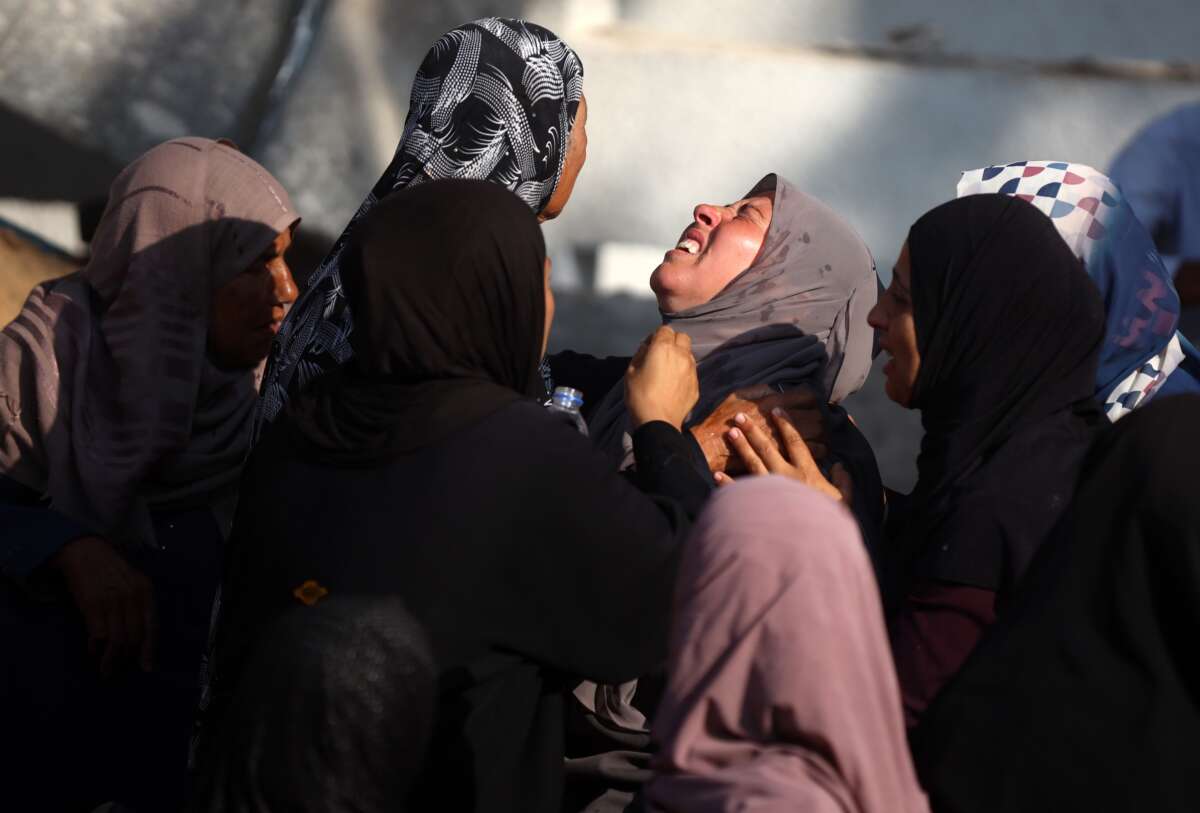
Yet, while grappling with unimaginable hardship and daily horrors, people in Gaza have begun clinging to the headlines, following every update on the negotiations with cautious hope. Everywhere you go, people ask one another with worry, their hearts heavy with anticipation: Will it happen this time? What’s standing in the way?
For many in Gaza, the word “ceasefire” alone is enough to revive a sense of hope. It recharges the spirit of Gazans worn down by months of relentless war, as children and adults alike begin to voice dreams of the simple joys they’ve been denied for so long.
Even though the recent discussions are only addressing the possibility of a temporary truce, followed by further negotiations toward a permanent ceasefire, it is seen as a refuge for many — a fleeting chance to breathe freely from the suffocating burdens of war. Still, nothing is guaranteed, given our experience with the last ceasefire in January, which lasted only two months before being violated by the Israelis.
The breakdown of the last ceasefire has deeply affected how people view the possibility of another one; hope has become intertwined with mistrust and uncertainty about its durability. During the last ceasefire, people were given only a short break from daily killing, displacement, and starvation.
Amid the pain and destruction, people in Gaza found the strength to gather the broken pieces of their lives and stand up again, hoping to reclaim even a small part of the beautiful life we once knew before the war began. For the first time in a long time, we experienced moments of peace — walking freely through the streets of Gaza without living in constant fear of being killed. We tasted delicious, nourishing food, which we had been denied for far too long.
While grappling with unimaginable hardship and daily horrors, people in Gaza have begun clinging to the headlines, following every update on the negotiations with cautious hope.
However, the Israeli government apparently saw this life as a luxury Gazans cannot be allowed. Determined to continue destroying what was already broken, they resumed the war, which shattered what Palestinians had begun to rebuild and plunged people in Gaza back into the same endless cycle of suffering.
Ihsan Alkateeb, 48, told me that once Israel resumed the war in Gaza, it became even crueler than before. He explained that Israeli forces took control of large areas of the Strip, including his neighborhood in Al-Qarara, a town in the Khan Younis governorate that is now under Israeli control and completely inaccessible to its residents. This forced him to live seven kilometers away from home in a tent in the Al-Mawasi area.
He also added that Israel’s starvation campaign is even more terrifying than the military assault itself. “It has drained our energy and left us in despair,” he told me, recalling how helpless he felt watching his children cry for food while he had nothing to offer. “I was forced to risk my life multiple times by following the humanitarian aid trucks and going to American aid distribution sites, which I consider death traps, just to get a bag of flour for my family.”
“We struggle to find enough water and even basic food to feed my hungry children.”
Alkateeb mentioned that, like all the people of Gaza, he is closely following the recent discussions about a 60-day ceasefire and is optimistic — hoping he can finally feed his children the food they long for and return to his neighborhood. However, he added that he is deeply concerned about the lack of guarantees from Israel regarding the resumption of war.
“If the world — and especially the American administration — doesn’t exert immense pressure on Israel to prevent the resumption of war after the temporary truce ends and to push for continued negotiations toward a permanent ceasefire, the situation in Gaza will become catastrophic, and the scenario of the January ceasefire will repeat itself all over again,” he said. “Israel will return to the war with even greater bloodshed and destruction, seeking to implement its plan to occupy the Strip, empty it of its residents, and push them toward Rafah in an effort to drive us out of our land.”
Nihad Nassar, 40, told me that during the January ceasefire, she and her family had the chance to return to their home in the north after months of displacement in the south. Although the house was partially destroyed, she said they “spared no effort to make it livable again.”
Once back in her home in the Al-Shujaiya neighborhood — where she was born and raised — Nassar said she felt like the happiest person in the world. For a moment, she believed the war was truly over, and she allowed herself to dream of a better future — one filled with peace and stability.
Nassar said the resumption of the Israeli military operation in March came as a shock — something she never imagined. Once again, she was forced to flee her beloved neighborhood after Israeli forces launched a large-scale ground invasion, seeking refuge in a tent in the Al-Rimal neighborhood of Gaza.
Nassar explained that the resumption of the war has deeply worsened her situation. “I now live in a small tent in an overcrowded camp, deprived of the basic necessities of life,” she told me. “We struggle to find enough water and even basic food to feed my hungry children. On top of that, we live in constant terror of the sounds of airstrikes every single day.”
“We want to return to our homes, rebuild our lives, and live in peace. Our lives are not a game.”
Nassar also added that once she heard about the negotiation talks, she began following them anxiously. Every day, she checks the news and constantly asks her husband and neighbors if they’ve heard any updates.
“When I hear about obstacles or major gaps between the two parties, I feel deeply depressed,” she told me. “Every minute makes a difference. We need a permanent ceasefire now. We are human beings — we’ve had enough of war. This torture must end.”
She added: “We want to return to our homes, rebuild our lives, and live in peace. Our lives are not a game.”
Nassar and Alkateeb are just two examples among hundreds of thousands of Gazans who remain steadfast in their dream of peace and dignity. They ask for nothing more than a chance to live a normal life, free from war and destruction.
As international calls for an immediate ceasefire grow louder, the question remains: Will these negotiations succeed in achieving lasting peace, or will we continue to endure recurring cycles of pain and devastation? Hope still lives, but it requires genuine support and sustained action from the international community to guarantee Gaza’s right to life, freedom, and peace.
Urgent Appeal for Your Support
Truthout relies on individual donations to publish independent journalism, free from political and corporate influence. In fact, we’re almost entirely funded by readers like you.
Unfortunately, donations are down. At a moment when independent journalism is urgently needed, we are struggling to meet our operational costs due to increasing political censorship.
Truthout may end this month in the red without additional help. We still need to raise $7,000. Please make a tax-deductible one-time or monthly donation if you can.