Did you know that Truthout is a nonprofit and independently funded by readers like you? If you value what we do, please support our work with a donation.
In late August, the sister of Luis Manuel Rivas Velásquez posted a tearful video on TikTok in which she announced that her brother had died while detained at the “Alligator Alcatraz” migrant jail in Florida.
Rivas Velásquez suffered a severe medical incident on August 5 — captured in real time through a phone call from another detainee that we shared publicly with consent given — and collapsed and lost consciousness. He was left in this state for about seven minutes until guards, who failed to administer cardiopulmonary resuscitation properly, finally dragged him away to the nearest hospital, about two hours away.
The Florida Division of Emergency Management, which administers “Alligator Alcatraz,” would not answer questions from Velásquez’s family, lawyer, or the media about his condition while he was hospitalized. The Department of Homeland Security (DHS) and Immigration and Customs Enforcement (ICE) also would not clarify what was happening. The hospital would not acknowledge whether he was in their care or not, and Rivas Velásquez did not show up in any public database pertaining to immigration detention.
After days of anguish, the family was finally told through a statement by DHS Assistant Secretary for Public Affairs Tricia McLaughlin that Rivas Velásquez was, in fact, alive and hospitalized.
Those detained in this migrant jail have effectively been administratively disappeared, and fail to show up in any federal or state public database.
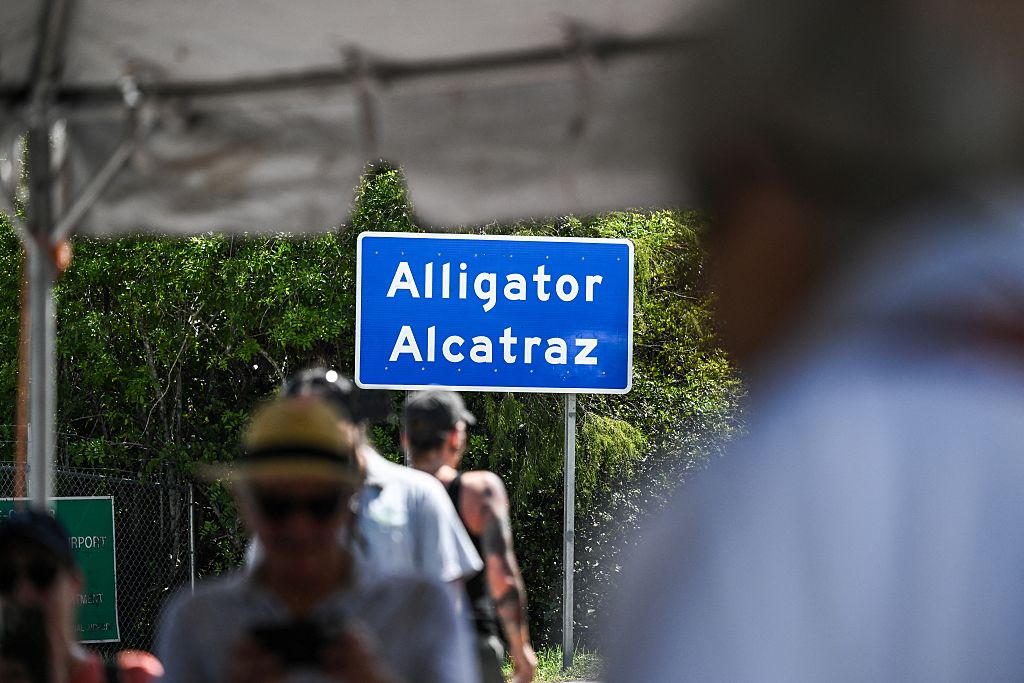
Rivas Velásquez’s story and many others like it show that since “Alligator Alcatraz” opened on July 1, it has been operating as an extrajudicial black site. A recent Miami Herald report highlights what the organization I work for, the Florida Immigrant Coalition, and others have been warning about since this site began operating: that those detained in this migrant jail have effectively been administratively disappeared, and fail to show up in any federal or state public database. The lack of transparency is so brazen, and secrecy has become so pervasive, that the state is refusing to even confirm the total number of people currently detained there.
To explain what’s happening at “Alligator Alcatraz,” we need to go back to the beginning of this horrible saga. The property where the migrant jail is located was formerly known as the Dade-Collier Training and Transition Airport, a semi-abandoned airstrip mostly used for training flights, located in the vulnerable Big Cypress National Preserve. It is adjacent to the Miccosukee Indian Reservation and currently has a dark sky designation, meaning that illumination infrastructure needs to be limited to decrease light pollution that poses a threat to endangered wildlife and birds whose flight patterns could be disrupted.
Florida Gov. Ron DeSantis weaponized an emergency order that he signed in January 2023, citing a “border crisis” as a rationale to build “Alligator Alcatraz” in a place with no plumbing, electrical, or brick-and-mortar infrastructure. The point needs to be made that Florida does not have a terrestrial border, and at no time was it under stress from a migration influx; in fact, the Florida Office of Economic and Demographic Research cited net migration into the state as a way to alleviate the slowdown of population growth and the resulting labor shortages.
When it became clear that Florida had no intention of conducting an environmental impact study for the jail as outlined by the National Environmental Policy Act, environmental watchdog organizations Friends of the Everglades and the Center for Biological Diversity filed a lawsuit, joined later by the Miccosukee tribe.
In an attempt to evade the National Environmental Policy Act process, Florida essentially cut ties with the federal government and DHS/ICE, and it has been running “Alligator Alcatraz” as a completely state-run facility through the Florida Division of Emergency Management. The fact that it’s completely state-run has been repeatedly stressed by lawyers representing Florida in the environmental lawsuit filed in federal court.
This effort by Florida to distance itself from the federal government has manifested in its refusal to sign federal legal agreements that would give the Florida Division of Emergency Management the authority to detain immigrants at “Alligator Alcatraz.” These agreements, like 287(G) or IGSA contracts, would clarify which entity has legal custody of people jailed at “Alligator Alcatraz” and would help inform legal processes for detainees.
Two federal judges have so far requested that state and federal governments produce these legal agreements to clarify jurisdiction and administrative responsibilities over immigration detention at the Everglades detention camp. One request was prompted by the previously mentioned environmental lawsuit, and the other by a lawsuit filed by civil rights groups alleging that the people jailed at “Alligator Alcatraz,” whom they represent, have not been afforded due process. They argue their constitutional rights are systemically violated, as the lack of a process and jurisdictional clarity denies them access to legal counsel, while also being held without formal charges, and stripped of bond hearings following the cancellation of immigration court proceedings.
This state-run, extrajudicial model for immigration jails is threatening to proliferate not just in Florida but across the U.S.
Working with family members whose loved ones were trapped at “Alligator Alcatraz,” we encountered numerous cases of people being held there for over a month, in some cases nearly two months, without having the opportunity to meet with their lawyers, nor with immigration officers or judges. People detained at the immigration jail said their arrival dates were being falsified, reportedly altered when their wristbands were scanned, to hide the fact they’ve been held longer than the 14-day legal limit without a specific action, like a custody transfer or case review, being taken after an ICE detainer was issued against them.
To emphasize the jurisdictional mess, State Rep. Anna Eskamani shared emails sent by the wife of a detainee to Miami’s Krome Detention Center, asking if the immigration court overseeing that facility also had authority over “Alligator Alcatraz.” Krome officials referred her to DHS, which in turn referred her to the Florida Division of Emergency Management, but that agency never bothered to clarify her inquiry.
This messy framework is by design. It serves to deny due process and legal recourse to people jailed at “Alligator Alcatraz.” We have seen hundreds of people jailed at “Alligator Alcatraz” who don’t appear on the ICE locator tool; people are being deported before scheduled bond hearings; and the Miami Herald reports that DeSantis is lying when he claims that everyone detained at “Alligator Alcatraz” has final orders of removal, meaning that an immigration order has ruled that an individual must leave the United States. Moreover, the complete lack of acknowledgement and communication with families when a loved one is hospitalized, which happens with frequency, is both unacceptable from a moral standpoint and puts the people who are trapped in the jail at further medical risk.
This state-run, extrajudicial model for immigration jails is threatening to proliferate not just in Florida but across the U.S.
Homeland Security Secretary Kristi Noem said “Alligator Alcatraz” is a model for state-run detention centers moving forward, detailing plans to build more facilities by commandeering airports and facilities across the country, with sites reportedly under consideration in Arizona, Nebraska, Louisiana, and Florida.
DeSantis has already opened a new migrant jail in North Florida dubbed “Deportation Depot,” which sits at the previously closed and now recommissioned Baker Correctional Institution. Public numbers say there are currently around 250 detainees held at the jail, but sources I have spoken to put the number closer to 400. Florida has also not presented federal legal agreements for this immigration jail, signaling that this could be the modus operandi moving forward. A third facility near Pensacola is in the works, dubbed “Panhandle Pokey” by state officials.
This is all a very lucrative business opportunity for those with the political connections to reap the benefits. The emergency decree that DeSantis used to seize the land to build “Alligator Alcatraz” also allows him to circumvent competitive processes when disbursing contracts to vendors operating there. This is not the only method to award no-bid contracts, however, as the Florida Division of Emergency Management also has an extensive list of pre-approved vendors that allows disbursement without a competitive process.
Hefty political donations often preceded the disbursement of these multimillion-dollar contracts; for instance, IRG Global Emergency Management Inc., a Texas-based emergency management company, donated $10,000 to the Republican Party of Florida and, within days, received a $1.1 million contract to provide “operational support services” at “Alligator Alcatraz.” The company would also be awarded two more contracts, totaling $5.1 million.
This new model allows politically connected individuals to make hundreds of millions of dollars off Florida’s taxpayers at the expense of jailed migrants.
According to procurement records reported by journalist Jason Garcia, Florida’s state government has awarded more than $350 million in contracts to companies connected with “Alligator Alcatraz,” and the DeSantis administration has already admitted in court that $218 million has been spent on the migrant jail’s operation. Just one obscure but connected company from Jacksonville scored a whopping $78 million contract to provide a range of different services at the site, including staffing, training, and security.
This new model of state-run extrajudicial immigration black sites allows many politically connected individuals to make hundreds of millions of dollars off Florida’s taxpayers at the expense of jailed migrants. The human impact is enormous, as detainees and their families are living through a nightmare, struggling to navigate what immigration attorneys described to the Miami Herald as “an alternate system where the normal rules don’t apply.”
In further display of the many conflicts of interest plaguing the state of Florida and its immigration detention framework, a new report published by Prism details how Judge Barbara Lagoa, who issued a stay reopening Alligator Alcatraz after an injunction temporarily shut down the site, is married to Paul Huck, partner at one of Florida’s most politically connected conservative law firms, earning millions from contracts tied to the state’s legal battles. Judicial ethics rules suggest that judges recuse themselves when their spouses’ financial interests could be affected by a ruling. Critics argue that Lagoa’s decision to weigh in on a case central to Florida’s legal agenda undermines public confidence in judicial impartiality, as her husband could stand to profit from the state’s larger legal strategy.
“It’s concerning to have on such an important case with huge ramifications for the environment a judge with that power to decide on this matter with a husband that is working on high-profile political cases on behalf of DeSantis,” said State Representative Eskamani. “From the most ethical position, she should have recused herself, and not doing so further erodes people’s trust in the judiciary.”
That’s putting it mildly. What’s happening in Florida needs to be restated clearly: We are seeing the proliferation of extrajudicial black sites, where people are administratively disappeared. This erosion of due process is now systemic and pervasive across the country, part of a much larger assault on constitutional rights being waged by the Trump administration, not just against immigrants but against all citizens.
Press freedom is under attack
As Trump cracks down on political speech, independent media is increasingly necessary.
Truthout produces reporting you won’t see in the mainstream: journalism from the frontlines of global conflict, interviews with grassroots movement leaders, high-quality legal analysis and more.
Our work is possible thanks to reader support. Help Truthout catalyze change and social justice — make a tax-deductible monthly or one-time donation today.