Did you know that Truthout is a nonprofit and independently funded by readers like you? If you value what we do, please support our work with a donation.
A group of Democratic senators is demanding information from more than two dozen banks on their overdraft policies and profits from overdraft fees.
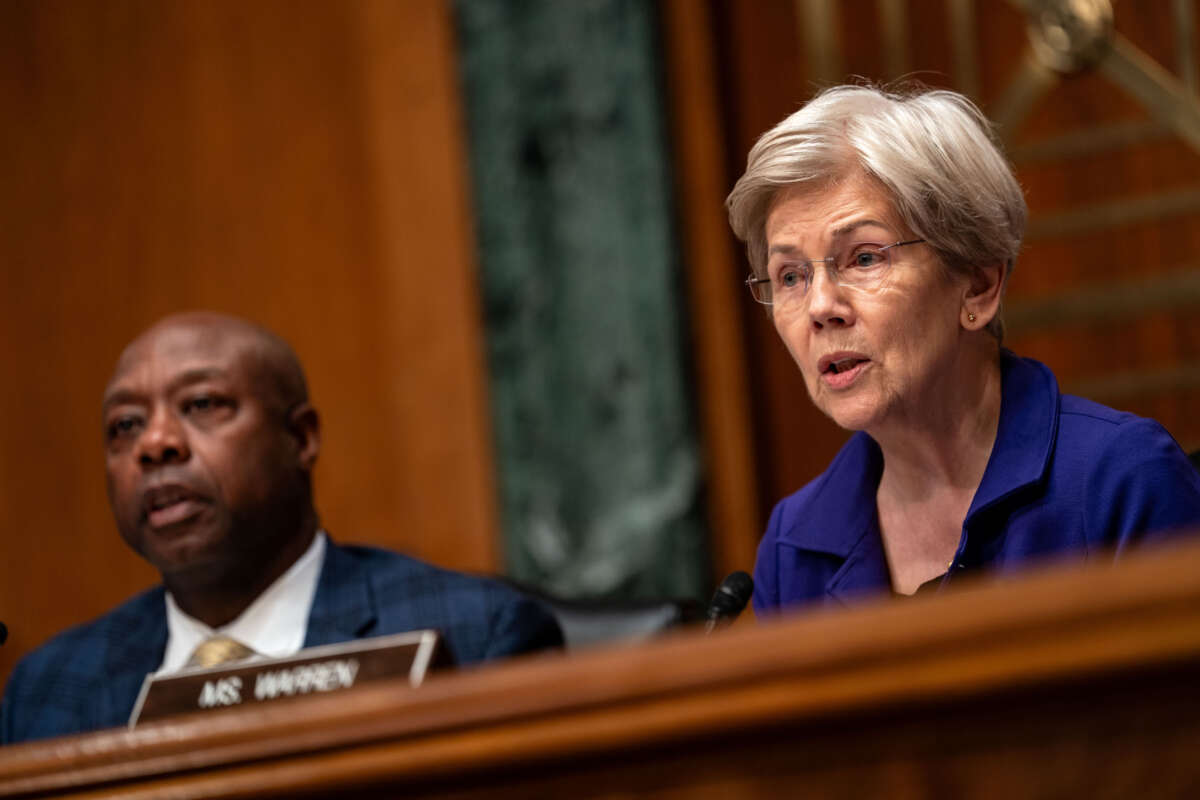
“Overdraft and non-sufficient fund (NSF) fees are ‘one of the most common exploitative mechanisms big banks use to target the poor,’” Senators Elizabeth Warren (D-Massachusetts), Richard Blumenthal (D-Connecticut), and Bernie Sanders (I-Vermont) wrote to 25 banks on August 28, including JPMorgan Chase, Wells Fargo, PNC Bank, TD Bank, and Bank of America.
“When consumers’ finances are already stretched thin, exorbitant overdraft fees can cause other payments to bounce — leading to even more fees in a vicious circle that can ‘turn setbacks into crises,’” they continued, noting that several banks have eliminated overdraft fees, including Ally, Capital One, CitiBank and Discover.
Banks have collected billions of dollars in overdraft fees from some of their poorest customers. Frequent over-drafters have an average of less than $350 in the bank, the senators wrote.
In 2024, JPMorgan and Wells Fargo each collected more than a billion dollars in overdraft fees; PNC Bank collected over $280 million; TD Bank collected just under $230 million; and Bank of America collected close to $150 million.
According to an analysis by the Consumer Financial Protection Bureau (CFPB), 35 percent of those charged overdraft fees had incomes between $35,001 and $65,000, compared with 18 percent of consumers with incomes between $100,000 and $175,000, as per the senators’ letter.
Earlier this year, President Trump signed a resolution that repealed CFPB’s $5 cap on almost all overdraft fees, which was supposed to go into effect in October.
The Trump administration is in the process of dismantling CFPB, among many other agencies. Before becoming a senator, Warren conceived of and helped establish the bureau, which Congress created in 2008, in the wake of the financial crisis.
Earlier this year, layoff notices were sent to more than 1,400 CFPB employees, which would leave just over 200 staffers at the agency.
Litigation temporarily halted the layoffs, but a Trump-dominated appeals court ruled in August that they can proceed. Trump appointees Judges Gregory Katsas and Neomi Rao sided with the administration and President Obama appointee Cornelia Pillard dissented.
Government Executive reports that during Trump’s first term, Rao was head of the Office of Information and Regulatory Affairs, which reports to the Office of Management and Budget (OMB). At the time, OMB was led by Russ Vought, who Trump chose to lead the agency again in February. Vought is also the current acting director of CFPB.
In Pillard’s dissent, she wrote that CFPB leadership may “run the Bureau as it determines best serves the public interest.”
“But it is emphatically not within the discretion of the President or his appointees to decide that the country would benefit most if there were no Bureau at all,” she continued. “Congress made the contrary decision in legislation establishing the CFPB, and the power to repeal that law lies with the legislative branch.”
We lost 15 percent of our traffic overnight.
We now have three full months of data since Google changed its search to feature AI results. The numbers are worse than we anticipated. Overall readership that comes to Truthout through Google is down 54 percent against last year. The number of new readers who discover Truthout via Google searches is down 49 percent, and returning users from Google are down 51 percent.
We lost 15 percent of our readership overnight. This was a readership we painstakingly built over decades, and it vanished because Google chose corporate greed over a healthy democracy.
We anticipate a loss of roughly $500,000 in online revenue as a result of this massive traffic plunge in the next year alone.
The only way we can keep publishing is with strong reader support. We are asking you to start a monthly donation to Truthout today — anything you can do, whether $5 or $25, makes a difference.