Did you know that Truthout is a nonprofit and independently funded by readers like you? If you value what we do, please support our work with a donation.
The Trump administration is planning to defund a number of COVID-19 testing sites across the country, and it remains unclear whether doing so might be part of a broad plan by the president to “slow down on testing.”
Thirteen sites across five states in the U.S. that have been funded since the start of the administration’s response to the coronavirus pandemic are set to lose federal dollars by the end of this month, according to reporting from Talking Points Memo. Seven of the sites included in that list are in Texas alone, a state that has seen rates of coronavirus increase substantially in just the past few days.
Looking over the past week’s numbers, from June 16 to 22, Texas witnessed a daily average of 4,037.85 cases. That’s more than double the previous week’s daily average, when just 2,018.71 cases per day were observed.
In spite of that spike in numbers, the Department of Health and Human Services (HHS) is saying that the defunding of those seven sites is necessary to “transition” away from federal government funded testing. The transition, however, goes against what many local health officials want to see happen.
“Cases are continuing to rise in Dallas County, and we want to continue with the testing,” Rocky Vaz, director of emergency management in Dallas, told Talking Points Memo.
HHS seemed adamant in ending the funding, Vaz explained. “They told us very clearly that they are not going to extend it,” he said, adding that he and his agency were “not expecting it to continue beyond June 30.”
The scheduled defunding, which may turn into closures, comes about as confusion abounds over President Donald Trump’s comments from a campaign event in Tulsa, Oklahoma, over the weekend. Trump told attendees at that event that he was frustrated with the rise in new coronavirus case figures, and that he believed the best way to address those numbers was to limit testing.
“When you do testing to that extent, you’re going to find more people, you’re going to find more cases. So I said to my people, ‘Slow the testing down, please,'” Trump said on Saturday.
The president doubled-down on Monday, saying in an interview that the “reason we have more cases is because we do more testing than any other country by far.” On Tuesday, Trump also tweeted that “with smaller testing we would show fewer cases!”
While the U.S. has performed more tests in terms of raw numbers, the president doesn’t appear to account for population differences. “The US may have done the most tests, but not the highest # of tests per capita,” Jennifer Nuzzo, a senior scholar at the Johns Hopkins Center for Health Security, wrote on Twitter, disputing the president’s accounts.
The comments from Trump have led many to wonder whether he’s more concerned with perceptions of the pandemic than eradicating or combating it.
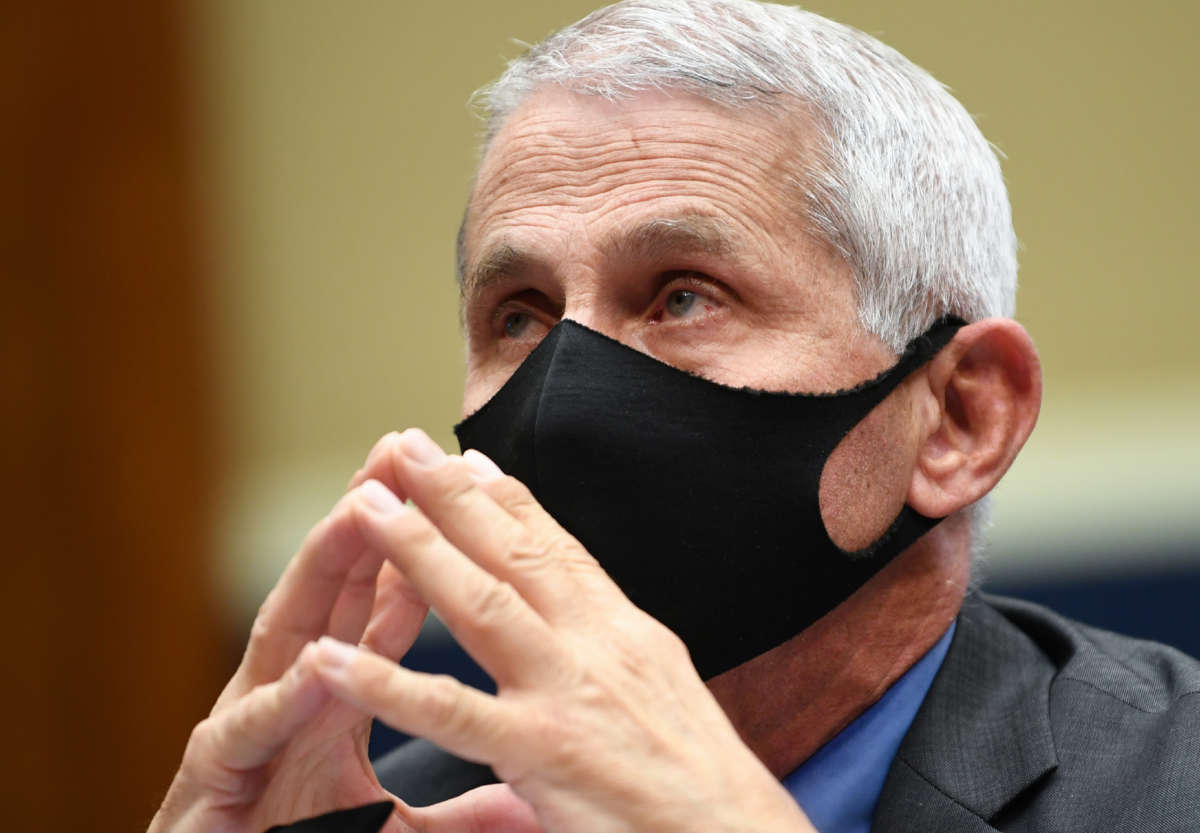
In a stark departure from Trump’s messaging, however, Anthony Fauci, a member of Trump’s coronavirus task force and the director of the National Institute of Allergy and Infectious Diseases, told Congress on Tuesday that the strategy on testing wasn’t to slow down, but to increase the number of tests conducted daily in the U.S. in the coming weeks.
“I, as a member of the task force, and my colleagues on the task force, I know for sure, to my knowledge, none of us have ever been told to slow down on testing,” Fauci said. “That just is a fact. In fact, we will be doing more testing.”
An urgent appeal for your support: 5 Days to raise $34,000
Truthout relies on individual donations to publish independent journalism, free from political and corporate influence. In fact, we’re almost entirely funded by readers like you.
Unfortunately, donations are down. At a moment when independent journalism is urgently needed, we are struggling to meet our operational costs due to increasing political censorship.
Truthout may end this month in the red without additional help, so we’ve launched a fundraiser. We have 5 days to hit our $34,000 goal. Please make a tax-deductible one-time or monthly donation if you can.