Honest, paywall-free news is rare. Please support our boldly independent journalism with a donation of any size.
Chicago charter teachers are racking up firsts. In December 2018, Chicago saw the first-ever walkout at a charter network in the United States. And on Thursday, teachers employed by two other private operators launched the nation’s first multi-employer charter school strike.
“We’ve been bargaining since last summer, and the process has been insulting to educators,” said Carlene Carpenter, a social studies teacher at the Latino Youth High School (LYHS), which is affiliated with the Youth Connection Charter School network. “If charter operators really cared about education, we wouldn’t be here today.”
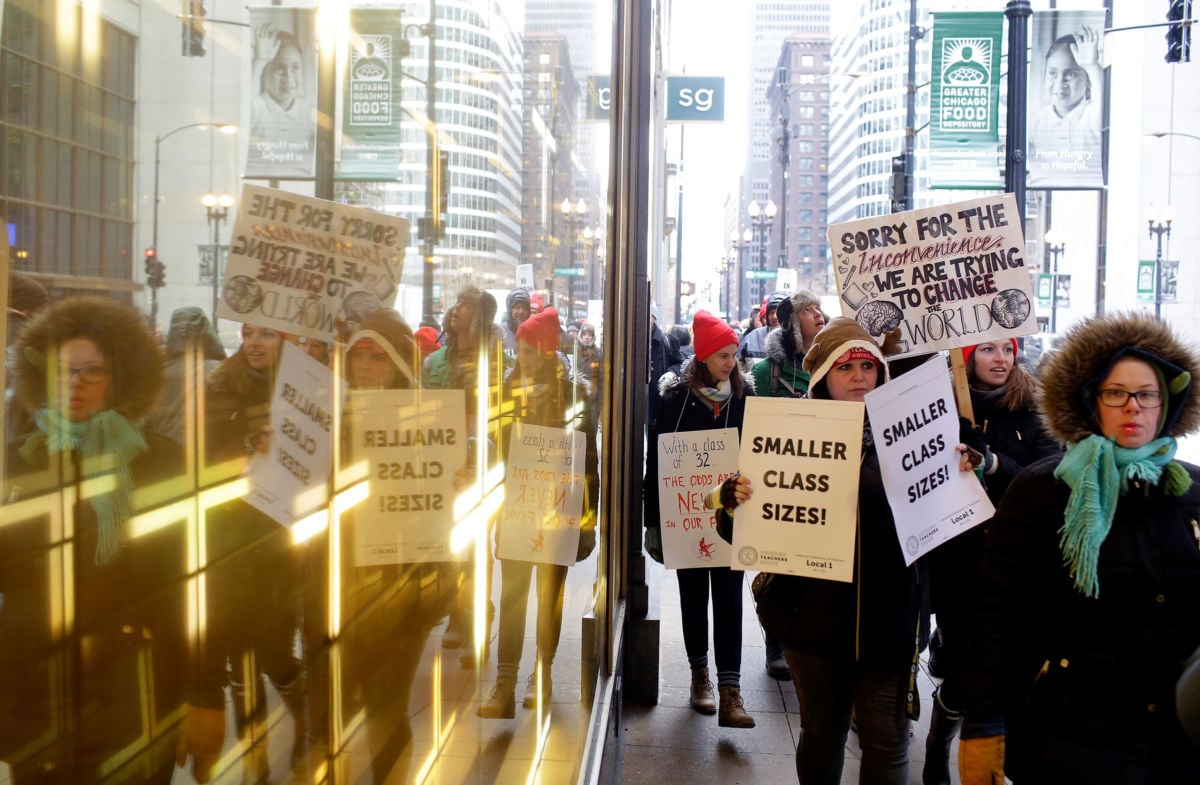
The past six months have seen more than 700 charter teachers at 22 different campuses walk off the job over stalled contract negotiations. All of them are represented by the Chicago Teachers Union’s recently formed charter division, which has been bargaining with teachers at 11 different operators using a set of common demands hashed out last spring. Key issues include pay bumps for charter teachers and support staff, who are typically paid less than their counterparts in district-run schools, as well as caps on class sizes, and more counselors and mental health supports for students.
At the end of the school day Wednesday, charter teachers from across the city held a May Day rally at the Chicago High School for the Arts (ChiArts), a school that operates privately on a contract with the district. That makes it technically distinct from an independently chartered school, putting it in a gray area that the union says school administration has exploited in order to skirt regulations and avoid paying into the teachers’ pension fund.
Comparatively low pay and benefits have resulted in high turnover and the disruption of students’ education, said Emily Maassen, a ChiArts teacher who spoke at the rally. “Educators leave and they’re replaced by a computer program,” she said, referring to an online learning program used in the school.
Early Thursday morning, ChiArts settled a contract with the union, narrowly avoiding a walkout. (Details of the agreement were not immediately available.) Another school, Youth Connection Leadership Academy in the city’s Bronzeville neighborhood, also reached an agreement with teachers Wednesday.
But at Latino Youth High School, as well as two schools run by the non-profit Instituto del Progreso Latino, which serve about 1,000 predominantly Latinx students from the city’s south and west sides, negotiations stalled, resulting in walkouts.
Carpenter, who has taught at LYHS for nearly six years, said that the school’s management “walked away from the bargaining table” at 5 p.m. Wednesday.
Pilsen Wellness Center, the nonprofit that operates the school, also sent a letter to parents Wednesday that the union said is intentionally misleading.
The letter, reviewed by In These Times, says that while other charter networks have accepted the CTU’s demands because they are financed directly by the school district, “we receive the majority of our funding from Youth Connection Charter School (YCCS), a small charter network with limited financial resources.”
In fact, with 19 campuses, YCCS is the largest charter network in Chicago. While it contracts with various nonprofit operators, it holds the charters to schools in its network and receives public funding according to the same formula as other charter schools. The union contends that the network receives “millions of public dollars” that it siphons away from the classroom toward “management fees and bloated executive payrolls and salaries.”
In response to questions from In These Times, LYHS said in an e-mail that while YCCS receives funds from CPS, “they do not pass 100 percent of the funding they receive from CPS to all of their campuses.”
LYHS said in the e-mail that since 2016, Pilsen Wellness Center has provided 6,500 clinical hours of mental health treatment to students. The school said that it does not ask students for proof of immigration status, in compliance with federal law, and that it assists uninsured students in applying for Medicaid. Undocumented immigrants are not eligible for Medicaid.
In an unusual move, Chicago Public Schools CEO Janice Jackson weighed in on charter labor strife this week in a letter to CTU and schools officials. Jackson said she was “very concerned” about the effect of the strike on at-risk students the schools serve, many of whom have already dropped out of other schools or crossed paths with the criminal justice system.
Teachers and staff say they’re on strike to ensure that students have access to counselors and adequate special education services.
“We serve students that experience trauma at higher-than-normal rates, and they need these resources,” said Carpenter. The school currently has just one counselor, meaning that there is a waitlist for students “who are self-referring and requesting services,” according to Carpenter.
Moreover, according to the union, insurance billing is currently required for mental health services at LYHS, effectively excluding undocumented students who make up a large part of the school’s population.
The two previous charter strikes in Chicago have ended with increases in teacher and staff pay, as well as wins for student resources. Those include caps on class sizes, carve-outs during the school day for special education case managers and strengthened “sanctuary school” protections that prohibit schools from sharing information with immigration enforcement—most of which Chicago Public School teachers cannot formally bargain over, due to restrictive state law.
“We’re raising standards,” said Chris Baehrend, president of the CTU’s charter division.
The union is still in negotiations with three other charter operators, and more strikes could follow this spring. The strategy of negotiating contracts simultaneously has paid off, said Baehrend, forcing charter operators to take measures that were previously off the table, such as cutting administration costs.
“We’ve learned that their bottom line is their bottom line,” said Baehrend. “But our bottom line is what students deserve.”
An urgent fundraising appeal: 48 Hours to raise $26,000
Truthout is one of only a few platforms for justice-oriented, grassroots journalism. Today, we face an existential threat.
Due to Google’s launch of AI search, we’ve seen a drastic plunge in our site traffic and, as a result, our revenue. We lost 15 percent of our readership overnight. This was a readership we painstakingly built over decades, and it vanished because Google chose corporate greed over a healthy democracy.
We are fundraising right now to meet our basic operating expenses. If you can support Truthout with a one-time or monthly donation, you will make a significant impact on our work. Anything you can do makes a difference — we appreciate your support.