Truthout is a vital news source and a living history of political struggle. If you think our work is valuable, support us with a donation of any size.
A resolution with wide bipartisan support is being pushed through Congress that would codify one of Donald Trump’s controversial foreign policy initiatives — the so-called Abraham Accords which strengthened U.S. support for Arab dictatorships in return for their formal recognition of Israel.
The Israel Relations Normalization Act has 329 House cosponsors, and 72 cosponsors in the Senate, almost evenly divided between the two parties.
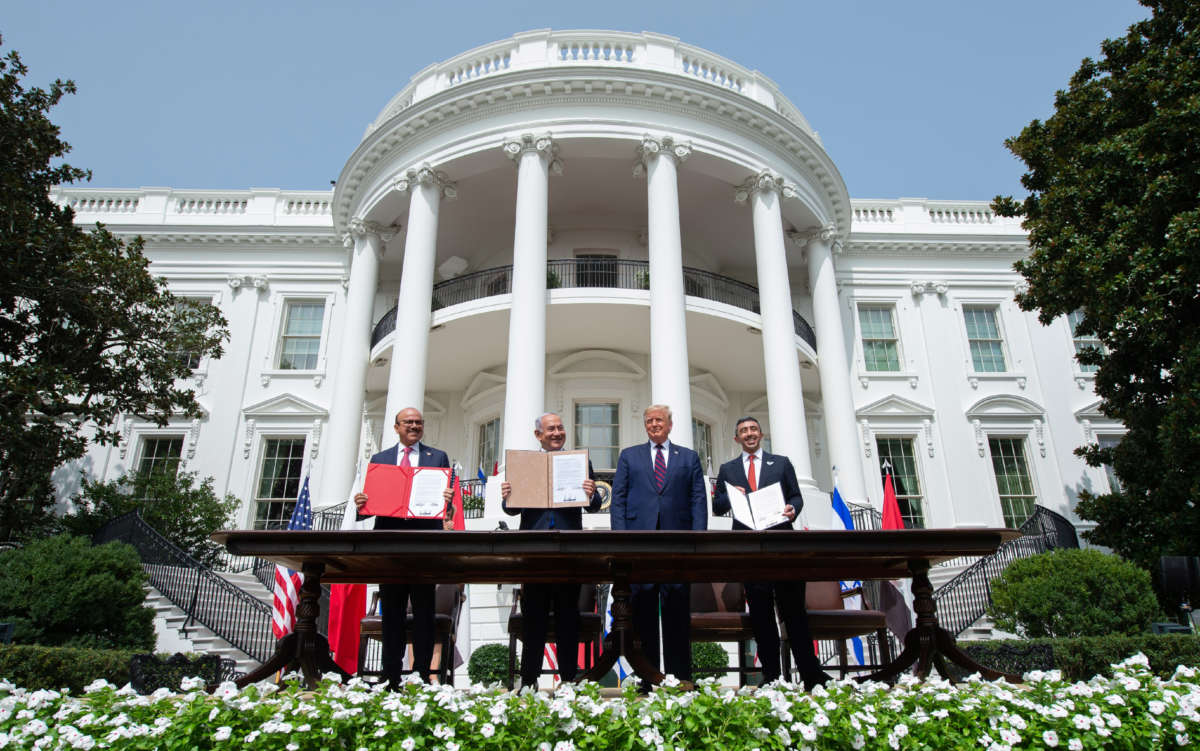
The bill celebrates and seeks to strengthen Trump’s deal which led Bahrain, the United Arab Emirates (UAE), Sudan and Morocco to normalize relations with Israel. None of these countries would have recognized Israel were it not for a series of actions by the United States that essentially amounted to bribery and extortion.
The bill asserts that the deals brokered by Trump and his son-in-law and adviser, Jared Kushner, were “peace agreements.” However, except for a small contingent sent by Morocco partway through the October 1973 conflict between Israel and a coalition of Arab states led by Egypt and Syria, none of the signatory countries had ever been at war with Israel. None of these countries were threatening Israel, none of them had the capacity to threaten Israel, and Israel’s distance from these countries range from 750 to 3,200 miles.
If passed, the bill would require the State Department to “develop and submit to the appropriate congressional committees a strategy on expanding and strengthening the Abraham Accords,” including ways in which the U.S. government intends to “leverage diplomatic lines of effort and resources to encourage normalization.”
The “normalization” of diplomatic ties in the 2020 agreements Congress seeks to expand and strengthen were part of a quid pro quo: In 2020, the tiny Gulf sheikdoms of Bahrain and the UAE agreed to recognize Israel in return for lucrative arms deal with the United States that Trump threatened to otherwise withhold. Sudan’s government agreed to normalize relations with Israel in return for the United States lifting devastating sanctions on that country. Most controversially, Morocco agreed to recognize Israel in return for the United States becoming virtually the only country to formally recognize Morocco’s illegal annexation of Western Sahara, which has been under a brutal Moroccan military occupation since its conquest of the former Spanish colony in 1975.
Criticisms of the Abraham Accords are effectively banned in these Arab states, each of which have notoriously bad human rights records. Bahrain, with the support of Saudi Arabia and the UAE, engaged in a brutal and deadly crackdown against nonviolent pro-democracy activists in 2011 and peaceful dissent continues to be suppressed in that island kingdom. The UAE is also a repressive regime which is particularly abusive to foreign workers which make up the majority of the population, and it has engaged in war crimes in Yemen. Sudan is ruled by a repressive military junta which has violently cracked down on pro-democracy activists after staging a coup this past fall, ousting the country’s civilian-led coalition government. The Moroccan monarchy continues its horrific decades-long occupation of Western Sahara, which Freedom House has ranked as second only to Syria in its suppression of political rights.
This bill could be seen as part of the decades-long tradition of the U.S. propping up Arab dictatorships suppressing pro-democracy struggles while then justifying its support for the Israeli occupation on the grounds that Israel is “the sole democracy in the Middle East.”
This legislative initiative perpetuates the myth that the key to Middle East peace is in having autocratic Arab states recognize Israel, not on Israel ending its occupation. There is no mention of the Israeli occupation in the bill, much less a call for it to end. Indeed, by weakening Arab leverage on Israel by recognizing that government prior to Israel recognizing Palestine, it eases pressure on Israel to make the necessary compromises for peace. For nearly 20 years, every Arab country has been on record supporting normalization of relations with Israel in return for Israeli withdrawal from the occupied territories and the establishment of a Palestinian state alongside Israel. This bipartisan majority in Congress sponsoring this bill, however, is insisting that Arab recognition be unilateral. This legislation, therefore, appears to be designed to remove this leverage from the Palestinian side, one of the few routes remaining to the millions of Palestinians suffering under the Israeli occupation and colonization of the West Bank.
It has long been a priority of successive U.S. administrations and congressional leaders of both parties to push Arab countries to recognize Israel while actively discouraging other countries to recognize Palestine. (Indeed, U.S. law requires cutting off all U.S. aid to any United Nations agency that includes Palestine as a member, which led President Obama to suspend U.S. contributions to UNESCO in 2011 and President Trump to withdraw altogether in 2017, resulting in major cutbacks to efforts to promote peace through international cooperation in education, arts, sciences and culture.)
As a result, despite the pro-peace rhetoric in the bill, the Israel Relations Normalization Act appears to be designed to make peace even more elusive by strengthening the Israeli occupation and weakening nonviolent means of challenging it.
A recent poll of U.S. Middle East scholars revealed that nearly three-quarters of those surveyed recognized the Abraham Accords has actually had a negative impact on the prospects of peace, with only 6 percent saying it has had a positive impact. The majority of congressional Democrats, however, have joined their Republican colleagues in insisting that this broad consensus of Middle East scholars is wrong, and that Trump was right.
Important Message: Please Read
For 25 years, Truthout has survived by publishing impactful investigative journalism and analysis; distributing full editions 365 days a year; and building a community of readers who support us with small, hard-earned donations.
Eighty percent of our $3 million yearly budget comes from small donors alone. Of those, 8,000 readers support us with monthly donations. Back in 2018, when Facebook decided to suppress the circulation of posts made by organizations, thereby cutting readers off from seeing many articles shared by the news organizations they had intentionally decided to follow, Truthout’s total traffic declined by 40 percent, as nearly all of our traffic from that platform disappeared.
Now, Google has recently rolled out its AI search bar, providing AI summaries instead of directing readers to our site. Google Search is our single largest source of traffic; it’s the route by which nearly one third of our readers find us. Much like in 2018, a shocking 40 percent of our Google traffic has disappeared overnight.
It will not be easy for Truthout to shoulder this blow. Nor will it be easy for our peers and collaborators — news sites that depend on traffic and aren’t bankrolled by large corporations.
If you can support Truthout with a donation today, you can help us resist the AI onslaught. Please give today.