Support justice-driven, accurate and transparent news — make a quick donation to Truthout today!
Supporters of the Iran nuclear deal welcomed news Friday that the Biden administration restored sanctions waivers seen as key to a mutual return to the agreement.
“This is excellent news for diplomacy!” tweeted the Friends Committee on National Legislation. The waivers, the group added, “will help facilitate negotiations to bring us back into the Iran nuclear deal, which will reduce the threat of war with Iran, and reduce civilian harm from sanctions.”
With Iran hawk Mike Pompeo then leading the State Department, the Trump administration rescinded the waivers allowing for international cooperation on Iran’s nuclear sites in 2020. That followed its 2018 move to pull the U.S. out of the Obama-era deal formally known as the Joint Comprehensive Plan of Action.
According to Agence France-Presse, the waivers allow “other countries and companies to participate in Iran’s civilian nuclear program without triggering U.S. sanctions on them, in the name of promoting safety and non-proliferation.”
The State Department has notified Congress of the waivers.
“We are issuing the waiver now for a simple reason,” said a senior State Department official to CNN. “It will enable some of our international partners to have more detailed technical discussions to enable cooperation that we view as being in our non-proliferation interests.”
The official called such discussions “necessary in the final weeks of JCPOA talks” and said “the waiver itself would be essential to ensuring Iran’s swift compliance with its nuclear commitments.”
“If talks do not result in a return to the nuclear agreement,” the official said, “such technical discussions could still contribute to achieving our non-proliferation goals.”
Anti-war group CodePink said the development marked “a step in the right direction” but added: “If only it hadn’t taken Biden a year to do so…”
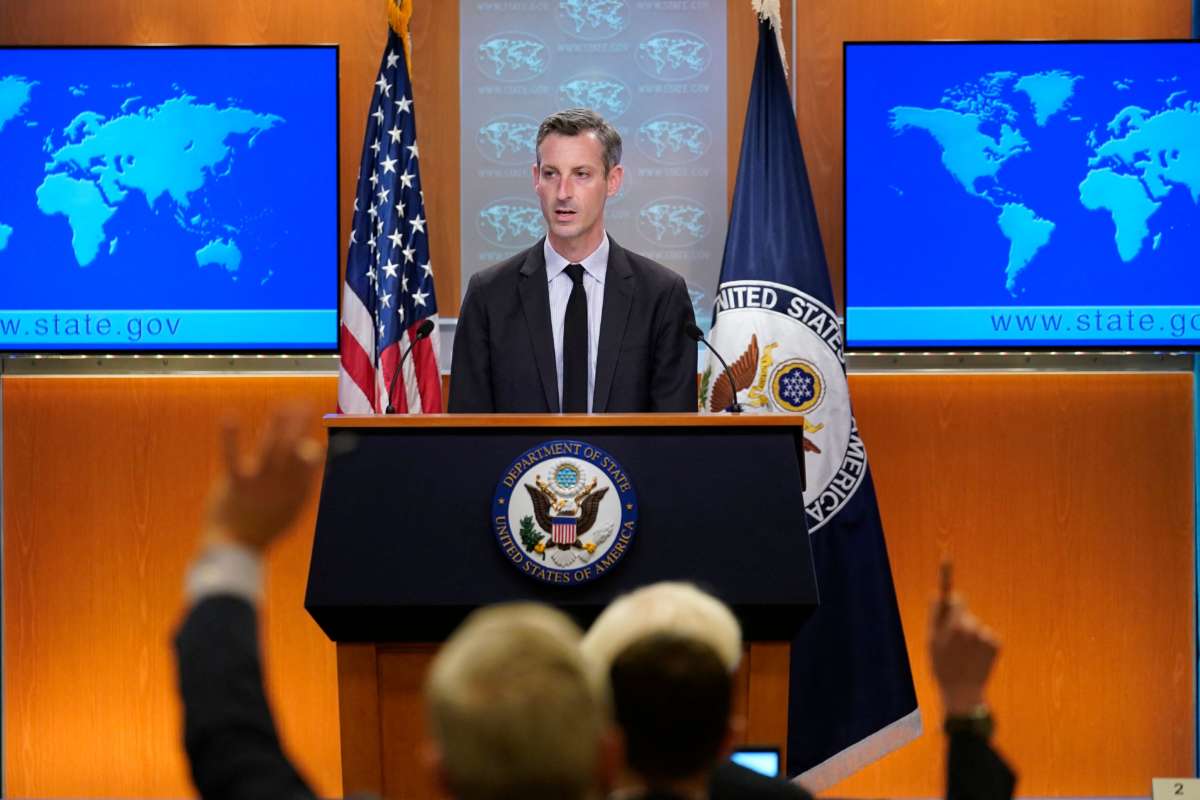
In a Friday tweet, State Department spokesperson Ned Price defended the decision from critics, saying that the U.S. “did NOT provide sanctions relief for Iran and WILL NOT until/unless Tehran returns to its commitments under the JCPOA. We did precisely what the last administration did: permit our international partners to address growing nuclear nonproliferation and safety risks in Iran.”
National Iranian American Council (NIAC) senior research fellow Assal Rad drew attention to the ongoing U.S.-imposed sanctions on Iran.
“As people who pushed Trump’s failed policy start yelling that this is a ‘concession’ to Iran, remember the sanctions crushing its economy are still in place,” she tweeted. “These waivers let other countries work on Iran’s civilian nuclear program, a step that helps bring it back to compliance.”
NIAC policy director Ryan Costello responded to the development in a statement in which he also drew attention to the continued sanctions.
“Trump never should have revoked these waivers in the first place, which are in the U.S. interest and benefit nonproliferation efforts,” said Costello. He called Biden’s move to restore them “a positive sign and welcome move” as it’s “in the interest of the United States, as well as the global community, and supports important nonproliferation goals.”
“The Biden administration is right that these waivers will not entail financial relief to Iran, though there remains a strong case for up front humanitarian relief as it is the people of Iran who have suffered the most under U.S. sanctions,” Costello added. “Hopefully this is a step to a full restoration of the JCPOA and relief for the people of Iran.”
Iran, meanwhile, has called the Biden move “not sufficient,” with its foreign ministry saying that “good will, in our viewpoint, means that something tangible happens on the ground.”
Final talks in Vienna on trying to revive the nuclear deal could take place next week.
Important Message: Please Read
For 25 years, Truthout has survived by publishing impactful investigative journalism and analysis; distributing full editions 365 days a year; and building a community of readers who support us with small, hard-earned donations.
Eighty percent of our $3 million yearly budget comes from small donors alone. Of those, 8,000 readers support us with monthly donations. Back in 2018, when Facebook decided to suppress the circulation of posts made by organizations, thereby cutting readers off from seeing many articles shared by the news organizations they had intentionally decided to follow, Truthout’s total traffic declined by 40 percent, as nearly all of our traffic from that platform disappeared.
Now, Google has recently rolled out its AI search bar, providing AI summaries instead of directing readers to our site. Google Search is our single largest source of traffic; it’s the route by which nearly one third of our readers find us. Much like in 2018, a shocking 40 percent of our Google traffic has disappeared overnight.
It will not be easy for Truthout to shoulder this blow. Nor will it be easy for our peers and collaborators — news sites that depend on traffic and aren’t bankrolled by large corporations.
If you can support Truthout with a donation today, you can help us resist the AI onslaught. Please give today.