Support justice-driven, accurate and transparent news — make a quick donation to Truthout today!
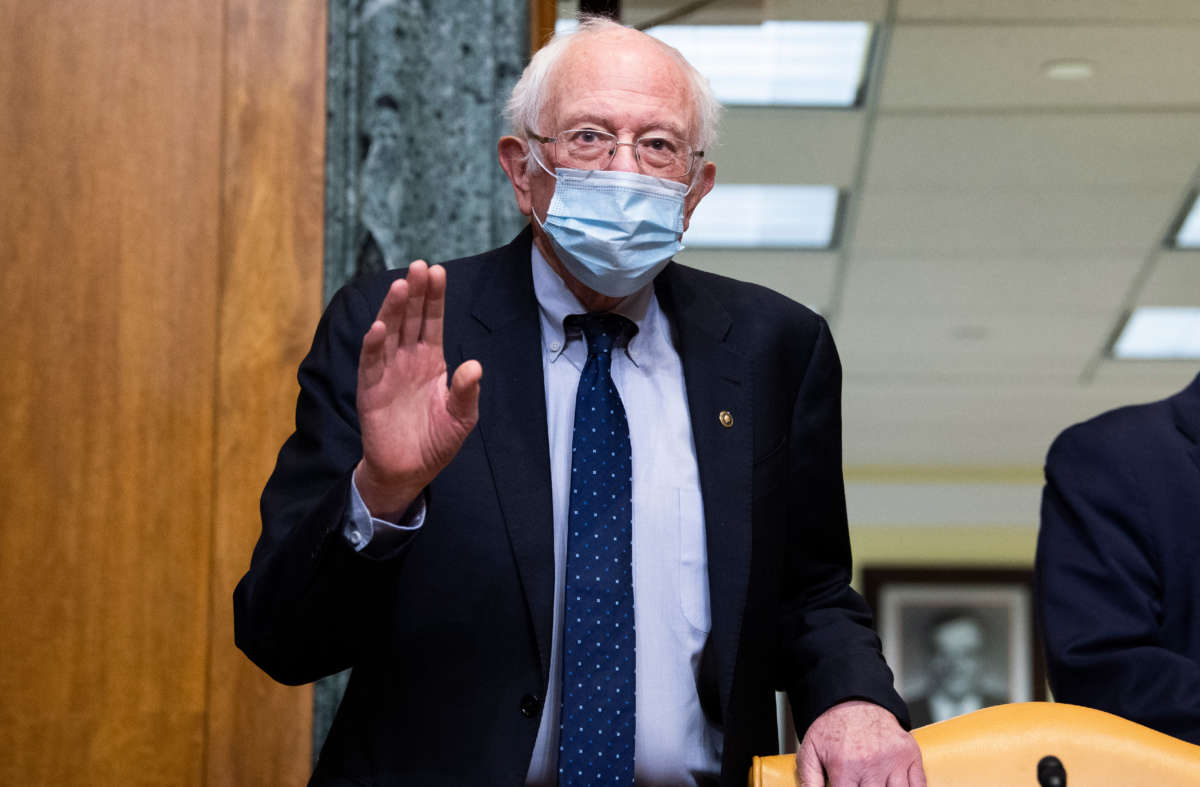
Sen. Bernie Sanders (I-Vermont) has asked Amazon CEO Jeff Bezos to testify before the Senate Budget Committee at a hearing on income inequality next Wednesday.
Sanders’s call comes during a fierce unionization fight in Bessemer, Alabama, where Amazon warehouse workers are voting on whether to form the company’s first U.S. warehouse union. The union drive has also inspired over 1,000 Amazon workers across the country to contact the Retail, Wholesale and Department Store Union about organizing their workplaces.
Amazon is fighting hard against this union drive as it has done in decades past. Truthout reported earlier this month that Amazon is paying anti-union consultants nearly $10,000 a day to thwart the Alabama union drive. The workers’ unionization effort has garnered support from politicians including Sanders, President Joe Biden and, surprisingly, Sen. Marco Rubio (R-Florida) — though Rubio’s intentions may be far from pure.
“What you are seeing right now in Bessemer is an example of the richest person in this country spending a whole lot of money to make it harder for ordinary working people to live with dignity and safety,” Sanders told The Washington Post. “If they can win, I think that will send a message to workers all over this country that if you are prepared to stand up and fight, you can win a union, you can win better wages and better working conditions.”
Bezos is not only the richest person in the U.S., but also the richest person in the entire world. Meanwhile, some Amazon workers earn so little that they have to use government subsidies like food assistance programs to survive.
The company has been holding mandatory anti-union meetings and posted fliers and banners discouraging workers from voting for the union. Managers regularly press employees on whether or not they’ve voted yet, NPR reports.
The Budget Committee hearing, which Sanders chairs, will also include testimony from union organizer and Amazon worker trainer Jennifer Bates. Bates has told NPR that Amazon’s message to the workers is, “Don’t let unions come between our relationship. But we don’t have a relationship,” she says. “We have a relationship with a computer and an app.”
The union drive has had far-reaching effects across the country as some have noted that the pushback by Amazon exposes the severe shortcomings of labor laws in the U.S. This week, Democrats in the House passed the pro-union PRO Act, which would outlaw some of the tactics that Amazon has been using against its workers if signed into law.
“It cannot be overstated how powerful it will be if Amazon workers in Alabama vote to form a union,” said Sanders last month. “They are taking on powerful anti-union forces in a strong anti-union state, but their victory will benefit every worker in America. I’m proud to stand with them.”
Amazon has touted their $15 starting wage as a shield against criticism over their anti-union efforts — the Bessemer workers’ wages start at $15.30 — but warehouse workers are often pushed to the brink as they strain their bodies to do manual labor and face heavy surveillance by the company.
But Amazon’s minimum wage is likely more reactive than proactive, and more about publicity and tactics than it is about actually treating their workers fairly. The company only raised its minimum wage shortly after Sanders introduced a bill in 2018 that would tax Amazon when employees collected food stamps, called the Stop BEZOS Act. The company has heavily publicized their minimum wage ever since, and experts say that Amazon is likely looking to gain purchase with the public while having a better chance of retaining its workers.
Bezos’s wealth has grown by about $70 billion during the pandemic, as many Americans — including his own workers — have suffered under oppressive work conditions and layoffs. This makes him “the poster child” of the high end of income inequality, Sanders told The Washington Post.
Press freedom is under attack
As Trump cracks down on political speech, independent media is increasingly necessary.
Truthout produces reporting you won’t see in the mainstream: journalism from the frontlines of global conflict, interviews with grassroots movement leaders, high-quality legal analysis and more.
Our work is possible thanks to reader support. Help Truthout catalyze change and social justice — make a tax-deductible monthly or one-time donation today.