Honest, paywall-free news is rare. Please support our boldly independent journalism with a donation of any size.
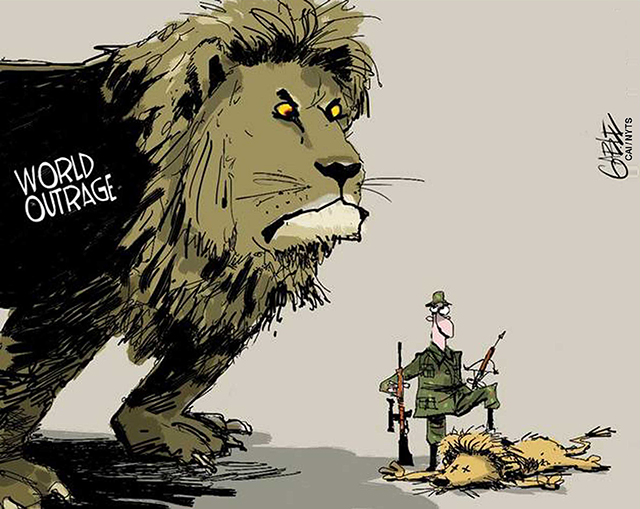
The Washington Post’s Wonkblog recently published a piece inspired by the American dentist who paid a lot of money to shoot Cecil the lion in Zimbabwe, asking why he – and dentists in general – make so much. Which was all pretty interesting to me, since I’ve never really thought about the economics of dental care.
But once you do focus on the issue, it turns out to have an important implication – namely that the ruling theory behind conservative notions of health reform is completely wrong.
For many years, conservatives in the United States have insisted that the problem with health costs is the fact that we don’t treat health care like an ordinary consumer good. People have insurance, which means that they don’t have the “skin in the game” necessary to incentivize them to watch costs. So what we need, the thinking goes, is “consumer-driven” health care, in which insurers no longer pay for routine expenses like visits to the doctor’s office, and in which everyone shops around for the best deals.
The usual response has been that this involves going where the money isn’t – that because health costs are dominated by big expenses that must be paid by insurers, there just isn’t much savings to be had from increasing deductibles and co-payments, for instance.
But what if even the underlying premise – that individual choice holds down costs – is all wrong?
As it turns out, substantially fewer people have dental insurance than have general medical insurance. And even when dental insurance is available, it typically leaves patients with a lot of skin in the game. But dental costs have risen just as fast as overall health spending, and it may be that the reduced role of insurers has actually raised those costs.
According to Wonkblog: “In the rest of medicine, insurers have an important function in limiting costs and promoting quality. The market power of Medicare and major national insurance companies allows them to insist on better rates for their customers when they negotiate with doctors and hospitals.”
“‘There’s been less presence from all kinds of insurance payers in the dental sector,’ explained Andy Snyder, who is in charge of oral health at the nonpartisan National Academy for State Health Policy. ‘Medicare does not cover routine dental services, and private dental coverage is far less common than private medical coverage. So, the dental industry has faced less of the cost containment and quality improvement pressures that the rest of the health care sector’s experienced over the last couple of decades.'”
So more skin in the game is not just useless, but actually counterproductive.
Important Message: Please Read
For 25 years, Truthout has survived by publishing impactful investigative journalism and analysis; distributing full editions 365 days a year; and building a community of readers who support us with small, hard-earned donations.
Eighty percent of our $3 million yearly budget comes from small donors alone. Of those, 8,000 readers support us with monthly donations. Back in 2018, when Facebook decided to suppress the circulation of posts made by organizations, thereby cutting readers off from seeing many articles shared by the news organizations they had intentionally decided to follow, Truthout’s total traffic declined by 40 percent, as nearly all of our traffic from that platform disappeared.
Now, Google has recently rolled out its AI search bar, providing AI summaries instead of directing readers to our site. Google Search is our single largest source of traffic; it’s the route by which nearly one third of our readers find us. Much like in 2018, a shocking 40 percent of our Google traffic has disappeared overnight.
It will not be easy for Truthout to shoulder this blow. Nor will it be easy for our peers and collaborators — news sites that depend on traffic and aren’t bankrolled by large corporations.
If you can support Truthout with a donation today, you can help us resist the AI onslaught. Please give today.