Honest, paywall-free news is rare. Please support our boldly independent journalism with a donation of any size.
The first two weeks of the U.S. and Israel’s war on Iran released a deluge of carbon emissions equivalent to the combined yearly climate warming pollution output of the lowest 84 emitters in the world, a new analysis finds.
Researchers for progressive think tank Climate and Community Institute found that the first 14 days of the assault released over 5 million metric tons of carbon dioxide emissions. This is more than the annual emissions of mid-sized economies like Iceland or Kuwait, and roughly the same as dozens of the lowest emitters together.
“No matter which of the many reasons Trump has since provided for attacking Iran, the US intervention in Iran is now clearly about oil, plunging the Middle East into another crisis and deepening the social, economic, and environmental costs of war,” wrote researchers Patrick Bigger, Benjamin Neimark, and Fred Otu-Larbi in a newsletter post about the analysis.
For their analysis, researchers examined reports from the media, international organizations and other independent institutions in order to gather data on factors like munitions quantities, fuel consumption, and infrastructure destruction. They then used that information to determine the volume of emissions based on prior research on emissions from the U.S. invasion of Iraq and from the Intergovernmental Panel on Climate Change.
The largest cause of emissions in the report is the destruction of homes and buildings, which has resulted in nearly 2.5 million tonnes of carbon dioxide emissions, the analysis found. Researchers based this estimate on data from the Iranian Red Crescent Society, which says that 20,000 units were damaged or destroyed in the conflict, including dozens of medical facilities and schools.
The emissions from building destruction alone are equal to those of 1.1 million gas-powered cars yearly, the group said.
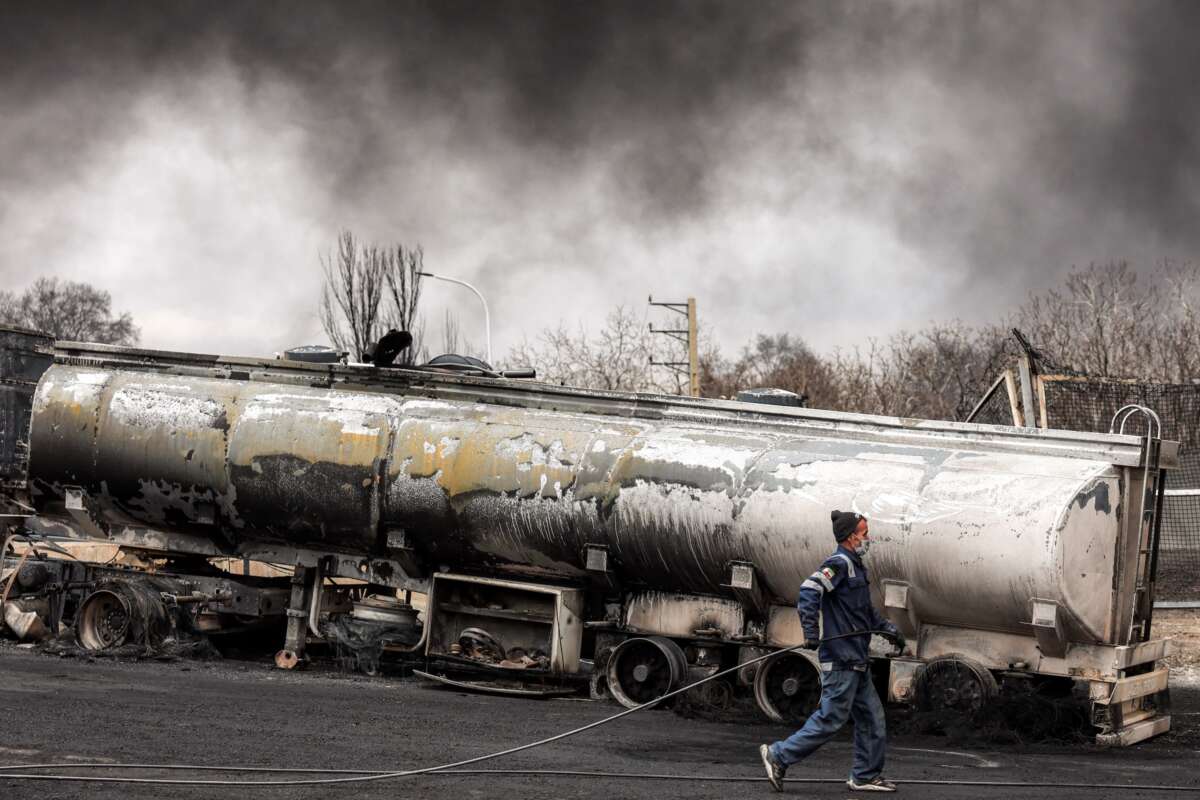
The second largest contributor was the attacks on oil facilities by Israeli and Iranian forces in areas across Iran and the Middle East, as well as strikes on tankers in the Strait of Hormuz, amounting to 1.9 million tonnes of carbon dioxide emissions.
The remaining emissions came from fuel used by military warships, fighter jets, and support vessels and vehicles; the loss of equipment like the U.S.’s and Iran’s downed aircraft, lost naval vessels, and destroyed missile launchers; and the intensive use of drone and missile attacks.
“The carbon costs of the war will continue to rise dramatically as it drags on,” the Climate and Community Institute researchers wrote.
“However, the most significant climate impact of the attack on Iran will not be the emissions of the conflict itself, but from its aftermath,” they went on. “As the US continues to press on in its ill-conceived quest for ‘energy dominance,’ fossil fuel production will be expanded in the name of energy security, locking in emissions from extraction infrastructure for decades.”
Wars and military activity have long been some of the worst contributors to the climate crisis. Researchers for Brown University’s Costs of War found in 2019 that, if the U.S. military were a country, it would rank as the 55th worst polluter globally. Israel’s 12-day war last June left environmental and climate impacts that will last decades, experts said.
The environmental impact on Iranians is already immense. Israel’s attack on Iranian oil facilities earlier this month caused a massive black cloud to blanket Tehran, leading to toxic rain and atmospheric effects that may cause health effects like cancer for decades to come.
But the climate emissions from the war, which has no end in sight, will affect the entire world.
The report comes as the U.S. goes through a record heat wave, with eight states setting an all-time high heat record in March. The heat wave would have been “virtually impossible” without changes caused by the climate crisis, research group World Weather Attribution said. More heat may be yet to come, as weather and climate experts predict an extremely strong El Niño this year, which typically means hotter temperatures across the globe.
An urgent appeal for your support: 72 Hours to raise $24,000
Truthout relies on individual donations to publish independent journalism, free from political and corporate influence. In fact, we’re almost entirely funded by readers like you.
Unfortunately, donations are down. At a moment when independent journalism is urgently needed, we are struggling to meet our operational costs due to increasing political censorship.
Truthout may end this month in the red without additional help, so we’ve launched a fundraiser. We have 72 hours to hit our $24,000 goal. Please make a tax-deductible one-time or monthly donation if you can.