Part of the Series
Walking the Walk
Did you know that Truthout is a nonprofit and independently funded by readers like you? If you value what we do, please support our work with a donation.
An interview with Ilana Berger and Tracy Van Slyke of The New Bottom Line.
As a still-recent addition to the organizing scene, The New Bottom Line is hardly more than a year old. Yet, in its short life, the network has been at the fore of several high-profile campaigns – including Move Our Money and the 99% Power protests.
The New Bottom Line brings together a number of prominent coalitions, including National People’s Action (NPA), the Alliance for a Just Society (AJS), People Improving Communities through Organizing (a faith-based group known as PICO) and the Right to the City alliance. A range of local community organizing groups also participate in the network.
Together, the groups have a much greater ability to place an economic justice agenda in the national spotlight than does any individual community organization. Moreover, their combined efforts represent a level of coordination among grassroots groups that would have been almost unimaginable just a few decades ago.
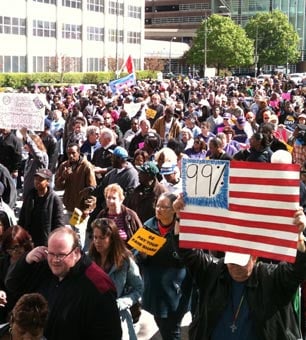
In recent months, the 99% Power actions brought protests to the annual shareholders’ meetings of corporations, including Wells Fargo, Walmart, Bank of America and Chevron. In this and other campaigns, New Bottom Line groups have played an important bridge role by working to connect Occupy activists and established grassroots organizations.
With the 99% Spring ending and a summer of activism beginning, I spoke with New Bottom Line co-directors Ilana Berger and Tracy Van Slyke about what’s next for their network and how their organizing model has evolved over the past year.
I asked first about how The New Bottom Line coordinates the various groups in its network.
Berger responded, “Our structure is really a core set of networks: NPA, AJS (which used to be the Northwest Federation of Community Organizations) and the PICO National Network. Later, the Right to the City Alliance joined. And then there are statewide groups that play a really active role in setting our strategic direction and participate in committees, like ACCE in California. The national organizers of the different networks participate in weekly calls and really drive the work collectively. It’s coordinated by the New Bottom Line staff, but we work as a national staff team with the networks.”
She added, “You do have slightly different cultures and strengths and challenges [among the member groups]. NPA has a really amazing track record of militant, well-organized and strategic direct action. That’s something that they do extremely well. PICO is known for its leadership and organizing in low-income communities. Over the years, the groups have spent a lot of time being invested in how they’re different from each other. But if you ask some random person on the street to distinguish between the networks, the differences are far less significant than the common goals. When you get everybody together in a room, that is really evident. So I think it’s an exciting and powerful thing to engage in collective strategy.”
Van Slyke added, “What’s amazing is that we’re seeing organizations look beyond traditional silos of issues, or turf, or funding, to really figure out how to consolidate power and learn from each other. They want to grow with each other in a brand new way. It’s pretty amazing.”
Agreeing with this, I asked the directors how they account for the increasing level of coordination among progressive groups in recent years.
Van Slyke said: “We’ve seen the power shift for decades to corporate control of our democracy and our economy. Our organizations, even if they grow to two or three times their size, can’t match that power individually. This forces the question of how we combine with other organizations to really start to match corporate power – on the ground, online and in the media.”
Speaking of The New Bottom Line’s formation last year, Berger noted, “I think there was a very sobering acknowledgment on the part of a lot of the networks that, for whatever reasons, people weren’t working together. People were feeling like, ‘We’re doing good work and we’re not getting where we need to get. ‘ If we want to win on the issues that all of us care about – like principal reduction for underwater home owners, capping the rate on payday loans, ending discriminatory lending practices and making the banks pay their fair share – we’re going to have to get over ourselves and work together.”
Given that the organizations involved in The New Bottom Line tend to be very grassroots and oriented toward local issues, I wondered how national coordination worked.
“I personally come out of local organizing,” Berger said. “I believe deeply if you’re going to have a national campaign or alignment, it’s got to be rooted in the work on the ground. You can’t start from the top and just try to move something. You’ve got to be building power for state and local groups as well as building a national agenda.”
“So, from the beginning, we built a steering committee, which is made up of people from each of the statewide groups and the network affiliates. One lesson that we’ve learned over time is that this cannot be an attempt to be overly dogmatic – prescribing one path forward and trying to shove square pegs into round holes. Rather, when New Bottom Line has felt most effective is when we’ve found the strengths of each network and are able to channel them into a collective narrative power.”
Given that the campaigns of New Bottom Line groups – such as efforts to resist foreclosures and to put pressure on big banks – have frequently overlapped with Occupy activism, I asked the directors how they have managed the interaction between established grassroots groups and new social movement formations.
Van Slyke cited the 99% Power protests as a fruitful collaboration: “I see it as a combination of the great Occupy energy that has developed over the last year with the critical grassroots and labor campaigns that were around before that and that continue to go on. It’s also adding in shared demands and shared vision.”
Berger noted that many community organizations were already running campaigns against banks and foreclosures prior to Occupy. “It is a sobering reality that folks have been doing foreclosure organizing for years,” she said, “just slogging through trying to save people’s homes. For a long time it was like, ‘a tree falls in the forest …’ But now all of the sudden, there’s a new interest in the mainstream media. It’s not like this stuff hasn’t been happening since 2008; it’s just that nobody was willing to cover it.”
Prior to the emergence of Occupy, New Bottom Line groups had planned several weeks of rolling actions for the fall, covering different major cities. “People said, ‘this is exciting,'” said Berger. “This is exactly the kind of thing that we hoped a national network would produce.”
“And then Occupy happened. Contrary to whatever controversy has been out there at different times, it felt like a really magical moment of collaboration. Folks on our side pretty quickly realized, ‘This is the spark we were looking for.'”
Berger believes community organizations played an important role in setting the groundwork for a national movement that would stand up for the 99 percent. “It wasn’t pixie dust that started Occupy,” she said. “There was work that had been happening over the last decade that helped build the moment. Clearly the Occupy crew blew it up – in a good way. What resulted was that the weeks of action we had planned were ten times bigger and better. In most, if not all, of the cities, there was strong collaboration between the Occupiers, the community organizations and the unions that were planning the actions. We got thousands more people and much more press than we would have if it had just been us.”
She added, “So much of what’s involved in organizing is moving things so that when the right moment comes we’re able to take advantage of it.” When Occupy hit, she said, “It felt like a rare moment when things happen and we were well situated to ride the wave, or help build the wave. It was a back and forth.”
I asked Berger about the critiques that some Occupy participants make of more established groups – for example, accusations of co-optation.
“I’m happy to have many tendencies in this work. I think we need lots of them,” she said. “I think the argument that we’re part of the Democratic Party is just not right. But, fine. There’s a role for all of us to play in transforming the economy into one that is people-centered and community-centered. A conversation about who’s co-opting whom, to me, just is not particularly useful. It’s more useful to figure out how we employ a wide range of tactics strategically to win.”
Berger argued that, despite some initial resistance, many community organizers have been open to learning from Occupy. “A lot of people [in the community organizing world] at first were freaked out by Occupy. They said, ‘Who are these people? What are they doing? They don’t have demands? We’ve been organizing for years and where were they?’ And I say, ‘Yeah, we’ve been organizing for years and look where we are. So let’s open it up. Let’s bring in some new blood. Let’s open ourselves to looking at different ways of doing things.'”
She cited Occupy Our Homes as a great example of cross-fertilization. “There’s a set of skills that the long-term organizers have that are useful. And there is some vision, creativity, imagination and youth that Occupy folks bring that’s useful,” she said. “With Occupy Our Homes, I saw some amazing collaboration, skill-sharing and relationship-building – all the stuff we need to build a movement.”
I concluded by asking what’s next for The New Bottom Line.
“We are figuring that out right now,” said Berger. “We’ve worked with other organizations to launch the Home Defenders’ League. There are now 16 million underwater homeowners; one in three families that owns a home is underwater [owes more on the home than the home is currently worth]. These homeowners are in many of the critical swing states for the presidential election. The highest rate of underwater homeowners is in Nevada, which is a key swing state. Also Michigan and Florida. We’re going to demonstrate that hundreds of thousands of these people will organize and vote on this issue.”
“As we launch the Home Defenders’ League, there will be 22 different actions in cities around the country. People reaching out to thousands and thousands of underwater homeowners to get them to join the league. It’s phone banks, community canvases and a few actions – but mostly organizing people. There will be a press launch and other actions later on in June.”
She noted that President Obama needs to be pressured on this issue. “Fannie Mae and Freddie Mac own 60 percent of the mortgages in this country. They refuse to do principal reduction. But the president could make that happen. So we’re making this an election issue.”
“There are also some really strong state-based workers’ initiatives. California and Massachusetts have statewide legislation on foreclosures, so we’re focusing in on the state fights and how they lift up the national.”
Finally, Berger said, campaigns such as Move Our Money and the fight against exploitative payday lending will also continue: “It’s about continuing to find the compression points where we can align our groups around the country to do actions at key moments – actions to lift the principles and practical actions that can make up a new economy.”
Press freedom is under attack
As Trump cracks down on political speech, independent media is increasingly necessary.
Truthout produces reporting you won’t see in the mainstream: journalism from the frontlines of global conflict, interviews with grassroots movement leaders, high-quality legal analysis and more.
Our work is possible thanks to reader support. Help Truthout catalyze change and social justice — make a tax-deductible monthly or one-time donation today.