Honest, paywall-free news is rare. Please support our boldly independent journalism with a donation of any size.
On Tuesday, the White House doubled down on Trump’s sexist remark toward a journalist last week, essentially claiming that the reporter had it coming for asking a legitimate question relating to the Epstein files.
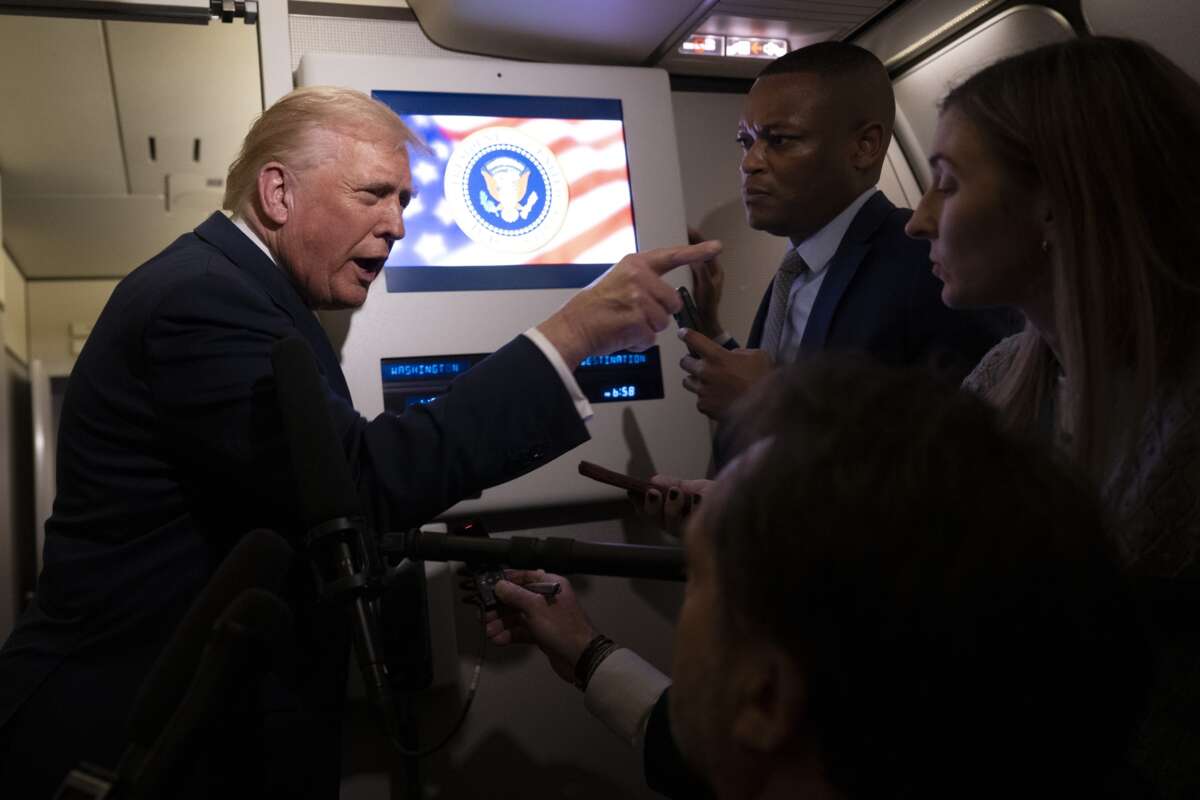
Bloomberg reporter Catherine Lucey was among the press gaggle aboard Air Force One on Friday. In a follow-up question to an earlier query on the Epstein files, Lucey asked Trump why he wouldn’t just release the documents if they didn’t include anything incriminating against him or his allies.
Trump interrupted her line of questioning, pointed his finger sharply at her, and said, “Quiet — quiet, piggy.”
Video of the interaction went viral over the weekend, with many observers condemning Trump’s attack on the journalist as misogynistic. On Tuesday, a White House spokesperson not only defended the president’s actions, but baselessly attacked Lucey once more.
“This reporter behaved in an inappropriate and unprofessional way toward her colleagues on the plane,” the spokesperson claimed. “If you’re going to give it, you have to be able to take.”
Many social media users criticized reporters who were nearby at the time of the incident for failing to condemn the president’s words right then and there, though HuffPost noted that the silence from journalists may have been an “attempt to avoid losing further access” to Trump.
“Our White House journalists perform a vital public service, asking questions without fear or favor,” a spokesperson for Bloomberg said regarding the attack on their reporter. “We remain focused on reporting issues of public interest fairly and accurately.”
This isn’t the only example of Trump lashing out at a female journalist this week — on Tuesday, when ABC News journalist Mary Bruce asked a question in the White House about U.S. intelligence’s conclusion that Saudi Crown Prince Mohammed bin Salman had “orchestrated the brutal murder of a journalist,” referring to former Washington Post columnist Jamal Khashoggi, Trump interrupted her.
“You’re mentioning somebody that was extremely controversial,” Trump claimed. “A lot of people didn’t like that gentleman that you’re talking about. Whether you like him, or didn’t like him, things happen. But [bin Salman] knew nothing about it, and we can leave it at that.”
“You don’t have to embarrass our guest by asking a question like that,” Trump went on.
After Bruce asked another question relating to the Epstein files, Trump again attacked her credibility.
“I think you are a terrible reporter,” Trump said, adding that he didn’t like her “attitude.”
“You ought to go back and learn how to be a reporter. No more questions from you,” he said.
Trump has a long history of berating journalists, at times even indicating to his base that he supports violence against people in media. But observers have noted these attacks tend to be more bitter and personal when the journalist happens to be a woman.
In 2015, during a debate among GOP contenders for president, host Megyn Kelly questioned Trump about his previous attacks on women, to which Trump responded, “What I say is what I say.” In a subsequent interview, he directed his ire toward Kelly, saying he had “zero respect” for her, that she was “highly overrated,” and that she had “blood coming out of her eyes, blood coming out of her, wherever.”
In 2017, New York Times columnist Gail Collins revealed that Trump had sent back copies of her articles he disliked, calling her a “dog and a liar” with “the face of a pig” in one of his missives.
Ava Thompson Greenwell, a professor within Northwestern’s Medill School of Journalism, opined about Trump’s attacks against female journalists during his first term in office.
“What he does is what we would call a micro-assault,” Thompson Greenwell said, referring to a type of microaggression that includes damaging or discriminatory comments based on a person’s identity. “It’s not subtle at all. It’s direct, it’s in your face, it’s a tongue lashing, it’s meant to cause harm.”
In a column this week on Trump’s attack against Lucey, The Atlantic’s Isabel Fattal noted that Trump’s “vitriol against those exercising their First Amendment rights is not limited to women,” but that “his comments to female reporters, however, have another through line: Why can’t you just be silent like a woman should?”
An urgent fundraising appeal: 6 Days to raise $41,000
Truthout is one of only a few platforms for justice-oriented, grassroots journalism. Today, we face an existential threat.
Due to Google’s launch of AI search, we’ve seen a drastic plunge in our site traffic and, as a result, our revenue. We lost 15 percent of our readership overnight. This was a readership we painstakingly built over decades, and it vanished because Google chose corporate greed over a healthy democracy.
We are fundraising right now to meet our basic operating expenses. If you can support Truthout with a one-time or monthly donation, you will make a significant impact on our work. Anything you can do makes a difference — we appreciate your support.