Honest, paywall-free news is rare. Please support our boldly independent journalism with a donation of any size.
President Trump is attempting to relax healthcare rules by fiat after failing repeatedly to pass an Obamacare-rollback law through Congress.
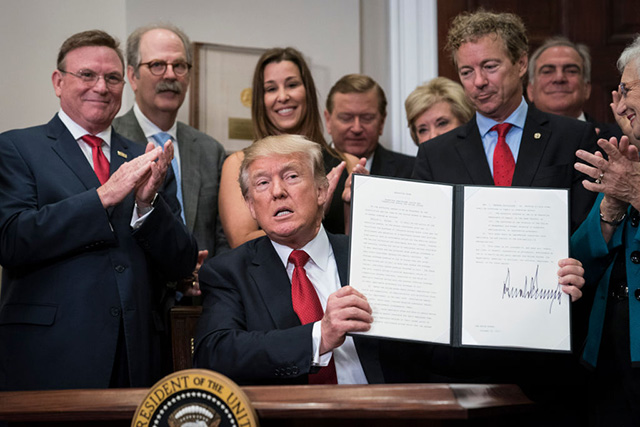
The President signed an executive order on Thursday in an effort to allow the propagation of health insurance plans without key requirements mandated by the Affordable Care Act.
“Every congressional Democrat has blocked the efforts to save Americans from Obamacare along with a very small, frankly, handful of Republicans,” Trump said.
The White House rolled out its decree at a ceremony featuring an introduction from one of those Republicans — Sen. Rand Paul (R-Ky.).
During the Obamacare repeal debate in Congress, the lawmaker made headlines for repeatedly rejecting fellow conservatives’ proposals, claiming they left too many regulations in place.
“When you get Rand Paul on your side, it has to be positive,” Trump joked.
Thursday’s executive order — if upheld by a judge — would allow the sale of plans that don’t include some essential healthcare benefits required by the ACA.
It would also relax rules on the formation of business associations, enabling the purchase of insurance across state lines. The order would also permit more reliance on short-term plans with limited benefits.
Democrats reacted to the decree by calling it “sabotage””sabotage” of the Affordable Care Act. If the order is deemed legal, it could lead to higher premiums for ACA-compliant plans — if fewer people sign up for them.
Public opinion polls have shown a majority of Americans throughout the year preferring Obamacare to Republican alternatives.
Meanwhile, about half the country currently wants to implement a single-payer healthcare system — like the sort proposed by Sen. Bernie Sanders (I-Vt.). About one-third of Americans oppose single-payer.
A recent Republican proposal to change federal healthcare expenditures — by changing them into block grants to states — was only approved by 20 percent of the country, according to a CBS poll. Trump said Thursday that he hoped the reform would eventually be approved by Congress.
“I believe we have the votes to do block grants at a little bit later time,” he remarked.
Sen. Paul praised Trump’s efforts to allow more interstate commerce in insurance markets, calling Thursday’s order the “biggest free market reform of healthcare in a generation.”
Cross-state deregulation also occurred in another financial industry, in recent decades — in banking, starting in the early 1980s.
Since the move to allow inter-state banking and since the implementation of other free market reforms, the US has played host to three major financial catastrophes — the Savings and Loan Crisis, the Dotcom Bubble, and the Subprime Mortgage Meltdown.
Press freedom is under attack
As Trump cracks down on political speech, independent media is increasingly necessary.
Truthout produces reporting you won’t see in the mainstream: journalism from the frontlines of global conflict, interviews with grassroots movement leaders, high-quality legal analysis and more.
Our work is possible thanks to reader support. Help Truthout catalyze change and social justice — make a tax-deductible monthly or one-time donation today.