Honest, paywall-free news is rare. Please support our boldly independent journalism with a donation of any size.
Research shows that government subsidies for the 1 percent are creating greater inequality. A new white paper by Roosevelt Institute Chief Economist Joseph Stiglitz offers solutions.
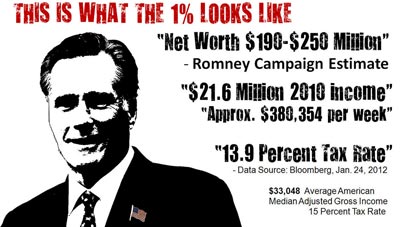
“What’s the effective rate I’ve been paying? It’s probably closer to the 15 percent rate than anything.” Mitt Romney made national news with that statement during the 2012 presidential election, since it meant he paid a lower effective tax rate than many middle-class Americans. The simple reason for his low tax bill? The tax code’s special treatment of investment income.
In a recent report published by the Center for American Progress, I examine how government subsidies for investment income are making economic inequality worse. The merits of subsidizing investment income are particularly questionable in light of new research published by renowned French economist Thomas Piketty in Capital in the Twenty-First Century. Piketty finds that economic inequality has increased dramatically in recent decades, and will get even worse as the rate of return on capital from investments largely owned by the wealthy exceeds the overall growth rate of the economy.
Nobel-winning economist Joseph Stiglitz, Chief Economist at the Roosevelt Institute, takes a hard look at subsidies for investment income in a new white paper on tax reform. Stiglitz advocates taxing capital gains and dividends at the same rates as ordinary income. Under current law, the federal government will deliver an estimated $1.34 trillion in subsidies to investors over the next 10 years in the form of reduced tax rates for capital gains and dividends. Sixty-eight percent of that money will go to the top 1 percent. Stiglitz argues that there is “no justification for taxing those who work hard to earn a living at a higher rate than those who derive their income from speculation.”
Stiglitz would also eliminate an expensive, but little-known, provision called “step-up in basis,” which subsidizes inherited wealth. By taking a step-up in basis, heirs selling inherited assets only have to pay taxes on the capital gain that took place since they received the asset – gains that accrued during the previous owner’s lifetime are never subject to income taxes. This tax break will cost about $644 billion over 10 years, with 21 percent of that subsidy going to the top 1 percent. For the wealthiest families, the benefits are staggering: 55 percent of the wealth in estates worth over $100 million is in the form of unrealized capital gains, meaning that these families will never pay income taxes on the majority of their earnings since the heirs will benefit from step-up in basis.
Defenders of tax breaks for investment income argue that these subsidies encourage savings and grow the economy, but over the past 60 years there has been no obvious relationship between economic growth and the top capital gains tax rate. Our economic problems are rooted in a lack of aggregate demand, but tax subsidies for investment income reduce demand even further for two reasons. First, they encourage investors to hold onto their wealth and consume less. Second, these subsidies increase economic inequality by primarily benefiting the rich, who tend to consume a much smaller share of their income than poor or middle-class individuals.
The assumption underlying subsidies for investment income is that wealthy investors are “job creators,” but Stiglitz points out that “much of the income of the top arises from rent seeking (wealth appropriation) – and thus impedes growth and efficiency.” Stiglitz is using the term “rent seeking” in a broad sense to mean income from ownership, monopolies, or special treatment from the government. Rent seeking does not grow the economy; it only redistributes wealth from within the economy to rent seekers. For example, landowners get their income from rents paid by tenants. Stiglitz points out that land is an ideal target for taxation, since taxes cannot possibly reduce the supply of land. Yet the United States is taking the opposite approach by allowing landowners to fully benefit from step-up in basis and reduced tax rates for capital gains.
Tax breaks for investment income are massive in scope, but often overlooked in discussions about the proper size and role of the federal government. These subsidies are part of what Suzanne Mettler calls the “submerged state,” government programs that deliver benefits indirectly, with recipients often not even recognizing that they are benefitting from public assistance.
But government programs administered through the tax code are still government programs. It makes no meaningful difference to the government or to beneficiaries whether a subsidy is delivered in the form of a check from the government, or as a reduction in taxes the beneficiary would otherwise owe (which often takes the form of a higher tax refund check from the government). The nonpartisan Joint Committee on Taxation explains that tax breaks “are similar to direct spending programs that function as entitlements to those who meet the established statutory criteria.”
The reaction Mitt Romney’s comments may be the best example of just how invisible government subsidies for investment income are for most Americans. Watching Romney deliver the full statement and explain that most of his income comes from investments, it was clear that he did not think he was making news. And he was right – Romney’s statement that day should not have been news. We already knew that he made most of his money from earlier investments, and the tax rate at the time on capital gains and dividends was 15 percent. The only reason Romney’s statement made headlines was that most Americans were either unaware of preferential tax rates for investment income, or did not realize the staggering benefits this subsidy delivers to extremely wealthy individuals.
It is no coincidence that government subsidies for investment income are delivered through the submerged state. These programs are not popular when the American people can clearly see their impact, and they add to the sense that the economic game is rigged for those at the top.
An urgent fundraising appeal: 72 Hours to raise $31,000
Truthout is one of only a few platforms for justice-oriented, grassroots journalism. Today, we face an existential threat.
Due to Google’s launch of AI search, we’ve seen a drastic plunge in our site traffic and, as a result, our revenue. We lost 15 percent of our readership overnight. This was a readership we painstakingly built over decades, and it vanished because Google chose corporate greed over a healthy democracy.
We are fundraising right now to meet our basic operating expenses. If you can support Truthout with a one-time or monthly donation, you will make a significant impact on our work. Anything you can do makes a difference — we appreciate your support.