Truthout is a vital news source and a living history of political struggle. If you think our work is valuable, support us with a donation of any size.
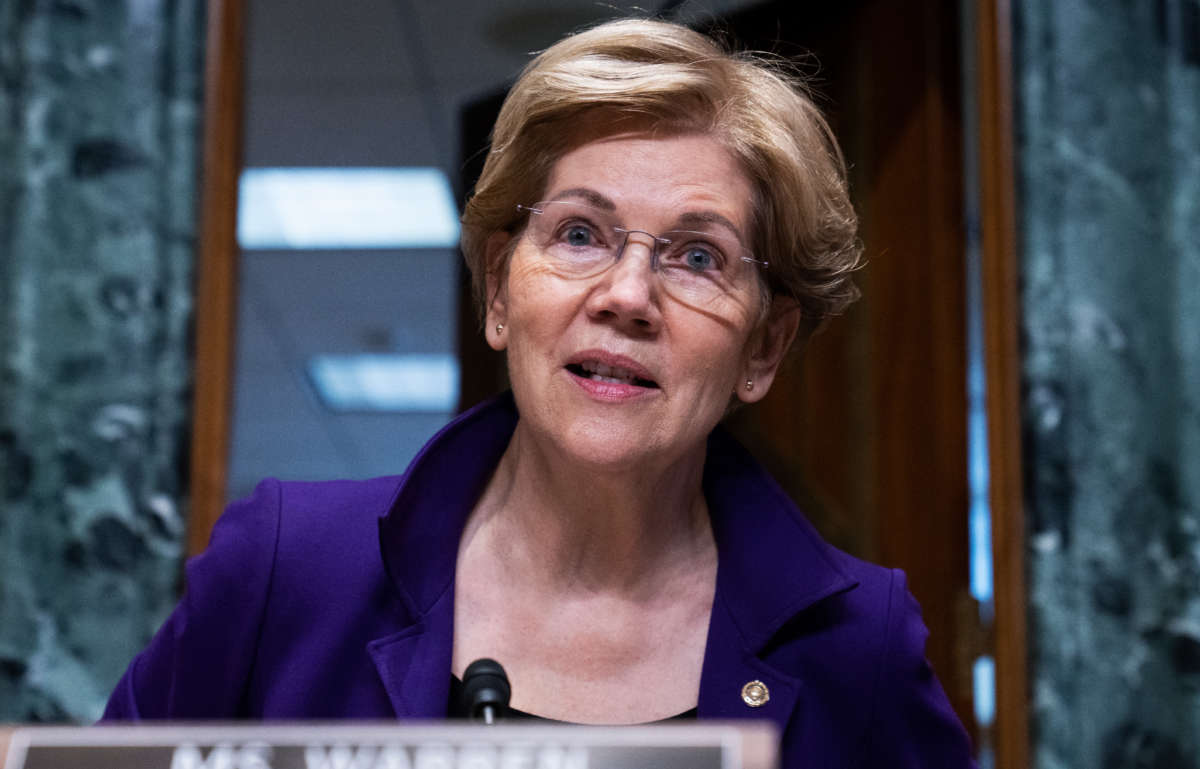
As corporations blame inflation for steadily rising prices as the pandemic continues to rock the economy, Sen. Elizabeth Warren (D-Massachusetts) is calling out big grocers for charging customers more while padding executives’ pockets.
Warren sent a letter to CEOs of big grocery chains on Monday detailing her concern over rising prices and questioning whether or not the companies are taking steps to protect consumers rather than trying to fleece them to increase their profit margins.
Though these companies have reported profits that have increased precipitously in recent months, “it appears that rather than defraying costs for consumers or providing hazard pay to essential frontline workers, these profits have gone directly into the pockets of executives and shareholders,” Warren wrote. The letters were sent to CEOs of Kroger, the largest grocery chain in the country, Publix and Albertsons, all of which have reported high profits in comparison to pre-pandemic levels.
As the lawmaker points out in her letter, these large grocers seem to revel in their current ability to take advantage of consumers. Experts say that stores are purposely raising prices higher than the cost of inflation to increase profit margins. “A little bit of inflation is always good in our business,” Kroger CEO Rodney McMullen said in a call with investors in June.
“Although the producer price index released earlier this week did show a rise in wholesale prices, this is clearly not the whole picture,” Warren wrote in her letter. “Behind the scenes, grocery chains have reassured investors that only consumers would be hurt.” She lists a series of questions for the corporations to answer by January 7, asking them to detail price changes for each department, profits made during the pandemic and worker pay policies.
Grocery bills for consumers have increased by over 6 percent over the past year, according to Consumer Price Index data, squeezing families for extra cash as they struggle with economic hardships. According to Census Bureau data, nearly 20 million adults in the U.S. live in households that are struggling to get enough to eat as of October.
Meanwhile, Kroger made $2.6 billion in 2020, up 5.6 percent from 2019, and their adjusted earnings as of the third quarter of this year are up 9.9 percent over the same period last year. Albertsons tripled its net income from 2019 to $1.89 billion in 2020. And Publix increased its net earnings for the third quarter by 13.9 percent over last year.
“Large grocers are blaming high food costs on inflation, but it’s time to talk about how they’re using every opportunity to rake in profits, reward executives and big shareholders while driving up prices even more,” Warren said in a statement.
“These companies made record profits during the pandemic and when faced with the choice to retain lower prices for consumers, and properly protect and compensate their workers, they greedily granted massive payouts to top executives and investors,” she continued. “They need to answer for these actions.”
The disparity between executive and worker pay has been especially stark at Kroger, where CEO McMullen’s compensation package jumped by over 45 percent to a total of $20.6 million in 2020. But, as McMullen enjoyed his extra $6.4 million, typical worker pay at Kroger dropped by 8.1 percent, with median pay dropping by over $2,000.
These same workers suffered through dangerous conditions as they worked frontline jobs during the pandemic. As the company hailed its grocery workers as “heroes,” it cut hazard pay early in the pandemic while pursuing over $1 billion in stock buybacks in 2020.
Some of the large grocers’ price raises have caused potential legal concerns. Consumers have filed a lawsuit in Texas, for instance, against Kroger, Albertsons, and other grocers for allegedly price gouging early in the pandemic, nearly tripling the price of eggs.
Important Message: Please Read
For 25 years, Truthout has survived by publishing impactful investigative journalism and analysis; distributing full editions 365 days a year; and building a community of readers who support us with small, hard-earned donations.
Eighty percent of our $3 million yearly budget comes from small donors alone. Of those, 8,000 readers support us with monthly donations. Back in 2018, when Facebook decided to suppress the circulation of posts made by organizations, thereby cutting readers off from seeing many articles shared by the news organizations they had intentionally decided to follow, Truthout’s total traffic declined by 40 percent, as nearly all of our traffic from that platform disappeared.
Now, Google has recently rolled out its AI search bar, providing AI summaries instead of directing readers to our site. Google Search is our single largest source of traffic; it’s the route by which nearly one third of our readers find us. Much like in 2018, a shocking 40 percent of our Google traffic has disappeared overnight.
It will not be easy for Truthout to shoulder this blow. Nor will it be easy for our peers and collaborators — news sites that depend on traffic and aren’t bankrolled by large corporations.
If you can support Truthout with a donation today, you can help us resist the AI onslaught. Please give today.