Truthout is a vital news source and a living history of political struggle. If you think our work is valuable, support us with a donation of any size.
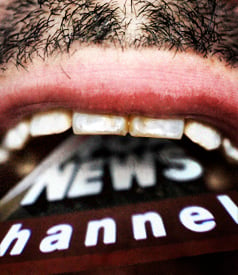
Washington – The TV anchorwoman was conducting a split screen interview with a journalist who had volunteered to be a witness at the execution of a man on death row in Utah for 25 years. “He had a choice,” said the journalist, “lethal injection or firing squad.” “Wow!” said the anchorwoman. Cue a blizzard of commercials for fast food, teeth whitener, stomach stapling, the new Cadillac. This was followed by the war in Afghanistan presented by a correspondent sweating in a flak jacket. “Hey, it’s hot,” he said on the split screen. “Take care,” said the anchorwoman. Coming up, was a reality show in which the camera watched a man serving solitary confinement in a prison’s “hell hole.”
The next morning I arrived at the Pentagon for an interview with one of President Obama’s senior war-making officials. There was a long walk along shiny corridors hung with pictures of generals and admirals festooned in ribbons. The interview room was purpose built. It was blue and arctic cold, windowless and featureless except for a flag and two chairs: props to create the illusion of a place of authority. The last time I was in a room like this in the Pentagon, a colonel called Hum stopped my interview with another war-making official when I asked why so many innocent civilians were being killed in Iraq and Afghanistan. Then it was in the thousands; now it is more than a million. “Stop tape!” he ordered.
This time, there was no Colonel Hum, merely a polite dismissal of soldiers’ testimony that it was a “common occurrence” that troops were ordered to “kill every mother fucker.” The Pentagon, says The Associated Press, spends $4.7 billion on public relations: that is, winning the hearts and minds not of recalcitrant Afghan tribesmen, but of Americans. This is known as “information dominance” and PR people are “information warriors.”
American imperial power flows through a media culture to which the word imperial is anathema. To broach it is heresy. Colonial campaigns are really “wars of perception,” wrote the present commander, Gen. David Petraeus, in which the media popularizes the terms and conditions. “Narrative” is the accredited word because it is post-modern and bereft of context and truth. The narrative of Iraq is that the war is won; and the narrative of Afghanistan is that it is a “good war.” That neither is true is beside the point. They promote a “grand narrative” of a constant threat and the need for permanent war. “We are living in a world of cascading and intertwined threats,” wrote the celebrated New York Times columnist Thomas Friedman, “that have the potential to turn our country upside down at any moment.”
Friedman supports an attack on Iran, whose independence is intolerable. This is the psychopathic vanity of great power which Martin Luther King described as “the greatest purveyor of violence in the world.” He was then shot dead.
The psychopathic is applauded across popular, corporate culture, from the TV death watch of a man choosing a firing squad over lethal injection to the Oscar-winning “Hurt Locker” and a new, acclaimed war documentary “Restrepo.” Directors of both films deny and dignify the violence of invasion as “apolitical.” And, yet, behind the cartoon facade is serious purpose. The US is engaged militarily in 75 countries. There are some 900 US military bases across the world, many at the gateways to the sources of fossil fuels.
But there is a problem. Most Americans are opposed to these wars and to the billions of dollars spent on them. That their brainwashing so often fails is America’s greatest virtue. This is frequently due to courageous mavericks, especially those who emerge from the centrifuge of power. In 1971, military analyst Daniel Ellsberg leaked documents known as the Pentagon Papers, which put the lie to almost everything two presidents had claimed about Vietnam. Many of these insiders are not even renegades. I have a section in my address book filled with the names of former officers of the CIA who have spoken out. They have no equivalent in Britain.
In 1993, C. Philip Liechty, the CIA operations officer in Jakarta at the time of Indonesia’s murderous invasion of East Timor, described to me how President Gerald Ford and Secretary of State Henry Kissinger had given the dictator Suharto ” a green light,” and secretly supplied the arms and logistics he needed. As the first reports of massacres arrived at his desk, he began to turn. “It was wrong,” he said. “I felt badly.”
Melvin Goodman is now a scholar at Johns Hopkins University in Washington. He was in the CIA more than 40 years and rose to be a senior Soviet analyst. When we met the other day, he described the conduct of the cold war as a series of gross exaggerations of Soviet “aggressiveness” that willfully ignored the intelligence that the Soviets were committed to avoid nuclear war at all costs. Declassified official files on both sides of the Atlantic support this view. “What mattered to the hardliners in Washington,” he said, “was how a perceived threat could be exploited.” The present Secretary of Defense, Robert Gates, as deputy director of the CIA in the 1980s, had constantly hyped the “Soviet menace” and is, says Goodman, doing the same today “on Afghanistan, North Korea and Iran.”
Little has changed. In America, in 1939, W.H. Auden wrote:
As the clever hopes expire
Of a low dishonest decade:
Waves of anger and fear
Circulate over the bright
And darkened lands of the earth,
Obsessing our private lives […]
Out of the mirror they stare,
Imperialism’s face
And the international wrong
Important Message: Please Read
For 25 years, Truthout has survived by publishing impactful investigative journalism and analysis; distributing full editions 365 days a year; and building a community of readers who support us with small, hard-earned donations.
Eighty percent of our $3 million yearly budget comes from small donors alone. Of those, 8,000 readers support us with monthly donations. Back in 2018, when Facebook decided to suppress the circulation of posts made by organizations, thereby cutting readers off from seeing many articles shared by the news organizations they had intentionally decided to follow, Truthout’s total traffic declined by 40 percent, as nearly all of our traffic from that platform disappeared.
Now, Google has recently rolled out its AI search bar, providing AI summaries instead of directing readers to our site. Google Search is our single largest source of traffic; it’s the route by which nearly one third of our readers find us. Much like in 2018, a shocking 40 percent of our Google traffic has disappeared overnight.
It will not be easy for Truthout to shoulder this blow. Nor will it be easy for our peers and collaborators — news sites that depend on traffic and aren’t bankrolled by large corporations.
If you can support Truthout with a donation today, you can help us resist the AI onslaught. Please give today.