Honest, paywall-free news is rare. Please support our boldly independent journalism with a donation of any size.
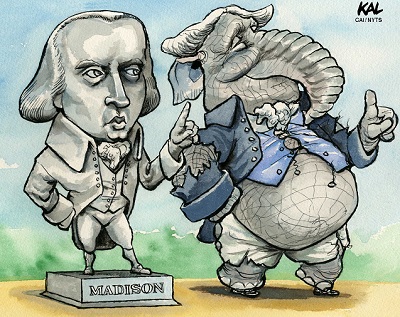
In a cover story for The New York Times Magazine, the writer Sam Tanenhaus recently asked, “Can the G.O.P. Be a Party of Ideas?”
Why, no. This is another edition of simple answers to simple questions.
More specifically, the “reform conservatives” Mr. Tanenhaus wrote about seem mainly to be offering supposedly new ideas for the sake of being seen to offer new ideas.
And there isn’t much there; can you find anything in the article that sounds like an important new idea rather than a minor tweak on the current conservative catechism? I can’t.
But then, the whole notion that new ideas are what politics is about is greatly overrated. Governing isn’t like selling smartphones; the underlying shape of the problems you have to confront changes quite slowly, and the basics of policy debate are quite stable.
In particular, the central policy debate in American politics hasn’t changed in decades, nor should it. Liberals want a strong social safety net, financed with relatively high taxes, especially on high incomes. Conservatives want much less of a safety net, and much lower taxes on the affluent.
Thirty-five years ago conservatives did produce a new argument – the claim that high taxes and generous benefits were producing such a drag on the economy that even lower-income Americans would be better off if we slashed all of that.
And they got most of what they wanted – much lower taxes on top incomes and an end to welfare as we knew it, though not to the big middle-class programs.
But growth failed to take off while inequality soared, so that the incomes of typical families grew much more slowly after the conservative revolution than before.
So much for that big idea.
Is there anything like that on the horizon? No – and it’s not clear why you should expect anything of the kind. What’s certain is that tweaking policy at the edges isn’t going to do much.
And I suspect that at some level the reform conservatives know this. I’d argue that the point of their proposed tweaks is less to achieve results than to let the G.O.P. dissociate itself from soaring inequality and stagnating incomes, without changing its fundamental policy stance.
And that’s not a trick that’s likely to work.
The Meme Is Out There
I recently answered some questions for Princeton magazine, and among them was this: “Please comment on how artificially low interest rates have impacted the current value of baby boomers’ retirement portfolios and should this be a consideration of the Federal Reserve?”
I don’t blame the editor, who after all isn’t supposed to be an economist. But this must reflect what people are hearing on the financial news; I’m pretty sure that a lot of people think that all the experts regard interest rates as “artificially low,” and have no idea that to the extent that such a notion makes any sense at all, interest rates are too high, not too low.
25 Years of Truthout: An important fundraising appeal
This September, Truthout is celebrating 25 years of publication. For over two decades, we have been a trusted source for fiercely independent journalism thanks to readers like you.
Looking to the next 25 years, we launched a special fundraising campaign. We still need to raise $16,000.
We are asking for your support at this juncture because we face greater threats than ever before in our organizational history. Trump and his MAGA allies are determined to control the information ecosystem, and movement-based organizations are subject to dangerous censorship and scrutiny.
If you can support Truthout with a one-time or monthly donation, you will make a significant impact on our work and our legacy. Anything you can do makes a difference!