Did you know that Truthout is a nonprofit and independently funded by readers like you? If you value what we do, please support our work with a donation.
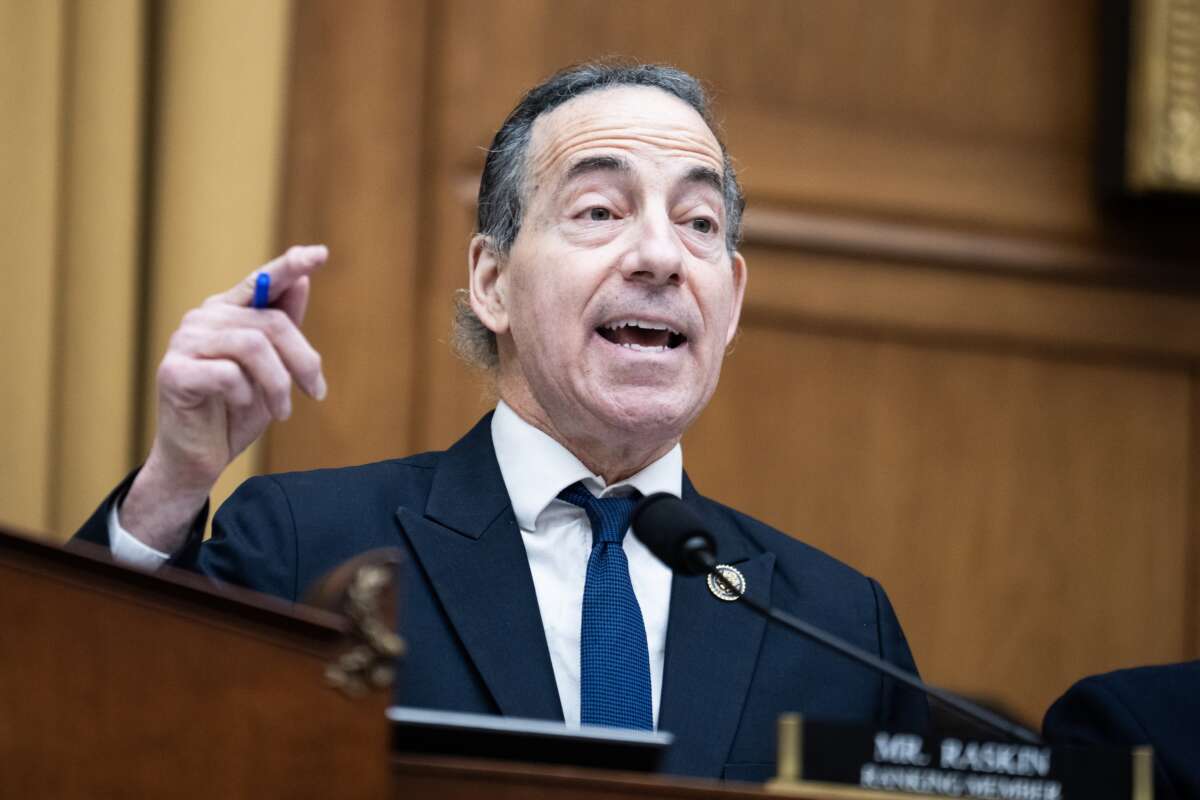
President Donald Trump has repeatedly claimed that he had “nothing to do with” Jeffrey Epstein. But his name reportedly appears in the unredacted files at least a million times, Rep. Jamie Raskin (D-Maryland) said on Tuesday after being granted access to the documents.
Raskin told Axios that he searched Trump’s name in the files on Monday, and it came up “more than a million times.”
This is a clear contradiction to what Trump has claimed about his involvement with the child sex trafficker.
Raskin has also told the press that he has found direct evidence undermining Trump’s claim that he barred Epstein from staying at his Mar-a-Lago club in Florida. Trump has maintained that he banned Epstein from Mar-a-Lago when he was continually poaching staff from the spa, including 16-year-old Virginia Giuffre, and exposing himself to employees.
However, Raskin said that there is a document within the files saying that Trump never banned him, according to a 2009 email exchange between Epstein and Ghislaine Maxwell. In the conversation, Epstein told Maxwell of a conversation he had with his lawyer, who spoke with Trump.
“Trump is paraphrased and quoted as saying, ‘No, Jeffrey Epstein was not a member of Mar-a-Lago, but he was a guest at Mar-a-Lago, and no, we never asked him to leave,’” Raskin said of the exchange to Axios.
Raskin’s findings are a drastic departure from previous reports finding that there are 38,000 mentions of Trump, his wife, or Mar-a-Lago in the redacted files that were released by the Trump administration at the end of January.
MS NOW reporter Matt Fuller noted that, if Raskin’s search was accurate, then it means that “the Department of Justice redacted more than 96% of the mentions of Trump.”
Raskin has accused the Trump administration of carrying out a “cover up” in regard to the files, and has said that he and other lawmakers found “tons of completely unnecessary redactions, in addition to the failure to redact the names of victims” when they reviewed the unredacted files.
“The DOJ is giving Members of Congress just four computers in a satellite office to read the unredacted Epstein File of more than 3 million documents. Working 40 hours a week on nothing else but this, it would take more than seven years for the 217 Members who signed the House discharge petition to read just the documents they’ve decided to release (and there are 3 million still being withheld),” said Raskin in a post on X.
“This is what a cover up looks like,” Raskin said.
The White House has been on the defense. On Monday, Deputy Attorney General Todd Blanche asserted over multiple posts on X that “DOJ is hiding nothing” and it is “committed to transparency.”
This, of course, ignores the fact that the Trump administration has redacted huge swaths of the documents, with officials actually removing some redactions after Raskin and Representatives Ro Khanna (D-California) and Thomas Massie’s (R-Kentucky) outcry on Tuesday.
On the House floor on Tuesday, Khanna named six men whose names he said were redacted from the official release of the files after he and Massie reviewed the unredacted documents at the DOJ for two hours on Tuesday. Those people were Les Wexner, a prolific Ohio billionaire, Sultan Ahmed bin Sulayem, an influential Emirati businessman, and four others whose identities are still relatively unknown: Nicola Caputo, Salvatore Nuara, Zurab Mikeladze and Leonic Leonov.
Press freedom is under attack
As Trump cracks down on political speech, independent media is increasingly necessary.
Truthout produces reporting you won’t see in the mainstream: journalism from the frontlines of global conflict, interviews with grassroots movement leaders, high-quality legal analysis and more.
Our work is possible thanks to reader support. Help Truthout catalyze change and social justice — make a tax-deductible monthly or one-time donation today.