
Did you know that Truthout is a nonprofit and independently funded by readers like you? If you value what we do, please support our work with a donation.
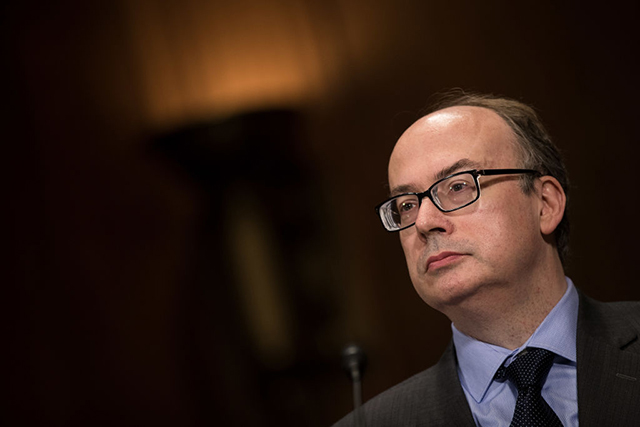 Jeffrey Bossert Clark, nominee to be an assistant attorney general, Environment and Natural Resources Division, looks on during a Senate Judiciary Committee nomination hearing concerning judicial nominations, on Capitol Hill, June 28, 2017, in Washington, DC. (Photo: Drew Angerer / Getty Images)
With all eyes on Donald Trump’s fixation on the Justice Department Russia probe, the administration looks set to put a fossil fuel industry loyalist at the head of the agency’s environmental protection division.
Jeffrey Clark, a longtime lawyer for energy companies and an environmental prosecutor under the George W. Bush administration, will be considered for the job next week by the Senate Judiciary Committee.
The selection to lead the Environment and Natural Resources Division saw his nomination delayed on Thursday by Democrats on the panel. The lawmakers exercised their right to “holdover” considerations of executive nominees.
Sen. Sheldon Whitehouse (D-R.I.) hit out at Clark, noting that the Republican has not ruled out the possibility of presiding over cases that involve a controversial former client: BP.
“For years, Jeffrey Clark defended BP, and has refused to commit to recusing himself from cases involving this constant former client,” Whitehouse said on Thursday.
According to a committee questionnaire, Clark said he would consult with the Justice Department’s ethics office “and will recuse myself from any matter in which it is required.”
The form also noted that Clark has represented BP in litigation arising from the 2010 Deepwater Horizon catastrophe, and that this work “has continued to the present time.”
Clark has also worked for the Chamber of Commerce, which Whitehouse described as a “constant mouthpiece of the fossil fuel industry.” On Tuesday, the House passed legislation, backed by the Chamber, which would weaken Clean Air Act rules on ozone emissions.
Whitehouse also hit out at Clark’s views on pollution, saying the lawyer has questioned climate science, and that “he has repeatedly refused to give a straight answer as to whether he believes [carbon dioxide] emissions are a negative externality of burning fossil fuel.”
“These were softballs,” Whitehouse said. “He completely whiffed.”
On Thursday, the Senate Judiciary Committee was mostly occupied with another nomination. Christopher Wray, Trump’s choice to replace James Comey as head of the FBI, was approved unanimously by the committee.
Democrats decided to waive their right to holdover the Wray nomination, praising him for vowing to operate independently of the White House.
The Democratic senators advanced Wray, despite the fact that many also expressed horror about a Wednesday interview Trump gave to The New York Times.
In the interview, the President said he “would have picked somebody else,” had he known beforehand that Attorney General Jeff Sessions would recuse himself from the Russia investigation.
“We are on the footsteps — or doorstep, I should say — of a Constitutional crisis,” Sen. Dick Durbin (D-Ill.) said.
“He will not be party to that,” Durbin said, referring to Wray’s confirmation hearing promises to refuse to obstruct justice. “He would rather resign.”
If you like what you’re reading, please support Truthout with a tax-deductible donation.
25 Years of Truthout: An important fundraising appeal
This September, Truthout is celebrating 25 years of publication. For over two decades, we have been a trusted source for fiercely independent journalism thanks to readers like you.
Looking to the next 25 years, we launched a special fundraising campaign. We still need to raise $16,000.
We are asking for your support at this juncture because we face greater threats than ever before in our organizational history. Trump and his MAGA allies are determined to control the information ecosystem, and movement-based organizations are subject to dangerous censorship and scrutiny.
If you can support Truthout with a one-time or monthly donation, you will make a significant impact on our work and our legacy. Anything you can do makes a difference!