Truthout is an indispensable resource for activists, movement leaders and workers everywhere. Please make this work possible with a quick donation.
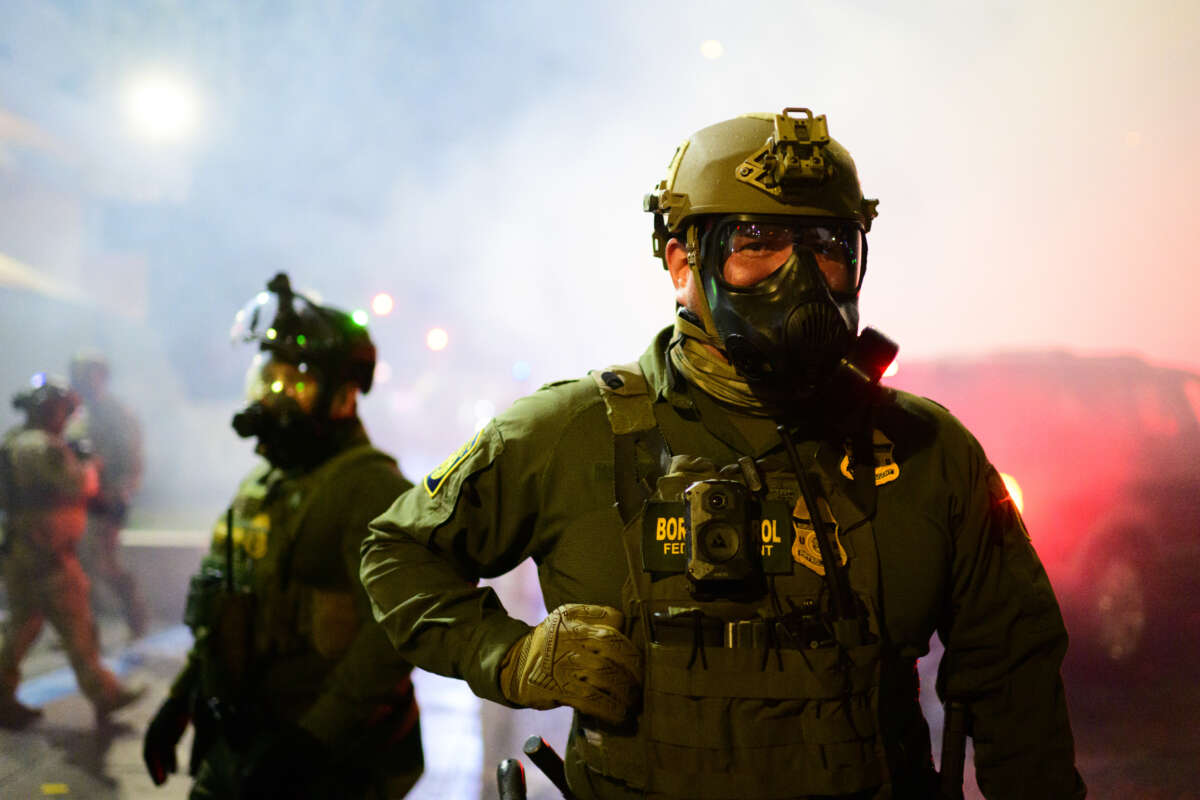
Recently, heavily armed and masked SWAT-like Immigration and Customs Enforcement (ICE) agents rolled up at a Chicago-area elementary school as classes ended for the day. Their target? A mom picking up her child. The footage is heart-wrenching: A woman in a pink sweatshirt, struggling frantically, is pressed into the pavement by armed bodies as she screams, “There is no signed warrant,”while members of an army invade her car.
Echoing Obama-era policies as well as those of the previous Trump administration, today’s ICE-perpetrated abductions separate loved ones again, and continue to shock the conscience of the nation.
But here’s an uncomfortable truth: These unforgivable community and family separations didn’t start at the border. Rather, ICE raids are one tip, and kinship and family separation one consequence, of the same carceral iceberg.
Hidden in Plain Sight: Kinship Separation
Whether through Native boarding schools, chattel slavery, mass incarceration, or internment camps, the United States has always used terror tactics to police kinship networks. Families, kinship networks and communities — especially those marked as “undesirable” by race, class, sexuality, ability, or immigration status — are repeatedly torn apart.
One of the most important systems of control and mass separation is hidden in plain sight: the child welfare system. Lurking inside our elementary schools and our hospitals, this system encourages and threatens “helping professionals” to relate more to the cops than to families and communities. It does this by capitalizing on anti-Black biases which conflate poverty with neglect, and then forces people to “report” these biases to the child “protection” system because it is “better to be safe than sorry.” But we are not safe — not our children, not our neighbors, not our parents, caregivers, or our siblings.
Beyond the now-militarized borders in neighborhoods like Chicago; Washington, D.C.; and other cities, children are being ripped from their parent’s arms every day in courtrooms and in the offices of the so-called child welfare system across the U.S.
The family policing system funnels resources and children into state systems which not only fail to protect young people but also nearly guarantee some of the worst life outcomes, including incarceration.
And it’s been happening for centuries.
While more commonly called the child welfare system, organizers and scholars (including those of us with decades of experience pushing back against it) use the term family policing or family regulation to point to the government apparatus that surveils, punishes, and tears apart poor, Black, Indigenous, and immigrant families. As generations of Black feminist organizers have recognized, including Rev. Annie Chambers and the Poor People’s Campaign, the welfare office, like the courtroom, is not safe. The family policing system criminalizes poverty by labeling it “neglect” — a word that can mean anything from missed doctor appointments to a fridge that’s assessed as not adequately stocked — and funds and empowers state agencies to remove children from caregivers without due process, often permanently. A record of being in a drug treatment program five years earlier was used against one parent to take away her children, without even meeting with the caseworker first. Far from offering support, the family policing system targets communities of color, uses allegations of harm to block caregivers from employment, and funnels resources and children into state systems, including group homes and residential centers, which not only fail to protect young people but also nearly guarantee some of the worst life outcomes, including incarceration. This isn’t care — it’s control.
Of course young people need medical care and a full fridge, but it’s no coincidence that those most vulnerable to this surveillance and punishment are the same communities and families already hit hardest by poverty, systemic racism, and other forms of engineered precarity. Comprising 14 percent of the child population in the United States, Black children are almost a quarter of the total population in foster care, and 53 percent of all Black children will experience a child protective services investigation before the age of 18.
ICE agents utilize key tactics honed through the family policing system. Every year, across the U.S., social workers “pound and pound like the police” and enter the homes of approximately 3.5 million children without a warrant, investigating households without cause: Less than 5 percent of the children in these homes have experienced physical or sexual harm.
When officials are pressed, child removal is often justified by invoking possible trafficking and the fear of child sexual harm. As one striking example, in early October 2025 an ICE raid on a south side Chicago apartment complex, complete with Blackhawk helicopters and SWAT teams, caught up citizens and non-residents. Minors were zip-tied with this familiar rationale from the Department of Homeland Security: “For their own safety and to ensure these children were not being trafficked, abused or otherwise exploited, these children were taken into custody until they could be put in the care of a safe guardian or the state.” Not only is state care unsafe and a site of (child) sexual harm, but if protection from sexual violence is pivotal, why not support initiatives and practices with real success, including meaningful and affirming sexual health education or child care and paid family leave?
Organizing for Now and Tomorrow
Our organizing is often immediate and responsive to what is in front of us, and justifiably so: We fight to stop a new prison from being built, or to repeal punitive anti-trans legislation, for example, and these moves may provide some temporary relief and build community.
But issue-, identity-, or place-based organizing are also frameworks forced on us by the state and violent systems. And it is never arbitrary which bodies or families the state tries to tell us do (or do not) merit our care and resources: For Melania Trump, Ukrainian children stolen by Russians are worthy of attention — yet she is radio silent on the young people, citizens and not, who are left alone in cities across the U.S. when their parents are snatched. (Such silence likewise extends to Gaza, which is facing the “largest orphan crisis in modern history.”)
To build long-term sustainable challenges to ICE and to family policing, we must see them as intertwined and part of overlapping punitive forms of the same carceral state.
Yet in our scramble to push back and to defend and support ourselves, we can miss the opportunity to make critical connections in our campaigns and organizing. In addition to the familiar scripts which recognize select white children and families as merit-worthy, attempts to privilege one age group over another are also hardly novel: Consider the Obama-era initiative Deferred Action for Childhood Arrivals, or DACA, which offered a limited protection from deportation to some eligible young people, but absolutely not their parents. Or the near-ubiquity of criminal background checks for adults, supported by a bipartisan consensus, which purport to protect children, while further restricting jobs and criminalizing public spaces for the adults in their lives. Or the expanding criminalization of access to trans-affirming support, books, and medical care for young people, under a familiar guise of “child protection” or “parental rights.” The list of policies, and carceral reform initiatives, that dangle possible life-saving resources to a few while damning others goes on and on.
Access to life-giving resources should not be redlined. We all deserve access to resources, no matter our age or race or ability or migrant status. Criminalization, policing, and censorship have never been effective strategies to build community well-being.
A clear strategy that builds on decades of previous organizing is “both/and”: We can form coalitions to dismantle and challenge a new proposed jail or the expansion of mandated reporting laws, for example, and also not wait to win these campaigns before we also create networks for support and survival. To build long-term sustainable challenges to ICE and to family policing, we must see them as intertwined and part of overlapping punitive forms of the same carceral state.
Resistance Is Everywhere
While the violence in this moment is devastating, so is the resistance. On the streets of Chicago, we are energized to witness hundreds of community members participate in the Whistlemania campaign; this ICE watch of orange whistles alerts and defends people at schools, parks, and community centers. We follow suspected ICE vehicles in our cars, honking wildly. People link arms and block roads to challenge ICE agents when they attempt to move in our streets. Religious vigils continue in front of the immigration prison on the outskirts of Chicago. Through these efforts, and so many more, we try to keep each other safe.
Concurrently, fueled by the grassroots, the movement against family policing is growing. The American Federation of Teachers concludes that family policing system investigations are harmful, and less than 10 percent of all reports are substantiated. The union is pushing, along with other networks, for social workers and educators to move from mandated reporting to mandated supporting: For example, if staff worry that a student is not getting enough food at home, AFT encourages them to develop a non-stigmatizing way to gather information, and if accurate, to then support the caregiver to access material and necessary resources instead of reporting to the family policing system. Mandated supporting for the AFT includes “professional growth on implicit bias,” and additional steps including “make caregivers the first call; consider a consultation that anonymizes the family; and share power with families by ensuring they know their rights.”
Yes, let’s blow our orange whistles in front of our elementary schools and parks when ICE invades — but why not also in blow our whistles in courtrooms, child welfare offices, and prison waiting rooms?
In 2023, Chanetto Rivers won a settlement from New York State after her child was removed when she tested positive for marijuana after giving birth. This was a powerful win; a stronger shift is the campaign to stop this from happening to others advanced by a statewide coalition to end non-consensual drug testing. The Maternal Health, Dignity and Consent Act would require informed consent before drug testing pregnant mothers and newborns in New York state.
In 2025, mothers in Baltimore are organizing the first convening calling for the end of the Cradle to Cage Pipeline, where mothers impacted by the family policing system in Maryland will gather for healing, truth-telling, and action. Meanwhile, numbers continue to swell at the annual Black Mothers March to end family separation, and in June 2025 Ashley Albert helped to inaugurate the annual Stolen Children’s Month.
As our organizing and protests against ICE and the family policing system highlight, we need more than reform. If the U.S. has billions of dollars to investigate caregivers who are living at the margins, and to hire people to be masked ICE agents, then the U.S. has billions of dollars to support people. We need resources diverted from surveillance and punishment to housing, health care, food, and support for communities.
We feel the energy, and the righteous anger of this moment as masked ICE agents roam our neighborhoods and wait outside our elementary schools. And we ask: How can we also channel this energy and commitment to fight criminalization in other spaces? Yes, immediate action is needed, and we are also committed to deepening a movement that recognizes the inter-relationships between these often site- and community-specific struggles and campaigns. Yes, let’s blow our orange whistles in front of our elementary schools and parks when ICE invades — but why not also in blow our whistles in courtrooms, child welfare offices, and prison waiting rooms?
Abductions from elementary schools or worksites or apartment lobbies, the state dollars that flow to new prisons and to border police, the bans that target trans- and Black-affirming young adult books — these are all pieces of the same lethal puzzle. Networks like upEND, Critical Resistance, Movement for Family Power, and so many Study and Struggle networks help us to make these connections, and to link up our analysis and our campaigns.
As we grow our networks, yes, blow the whistle. These whistles are symbols, tools, and protests all in one. When we hear a whistle, we look. We pay attention. We stop the play. The orange whistle is a warning — like a construction vest or a traffic cone. Let every judge and caseworker hear the sound of collective outrage when another community is torn apart for being poor or undocumented, or for not being the nuclear heterosexual and child-full family.
Sound the alarm, and do it so forcefully that the vibrations force the system to crumble. Then all that will be left is us: strong, steadfast, and ready to build something new, together.
25 Years of Truthout: An important fundraising appeal
This September, Truthout is celebrating 25 years of publication. For over two decades, we have been a trusted source for fiercely independent journalism thanks to readers like you.
Looking to the next 25 years, we launched a special fundraising campaign. We still need to raise $16,000.
We are asking for your support at this juncture because we face greater threats than ever before in our organizational history. Trump and his MAGA allies are determined to control the information ecosystem, and movement-based organizations are subject to dangerous censorship and scrutiny.
If you can support Truthout with a one-time or monthly donation, you will make a significant impact on our work and our legacy. Anything you can do makes a difference!