Honest, paywall-free news is rare. Please support our boldly independent journalism with a donation of any size.
If you’ve ever questioned whether our country has an inequality problem, this election should provide all the evidence you need. As billionaires used their financial firepower to throw support their preferred candidates’ way, Americans who’ve been left behind took out their frustrations at the ballot box.
How do we get started on this next chapter in the fight to reverse extreme inequality? With Senate Republicans still short of a filibuster-proof supermajority, next year’s debate over the expiration of the Trump tax cuts could still present one opportunity.
But it’s also likely that any near-term policy progress will have to start at the city and state levels and work its way up to the federal level. Three progressive tax victories from Tuesday are an encouraging sign.
Washington state’s Initiative 2109 was the most important tax-related ballot measure of the year. Hedge fund executive Brian Heywood bankrolled this campaign, hoping to repeal the state’s innovative capital gains tax on high earners.
With 62 percent of votes counted, the rollback proposal went down in a 63-37 landslide.
“This victory shows that advocacy in support of creating a more equitable tax code works,” Melinda Young-Flynn, Communications Director at the Washington State Budget and Policy Center, told Inequality.org.
“So many groups and individuals – including business owners, labor unions, teachers, racial justice advocates, parents, lawmakers, and many more – have worked together for more than a decade to help the public at large in our state make the connection between commonsense progressive taxes and the very real needs of our communities.”
Introduced in 2022, Washington state’s path-breaking policy imposes a 7 percent excise tax on capital gains from the sale of stocks, bonds, and other assets that exceed $250,000 per year (excluding real estate sales). Who makes that much from their financial investments? Fewer than 1 percent of the state’s richest residents.
Prior to the introduction of this tax in 2022, Washington’s wealthy had flourished under a state constitution that prohibits income tax. The capital gains tax does an end-run around that ban and the state supreme court has ruled it constitutional.
In its first two years, the capital gains levy has raised $1.3 billion for investments in child care and early learning, public schools, and school construction.
“The people of Washington have sent a clear message,” says Young-Flynn. “The well-being of kids takes precedence over tax breaks for the ultra-wealthy. All those of us who care about economic justice know it’s well past time to stop giving the ultra-wealthy a special deal in the tax code at the expense of everyone else.”
Washington state voters also beat back an effort to allow employees to opt out of a new payroll tax for long-term care insurance if they waive the benefit of that state-operated program. If this measure had passed, it likely would’ve rendered the insurance program financially unviable. Fortunately, voters rejected the proposal by a 55-45 margin.
In Illinois, voters expressed support for an extra 3 percent tax on income of over $1 million, with revenue going to property tax relief. With 89 percent of votes counted, Illinois voters approved the ballot measure by an 89-11 margin. While this measure is nonbinding, organizers hope this victory will stoke efforts to put a constitutional amendment on the ballot in 2026 to authorize the new tax on the rich.
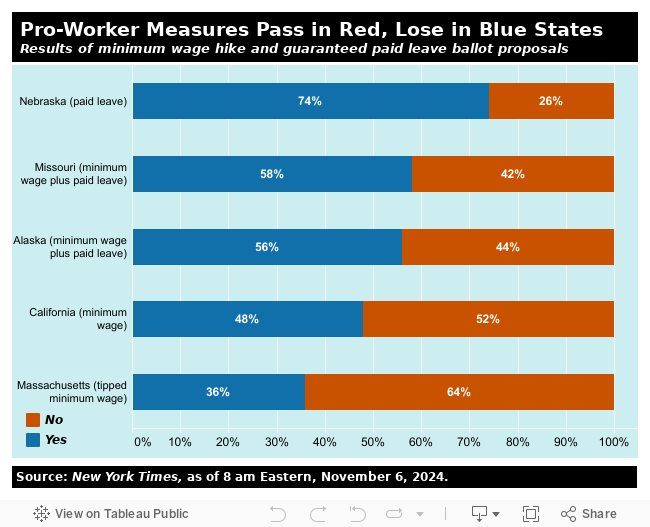
In addition to these fair tax victories, I’m heartened by the passage of pro-worker reforms in several “red” states — in sharp contrast to the positions of their Republican representatives in the U.S. Congress. Voters in Nebraska, Missouri, and Alaska approved guaranteed paid leave and Missouri and Alaska also passed state minimum wage hikes.
A friend just wrote to me with this message: “A tree outside my window is nearly bare. Perhaps it is an image of our national life this morning. We have a choice: to focus on the bare branches or to appreciate the colorful leaves.”
These state victories against the scourge of inequality are some of the colorful leaves I’m appreciating today.
Urgent Appeal for Your Support
Truthout relies on individual donations to publish independent journalism, free from political and corporate influence. In fact, we’re almost entirely funded by readers like you.
Unfortunately, donations are down. At a moment when independent journalism is urgently needed, we are struggling to meet our operational costs due to increasing political censorship.
Truthout may end this month in the red without additional help. We still need to raise $7,000. Please make a tax-deductible one-time or monthly donation if you can.