Truthout is an indispensable resource for activists, movement leaders and workers everywhere. Please make this work possible with a quick donation.
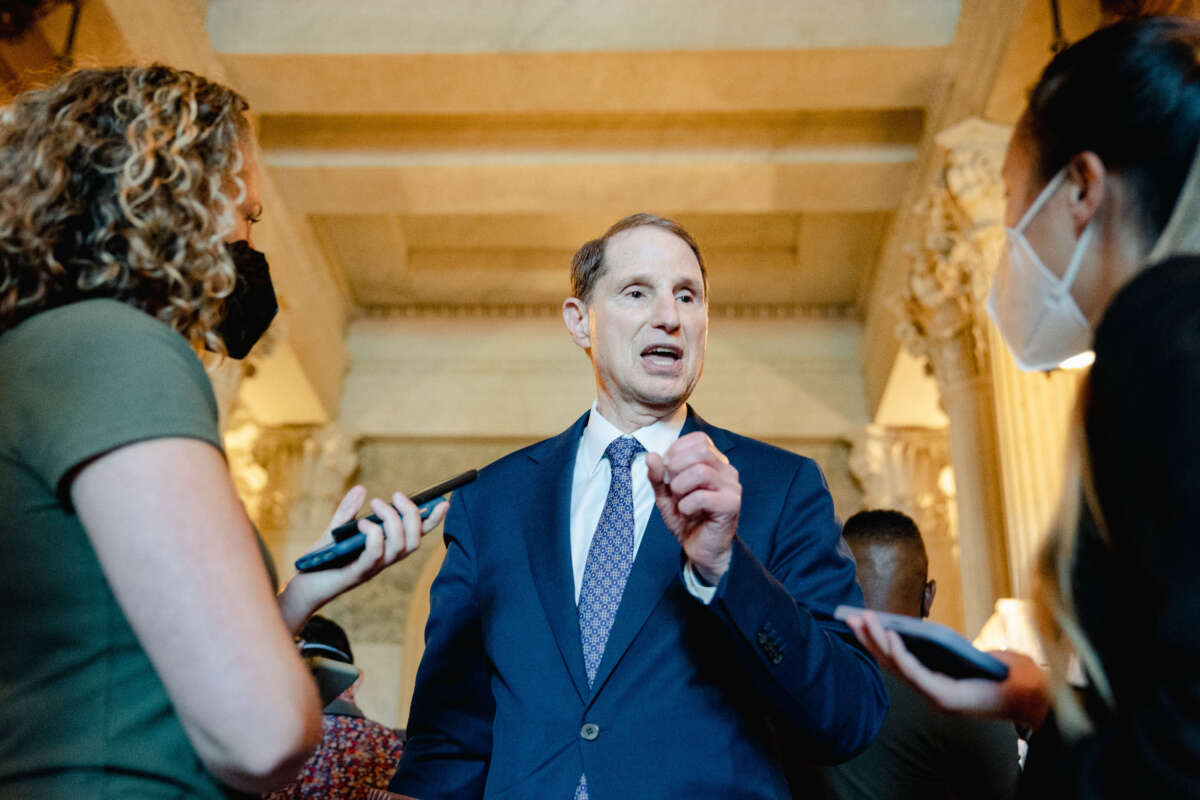
Senate Finance Chair Ron Wyden (D-Oregon) introduced a bill last week aimed at bringing an end to loopholes in the tax code that have, for decades, allowed the wealthiest Americans to avoid paying taxes on a huge portion of their incomes and assets.
The Billionaires Income Tax Act takes aim at a practice known as “buy, borrow, die” by taxing unrealized capital gains, the very heart of the three-step process that is employed by a huge portion of wealthy Americans, including some of the richest people on Earth. The tax would apply only to people with more than $100 million in income each year, or those with over $1 billion in assets for three consecutive years — or just a few hundred of the richest Americans.
“America’s tax code is riddled with loopholes that allow the ultra-wealthy to get away without paying their fair share, while working families have to play by a different set of rules and pay taxes out of each paycheck,” Wyden said in a statement. “You can only have a successful economy if you have a tax code that treats everyone fairly.”
The proposal would place a tax on unrealized capital gains by marking billionaires’ tradable assets like stocks to market each year, meaning that their value would be recorded regardless of whether or not the taxpayer has sold the asset.
This targets the borrowing part of “buy, borrow, die,” in which wealthy Americans buy an asset, borrow against that asset’s growth in order to fund their lifestyles, and then pass their assets onto their children when they die, often entirely tax-free. The practice of “buy, borrow, die” has allowed the tax rates paid by billionaires to plummet; according to data from ProPublica, some billionaires have paid lower than a 1 percent tax on their wealth gains in recent years.
Those who qualify for the tax would also pay a tax known as a “deferral recapture amount” on the asset when they sell it on top of the usual tax that reflects interest on taxes that were “deferred” for the time that the asset was held, according to the lawmakers’ summary of the bill. Meanwhile, the bill also tweaks rules for a major loophole exploited by the wealthy for the “die” portion of the process that allows the wealthiest Americans to circumvent estate taxes, through grantor trusts.
The bill has been cosponsored by 15 Democratic senators, including Senators Bernie Sanders (I-Vermont) and Elizabeth Warren (D-Massachusetts). It has also been endorsed by over 100 advocacy organizations and unions, including the AFL-CIO, the International Brotherhood of Teamsters and the United Auto Workers.
“For too long, billionaires have rigged the rules to cut their taxes to the bone, all while working families struggle to make ends meet. We should be investing in American families, not letting billionaires off the hook — and the Billionaires Income Tax takes an important step to make our tax system fairer,” Warren said in a statement.
The bill’s introduction comes as billionaire wealth has spiraled out of control in the U.S., with little to no guardrails to wealth accumulation as the gulf between the rich and the working class grows larger and larger. According to Americans for Tax Fairness, a sponsor of the bill, U.S. billionaire wealth has grown to a record $5.2 trillion as of September of 2023, up from $2.3 trillion in 2017, when Republicans passed their major tax overhaul.
Meanwhile, though everyday Americans are struggling to get by due in part to inflation, quarterly corporate profits hit a near-record high in the third quarter of 2023, hitting $3.28 trillion — just below the all-time high of $3.3 trillion in Q3 of 2022.
An important fundraising appeal: We still need to raise $9,000
Truthout is one of only a few platforms for justice-oriented, grassroots journalism. Today, as political censorship from the right intensifies, we have no choice but to ask for your help.
We are fundraising right now to cover our basic operating expenses. If you can support Truthout with a one-time or monthly donation, you will make a significant impact on our work. Anything you can do makes a difference — we appreciate your support.