Truthout is a vital news source and a living history of political struggle. If you think our work is valuable, support us with a donation of any size.
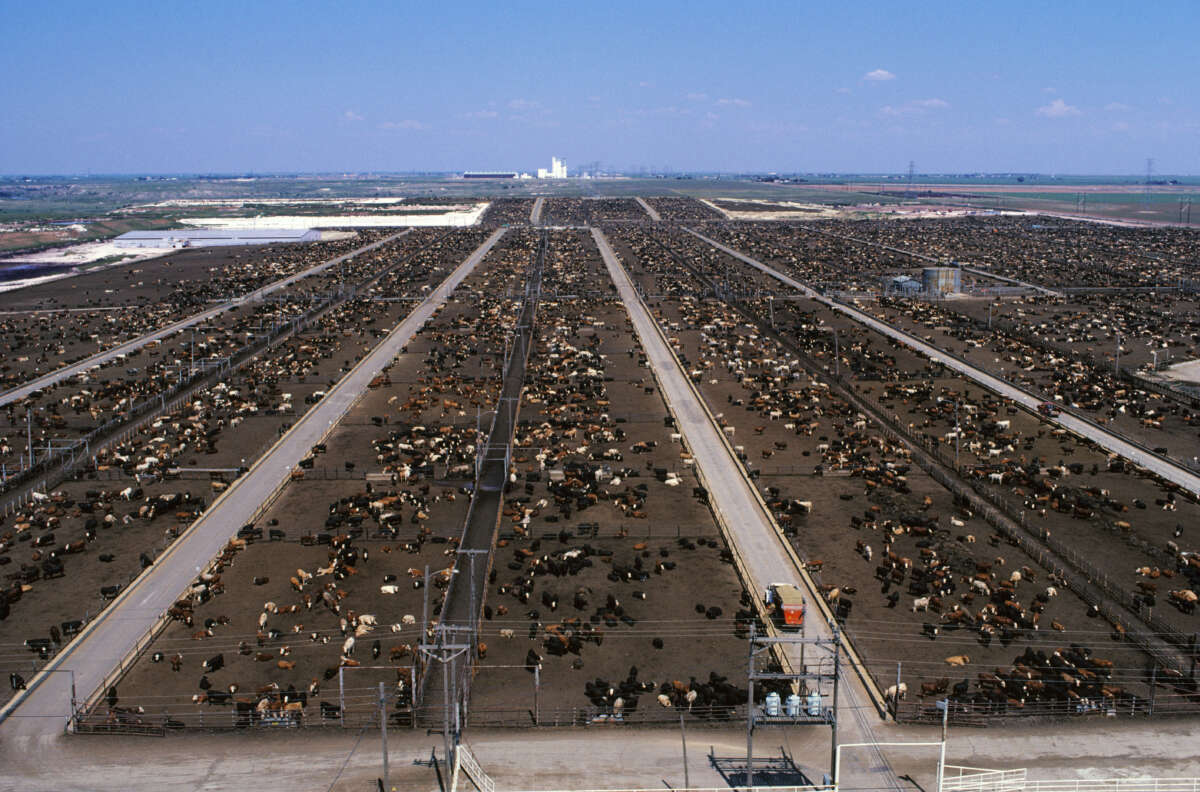
People living near concentrated animal feeding operations, or CAFOs, in California, Texas and Iowa suffer from higher rates of cancer, suggesting that the air and water pollution from the massive farms may be playing a role, according to a new study.
The study, published in the journal Environmental Research, comes just weeks after a years-long report in Iowa found the state’s agricultural chemicals and CAFO pollution are, in part, behind its rising cancer rate.
In the new study, Yale University researchers examined the rates of all cancers over the past 20 years in Texas, California and Iowa counties along with the density of CAFOs in the counties. High exposure counties were defined as those in the top 25% of CAFO density for their state. The researchers found rates for all types of cancers were 4% higher in highly exposed California counties, and 8% higher in highly exposed Iowa and Texas counties when compared to counties with lower CAFO density.
They found certain cancers were more strongly associated with CAFO density in each state. For example, stronger links were seen for bladder cancer in California, colorectal cancer in Iowa, and lung and bronchus cancer in Texas.
Iowa has the highest number of CAFOs in the country, according to federal data that ranks California fifth and Texas sixth.
Lead author Jiyoung Son, an associate research scientist at the Yale School of the Environment, said there are “multiple pathways” by which CAFOs could cause higher cancer rates. They emit air pollutants including ammonia and hydrogen sulfide, particulate matter, and volatile organic compounds, she said, which can form secondary pollutants in the atmosphere.
“Exposure to these substances is linked to inflammation, oxidative stress, and immunosuppression, which can all contribute to cancer development,” she said.
In addition, CAFOs are major sources of water pollution from the large amounts of manure that are stored or spread on fields as fertilizer. This can lead to nitrate contamination in water, which can lead to the formation of carcinogens. Nitrate pollution in water has been linked to various cancers including colon, bladder and thyroid cancers.
“In the past, policymakers have been able to say they don’t know how nitrate impacts our health, especially when it comes to cancer,” said Sarah Green, executive director at the Iowa Environmental Council. “As more and more studies emerge, the people in power can no longer claim they don’t know.”
Son and colleagues warn in the study that nitrate pollution may disproportionately impact rural homes on private wells.
“Private wells are largely unregulated, and many households may remain unaware of contamination risks or lack resources to treat their water,” they wrote.
The study did not test people’s actual exposure, and does not definitively prove that CAFOs cause cancer, the authors wrote. Some cancers were not linked to CAFO density, including breast cancer in Texas and Iowa.
Wendy Brannen, vice president of communications & marketing for the National Pork Producers Council, pointed out that Son and colleagues acknowledged certain limitations of the study — specifically that poverty, limited healthcare access, and lower cancer screening rates could be behind the associations seen.
Iowa CAFOs and Cancer Rates
The study comes on the heels of a report from the Iowa Environmental Council and The Harkin Institute, that found agricultural pollutants — including pesticides and CAFO-generated pollution — are, in part, driving the Iowa’s high cancer rates. Iowa has the second-highest rate of cancer in the nation and is only one of three states where cancer is rising, according to the National Institutes of Health.
Iowa’s CAFOs, along with fertilizers applied to crops, contribute to Iowa’s Des Moines and Raccoon rivers being in the top 1% of rivers nationwide for nitrate contamination. An estimated 80% of the contamination comes from agriculture. Just this week the Iowa Department of Natural Resources announced an investigation into a manure spill into a waterway.
“In Iowa … these findings are particularly stark,” Food & Water Watch research director Amanda Starbuck said of the new Yale study. “Iowa’s factory farms produce 109 billion pounds of manure each year — over 25 times as much as the state’s human population — driving elevated cancer-linked nitrate water pollution.”
Adam Shriver, co-author of last month’s report from Iowa and director of wellness and nutrition policy at The Harkin Institute, said Iowa should bolster its tracking of manure spreading so residents and regulators have a better sense of where pollution might occur.
“It just seems like a no-brainer that you would want to have a system that has a geospatial map of where all the manure is being applied so that you have a better sense of what is happening in the waterways,” he said.
Brannen said a separate report on cancer in Iowa published last month by the Iowa Cancer Registry found that Iowa farmers have 13% fewer cancers overall than the general population in the state.
“The most rigorous, long-term research available — following actual farmers for 30 years — finds that Iowa farmers are significantly less likely to develop cancers than the general population, not more,” she said. “That finding should be the headline here.”
Son said the next step to understand CAFOs’ role in cancer is to get more granular data.
“Right now we are looking at counties as a whole, that is useful for identifying patterns, but we want to understand direct exposure to individuals for more precise exposure estimates,” she said.
An urgent fundraising appeal: 10 Days to raise $50,000
Thank you for reading Truthout today. We have a brief message before you go —
Unfortunately, donations are down for Truthout at a time when media is under immense pressure. Trump is arresting journalists, Big Tech is censoring independent news, and economic conditions for media have been worsening for years.
Simultaneously, movement media is vital in the fight against Trump’s authoritarian reign. Our mandate to tell the truth, share strategies for resistance, and speak against fascism is ever more urgent in this deluge of political censorship. Yet, we are struggling to meet our publishing costs when our work is so urgently needed.
If you can support Truthout with a one-time or monthly donation, you will make a significant impact on our work. Please give today during our fundraiser (10 days left).