Did you know that Truthout is a nonprofit and independently funded by readers like you? If you value what we do, please support our work with a donation.
As a result of the coronavirus pandemic, hospitalizations skyrocketed in 2020, but routine visits to the doctor’s office and demand for new prescription medications fell sharply during the worldwide lockdown.
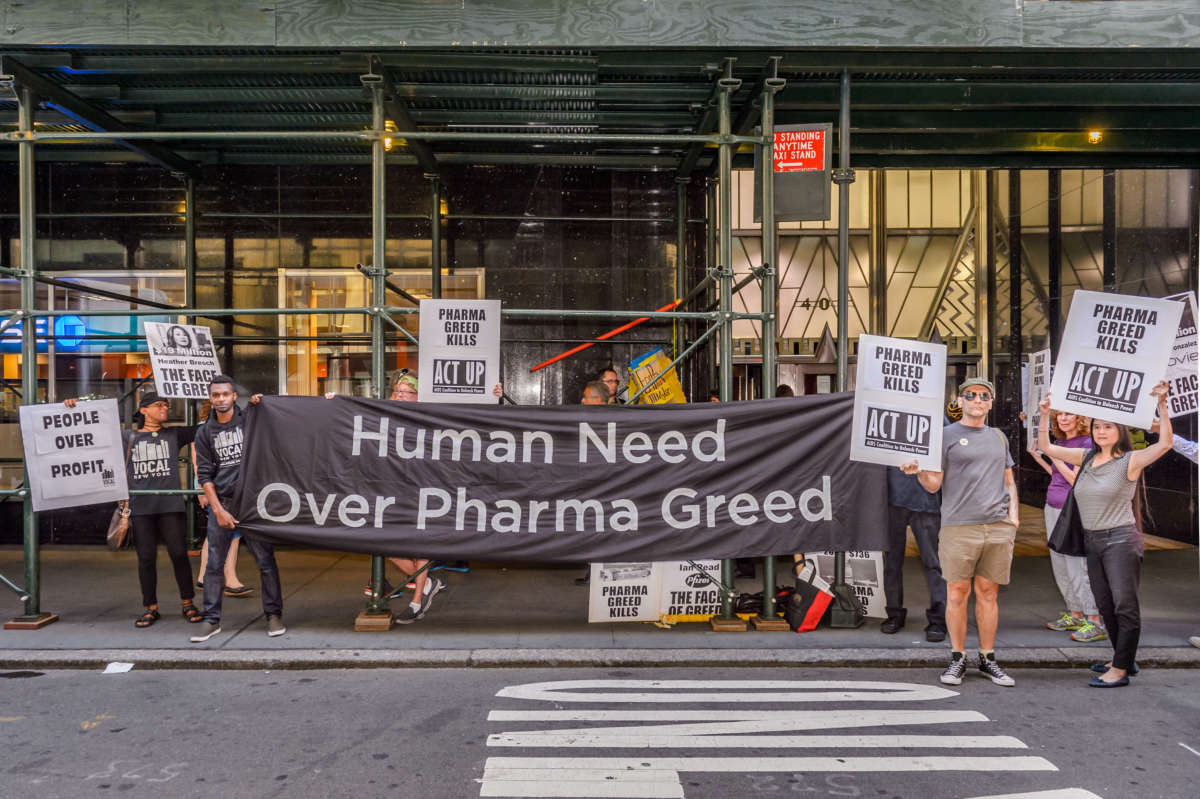
To make up for lost revenue, the pharmaceutical industry plans to ring in the New Year by raising prices on more than 300 drugs in the United States on January 1, according to an analysis by healthcare consulting firm 3 Axis Advisors, whose findings were summarized in an exclusive report published Thursday in Reuters.
As Reuters pointed out, “The increases come as pharmaceutical companies like Pfizer are playing hero by developing vaccines for Covid-19 in record time.”
While scientific advances made by pharmaceutical companies have contributed to defeating the pandemic, critics argue that it would be naive to assume the industry is simply motivated to improve people’s well-being.
“Big Pharma’s greed is a danger to public health,” Reps. Pramila Jayapal (D-Wash.) and Mark Pocan (D-Wis.) said earlier this year, when Gilead announced that it would charge U.S. hospitals $3,120 per privately insured patient for a treatment course of remdesivir, a Covid-19 drug whose development was financed in large part by taxpayers.
Pfizer spokesperson Amy Rose pointed to the coronavirus vaccine the company developed with Germany’s BioNTech in an attempt to justify next year’s drug price hikes. “This modest increase,” Rose said in a statement, “is necessary to support investments that allow us to continue to discover new medicines and deliver those breakthroughs to the patients who need them.”
Nevertheless, as David Mitchell, a cancer patient and founder of Patients for Affordable Drugs Now, said last month, “Drugs don’t work if people can’t afford them.”
To “get innovation we need at prices we can afford,” Mitchell added, “restore balance… [and] end unlimited drug corporation pricing power.”
Drug manufacturers, including Pfizer, Sanofi USA, and GlaxoSmithKline, “are also fighting new drug price cutting rules from the Trump administration, which would reduce the industry’s profitability,” Reuters reported.
President Donald Trump pledged in 2016 to reduce prescription drug prices in the U.S., which are among the highest in the world, but it wasn’t until late 2020 that he issued a handful of executive orders meant to slash prices. According to Reuters, “Their impact could be limited by legal challenges and other problems.”
The news outlet continued:
A federal judge earlier this month blocked a last-minute Trump administration rule aimed at lowering drug prices that was set to be implemented at the beginning of the year. It was challenged by drug industry groups including PhRMA, the nation’s leading pharmaceutical trade group.
President-elect [Joe] Biden has also vowed to reduce drug costs and to allow Medicare, a U.S. government health insurance program, to negotiate drug prices. He has support from congressional Democrats to pass such legislation, which the Congressional Budget Office has said could cost the industry more than $300 billion by 2029.
As Common Dreams reported last month, researchers have linked the failure to address the unaffordable costs of prescription medications to a rise in “cost-related nonadherence” to drug therapy, which increases preventable suffering, premature deaths, and healthcare spending.
We lost 15 percent of our traffic overnight.
We now have three full months of data since Google changed its search to feature AI results. The numbers are worse than we anticipated. Overall readership that comes to Truthout through Google is down 54 percent against last year. The number of new readers who discover Truthout via Google searches is down 49 percent, and returning users from Google are down 51 percent.
We lost 15 percent of our readership overnight. This was a readership we painstakingly built over decades, and it vanished because Google chose corporate greed over a healthy democracy.
We anticipate a loss of roughly $500,000 in online revenue as a result of this massive traffic plunge in the next year alone.
The only way we can keep publishing is with strong reader support. We are asking you to start a monthly donation to Truthout today — anything you can do, whether $5 or $25, makes a difference.