Part of the Series
Covering Climate Now
Support justice-driven, accurate and transparent news — make a quick donation to Truthout today!
After years studying the climate, my work has brought me to Sydney where I’m studying the linkages between climate change and extreme weather events.
Prior to beginning my sabbatical stay in Sydney, I took the opportunity this holiday season to vacation in Australia with my family. We went to see the Great Barrier Reef — one of the great wonders of this planet — while we still can. Subject to the twin assaults of warming-caused bleaching and ocean acidification, it will be gone in a matter of decades in the absence of a dramatic reduction in global carbon emissions.
We also travelled to the Blue Mountains, another of Australia’s natural wonders, known for its lush temperate rainforests, majestic cliffs and rock formations and panoramic vistas that challenge any the world has to offer. It too is now threatened by climate change.
I witnessed this firsthand.
I did not see vast expanses of rainforest framed by distant blue-tinged mountain ranges. Instead I looked out into smoke-filled valleys, with only the faintest ghosts of distant ridges and peaks in the background. The iconic blue tint (which derives from a haze formed from “terpenes” emitted by the Eucalyptus trees that are so plentiful here) was replaced by a brown haze. The blue sky, too, had been replaced by that brown haze.
The locals, whom I found to be friendly and outgoing, would volunteer that they have never seen anything like this before. Some even uttered the words “climate change” without any prompting.
The songs of Peter Garrett and Midnight Oil I first enjoyed decades ago have taken on a whole new meaning for me now. They seem disturbingly prescient in light of what we are witnessing unfold in Australia.
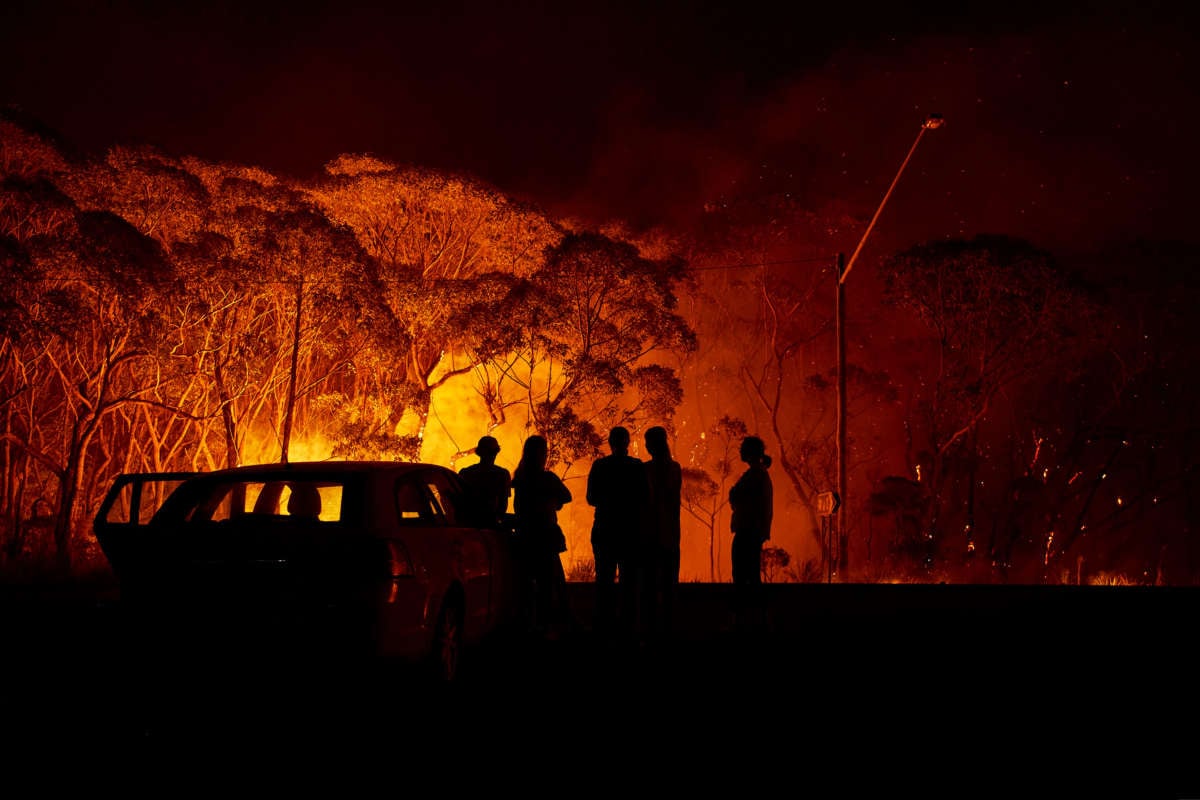
The brown skies I observed in the Blue Mountains this week are a product of human-caused climate change. Take record heat, combine it with unprecedented drought in already dry regions and you get unprecedented bushfires like the ones engulfing the Blue Mountains and spreading across the continent. It’s not complicated.
The smoke is so thick in Katoomba tourists are opting for photos with billboards, rather than the Three Sisters themselves. @abcsydney pic.twitter.com/MOWvH8UBgs
— Tom Lowrey (@tomlowrey) December 30, 2019
The warming of our planet — and the changes in climate associated with it — are due to the fossil fuels we’re burning: oil, whether at midnight or any other hour of the day, natural gas, and the biggest culprit of all, coal. That’s not complicated either.
When we mine for coal, like the controversial planned Adani coalmine, which would more than double Australia’s coal-based carbon emissions, we are literally mining away at our blue skies. The Adani coalmine could rightly be renamed the Blue Sky mine.
In Australia, beds are burning. So are entire towns, irreplaceable forests and endangered and precious animal species such as the koala are perishing in massive numbers due to the unprecedented bushfires.
The continent of Australia is figuratively — and in some sense literally — on fire.
Yet the prime minister, Scott Morrison, appears remarkably indifferent to the climate emergency Australia is suffering through, having chosen to vacation in Hawaii as Australians are left to contend with unprecedented heat and bushfires.
Morrison has shown himself to be beholden to coal interests and his administration is considered to have conspired with a small number of petrostates to sabotage the recent UN climate conference in Madrid (“COP25”), seen as a last ditch effort to keep planetary warming below a level (1.5C) considered by many to constitute “dangerous” planetary warming.
But Australians need only wake up in the morning, turn on the television, read the newspaper or look out the window to see what is increasingly obvious to many — for Australia, dangerous climate change is already here. It’s simply a matter of how much worse we’re willing to allow it to get.
Australia is experiencing a climate emergency. It is literally burning. It needs leadership that is able to recognise that and act. And it needs voters to hold politicians accountable at the ballot box.
Australians must vote out fossil-fuelled politicians who have chosen to be part of the problem and vote in climate champions who are willing to solve it.
This article originally appeared in The Guardian and is republished here as part of Covering Climate Now, a global journalistic collaboration to strengthen coverage of the climate story.
Media that fights fascism
Truthout is funded almost entirely by readers — that’s why we can speak truth to power and cut against the mainstream narrative. But independent journalists at Truthout face mounting political repression under Trump.
We rely on your support to survive McCarthyist censorship. Please make a tax-deductible one-time or monthly donation.