Truthout is a vital news source and a living history of political struggle. If you think our work is valuable, support us with a donation of any size.
Whenever a natural disaster is headed towards the prison where I am incarcerated, we all joke that we are in a fortress: safe because nothing can get in and no one can get out. But on January 25, 2025, I was reminded that outside disasters affect us here, too. That day, the Bureau of Prisons flipped my life upside down.
It was a cold Saturday morning, and the rest of the women and I were catching up on sleep. I awoke to banging on my door.
“Get up and get dressed!” a voice yelled.
I began frantically asking where I was going. My bunkie woke up and tried to assure me that I was probably being drug tested or taken on a medical trip; she told me that I would be back shortly.
“A medical trip on the weekend? No way,” I thought to myself.
I threw on a coat and exited my room to find not one, not two, but three male officers waiting for me. Something was not right. One of the officers told me to place my hands behind my back. The cold metal of handcuffs hugged my wrists, and my heart began to echo my mind’s suspicions. But the officers kept talking, claiming that they did not know what was happening, as they escorted my trembling body to the place no prisoner wants to go: the Special Housing Unit (SHU), solitary confinement.
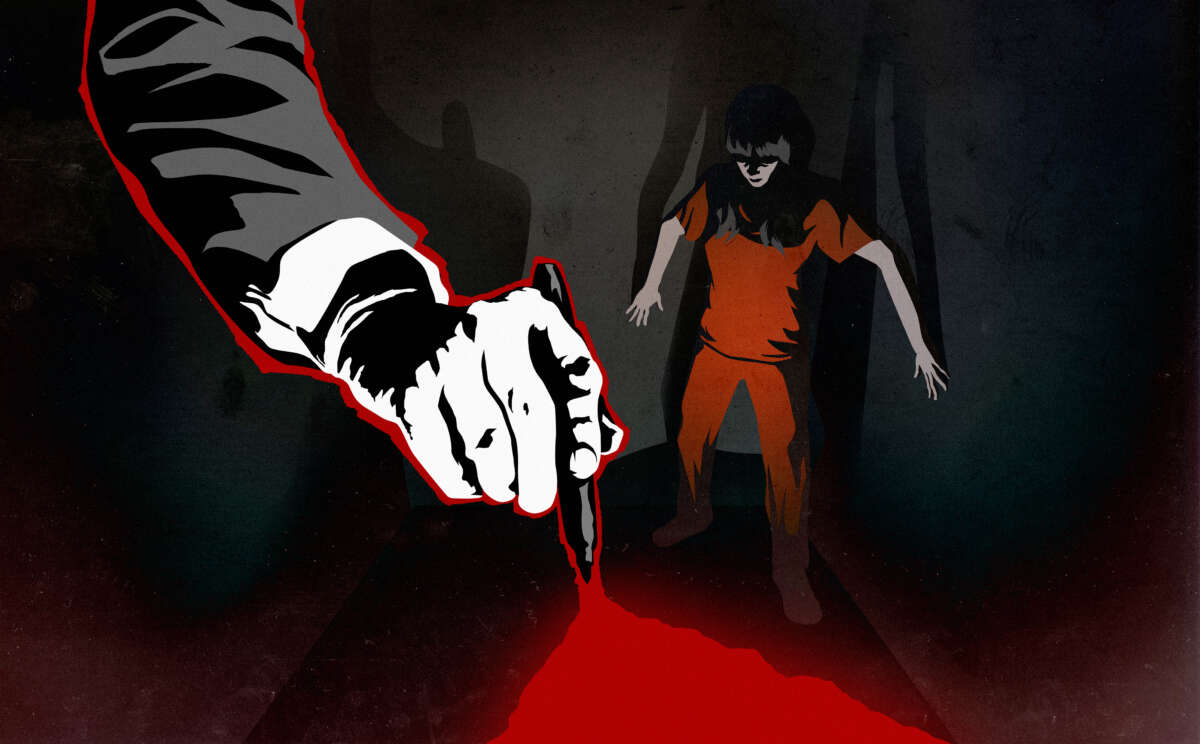
Once inside, I was made to strip, squat, and cough, before being handed a thin orange jumpsuit. I wondered if I was dreaming, or having a flashback to when I was first arrested. Hours went by slowly as I stood in a holding cell with nothing but my racing thoughts, a stool, and a cage door facing the officer’s station. A nurse, an officer, and a counselor walked by. I asked the same question, again and again. They said they didn’t know why I was there. They casually told me to calm down; the lieutenant would be here shortly to explain.
Upon the lieutenant’s arrival I begged for an explanation.
“Look,” she said. “Ever since Trump got back into office there have been many changes.”
And that’s when I knew: The “rumors” I’d heard about Trump sending transgender women to men’s prisons were not rumors after all. My bunkie and I had recently laughed about the crazy idea of me sharing a room with a man, but this situation was no joke.
“He signed an executive order recognizing only two genders,” the lieutenant continued. “We’re sending you to a men’s facility.”
That’s when I let out a noise from deep inside my soul that I had never heard a human make before. Everything froze as my perception of time slowed. Seconds turned into hours as tears ran from my eyes.
“This has to be a mistake!” I began screaming. “I’m a woman, an aunt, I’m my mother’s daughter!”
I leaned against the wall and slid onto the dirty floor, my physical self mirroring how low my mental self felt. “I can’t go to a men’s prison!” I screamed. “They will rape me to death!”
“We’re sorry, there is nothing we can do. His new executive orders are affecting us as well,” the lieutenant told me. “I will give you a phone call to alert your family before we pack up your property for transfer.”
Within seconds, my temporary prison term became a potential death sentence, handed over by the president. All for merely existing.
I always thought that if I just minded my own business, educated myself, and kept my faith strong, I would eventually leave prison and return to my family in one piece. Now, I questioned whether I would even make it out alive.
My family and I immigrated to this country from Bosnia after we escaped the genocide in the 1990s. We were chasing the “American dream,” which, for me, had included my gender transition at 24 years old. I never believed that in 2025 the American government could put one of its own citizens in grave danger just for being themselves, or that being trans would constitute a death penalty.
Everything I believed was clearly wrong.
After being assigned to a cell in the SHU, I was granted my phone call. My mother already suspected that something evil had happened because my bunkie called to notify her that her daughter had been taken away somewhere. She broke down as I explained what happened. Her screams echoed my earlier words. “But you’re a woman!” she cried. “You’re my daughter. How can they do this?”
I had to end the phone call as she tried reassuring me that our family would find a solution.
Days went by as my hope disappeared and suicidal thoughts invaded my mind.
“I’ll kill myself before I allow the government to do it,” I thought.
The following week slowly passed without relief. Finally, one afternoon, God whispered to me, telling me to finally rest. Yet once again, I was woken up by someone banging on my door. “Get your stuff, you’re going back onto the compound!” the captain yelled.
I never imagined that I would be so excited to go back to prison. I rolled up everything within seconds and grabbed my mat. Apparently, the psychology department and central office had spoken and decided to let me stay – for now.
I found out that a lot happened in the days following my life-altering SHU experience. GLAAD had connected my family with a team of lawyers that, to this day, are fighting for my life, struggling to keep me from ever stepping foot into a men’s prison. At the time of this writing, a federal judge has granted a temporary injunction requiring the Bureau of Prisons to keep me at a women’s facility. I pray it will be made permanent.
Random women I’d never spoken to have approached me to tell me that they prayed for me after hearing the news, affirming that I belong with women and not men.
But none of this keeps the nightmares away. I have constant, graphic night terrors of men in prison uniforms raping and killing me. I have had to start mental health medication to minimize the debilitating panic attacks I now suffer every time I hear keys rattling at night.
While in prison, I have learned to choose my battles. I can roll my eyes at some petty issues. But others are so serious that they have to be treated as long, uphill struggles for change. The battle I’m in right now is for my very existence. By the grace of God, I have an army of kind people supporting me on my way to the top of the hill. I do not know what the future holds for me, but I believe that love will always trump hate. And for that belief, I am thankful.
Media that fights fascism
Truthout is funded almost entirely by readers — that’s why we can speak truth to power and cut against the mainstream narrative. But independent journalists at Truthout face mounting political repression under Trump.
We rely on your support to survive McCarthyist censorship. Please make a tax-deductible one-time or monthly donation.