Truthout is a vital news source and a living history of political struggle. If you think our work is valuable, support us with a donation of any size.
“I don’t know when I will be able to contact you again.” my cousin Ahmad told me during a WhatsApp call from Tehran last summer, in the midst of the 12-day war between Israel and Iran. “Maybe it wasn’t wise to come here. Afghanistan would probably have been safer.” For days, his internet connection had stopped working. Eventually, a privileged neighbor shared their Starlink satellite internet access with my cousin. When the war ended, the Iranian authorities banned its use.
“Anyone using Starlink is suspected of collaborating with the ‘enemy’ — meaning Israel’s intelligence service, Mossad. People are arrested and might even be executed,” Ahmad told me back then, his voice tense.
Today, I rarely hear Ahmad’s voice. Every few hours, I grab my phone to check if he is online. But since the United States and Israel illegally attacked Iran at the end of February, beginning a large-scale bombing campaign all over the country, another internet blackout is haunting Iran. The Iranian state has plunged the country into a near-total digital blackout, and millions of people remain without any connection to the outside world.
The only thing that I know is that my relatives left Tehran for a calmer region far away from the city. After they left, their civilian neighborhood in Tehran was heavily bombed. The building next to their apartment was hit by airstrikes and reduced to rubble.
While people try to reach loved ones amid the digital blackout, news of some dystopian scenes is making its way out of the country. On the very first day of its war, the United States bombed a girls’ school in the city of Minab with Tomahawk missiles and killed at least 175 children. What also shocked many people around the world was the occurrence of what experts call “black rain” — toxic, acidic precipitation that fell across large parts of Tehran, a city of about 10 million people, after U.S. and Israeli strikes on oil refineries belonging to the Iranian regime.
The U.S. and Israel also extrajudicially killed Ali Khamenei, Iran’s authoritarian supreme leader, turning him into a martyr for millions of his followers.
From Refugees to “Mossad Spies”
Almost two years ago, my cousin Ahmad took his mother and sister and fled from Kabul to Tehran. He reconnected with former university friends and hoped to find work with the United Nations or the International Organization for Migration. “There are many Afghan refugees here. I heard they needed qualified staff,” he said. In the end, nothing came of it. He was not able to find work.
Then the bombs started falling.
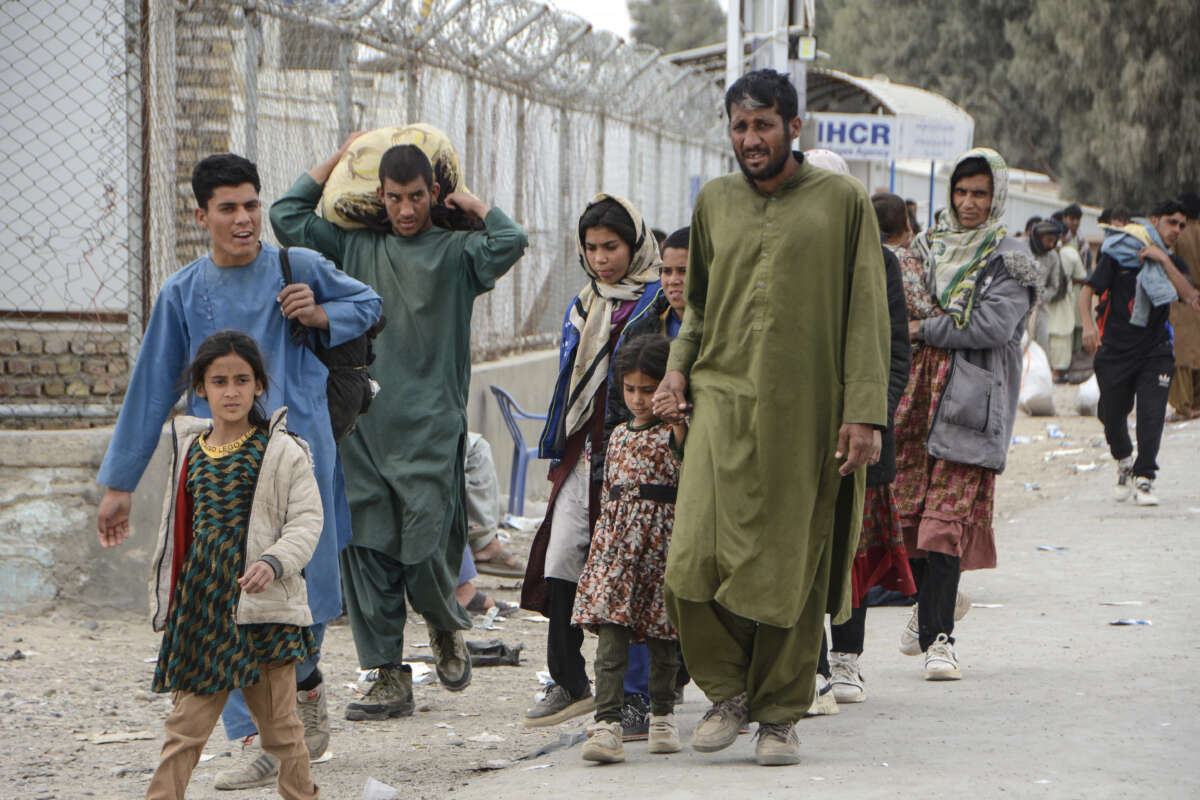
When Israel launched its attacks on Iran last summer, my relatives and millions of other Afghans suddenly found themselves trapped in yet another war. Like the more than 4 million Afghan refugees estimated by the UNHCR to be living in Iran, Ahmad became part of a population that was quickly turned into a convenient scapegoat.
“We came here because we were no longer safe in Afghanistan.”
Shortly after the Israeli strikes began, Iran’s leadership began to blame Afghan refugees for their own security failures. In the past those refugees had been labeled thieves, rapists, or terrorists by state media. Now they were accused of being “spies” and “collaborators” for Israel’s intelligence services. According to state media narratives, Afghans had allegedly passed coordinates to Israeli operatives or assembled drones for them.
During the 12-Day War, numerous Afghan men were arrested and paraded on state television. Their images spread quickly across Instagram and TikTok.
“We were terrified,” Akhtar Mohammad, an elder man from Kabul, told me. He fled to Iran with his family after the Taliban returned to power in Kabul. Mohammad had left Afghanistan because he feared the return of militant rule. “I didn’t want my daughters to grow up under the Taliban again,” he explained.
But today, they live in Kabul again. “We realized we weren’t safe [in Iran] either,” he said.
A Long History of Refuge — and Exclusion
Iran has been one of the primary destinations for Afghan refugees for more than four decades. The first major waves arrived in the early 1980s, after revolutions reshaped both countries.
In Tehran, Islamic political forces led by Ayatollah Ruhollah Khomeini had recently seized power. In Kabul, Marxist forces backed by the Soviet Union overthrew Afghanistan’s fragile republic. The leadership of both quickly turned into brutal regimes.
The new Iranian leadership persecuted secularists and leftists. In Afghanistan, the communist government targeted religious and traditional elites. The Soviet invasion in 1979 and the proxy war that followed forced hundreds of thousands of Afghans to flee — many of them across the border into Iran.
Over time, this displacement became permanent.
Today, millions of Afghans live in Iran but are rarely treated as part of the country’s social fabric, and their rights have always been neglected by both state and society. Many of my friends or other family members who lived in Iran shared gruesome stories after their arrival in Europe. They said that while in Iran they were exploited, experienced racism, or were hunted and tortured along the border by Iranian soldiers.
Exploitation and Racism
For many Afghans, Iran has long been synonymous with exploitation and racism.
While Afghanistan was ravaged by decades of war, Iranian cities such as Mashhad, Shiraz, and Tehran expanded on the backs of Afghan laborers during the last four decades. To this day, Afghan workers perform some of the most dangerous and poorly paid jobs in construction and agriculture. Many of the skylines we see Israeli and U.S. strikes destroy today were actually built by them. At the same time, Afghan workers face hostility from the authorities while also facing discrimination from large segments of Iranian society, in which the word “Afghani” is often used as a slur.
More than 1 million Afghans have been forced to return to Afghanistan from Iran in recent months.
Afghans are officially barred from living in at least 16 Iranian provinces. Some public parks carry signs reading “No Afghans allowed.” Their movement is heavily regulated; access to transportation, employment, and housing is tightly controlled. The majority of Afghan refugees lack legal status, which means their children are often denied access to schools and higher education.
Over the years, the Iranian state has repeatedly exploited this vulnerability. When the war in Syria erupted, Tehran recruited thousands of Afghan refugees — many from the Shia Hazara minority — into the Fatemiyoun Brigade, a militia fighting on behalf of Bashar al-Assad’s former regime in Damascus. Families were promised residence permits and access to education or employment. Many of those sent to the front lines were teenagers.
“Once Again, We Are Blamed for Everything”
“We came here because we were no longer safe in Afghanistan,” said Khatera Ahmadi, a 50-year-old widow who arrived in Tehran with her family last year.
Under Taliban rule, repression in Afghanistan has intensified dramatically. Women and girls have been pushed almost entirely out of public life, education, and the workforce. Armed Taliban units raided Ahmadi’s home several times.
“They thought ISIS fighters were hiding in our house,” she recalled. “It didn’t matter that I was alone with my children.”
When Israel’s attacks on Iran escalated last year and the security crackdown began, her family started wondering whether they would have to flee yet again.
“The [Iranian] government is hunting Afghans now,” Ahmadi described after the 12-Day War. “Once again, we are supposed to be responsible for everything. It’s unbearable.”
When the new war started, they went on the run again.
Deportations and Humanitarian Collapse
In the aftermath of last summer’s war and the subsequent security crackdown, Iranian police raided factories and homes where Afghan refugees were believed to be staying. Reports of arbitrary arrests, torture, and executions have grown dramatically.
At the same time, mass deportations have accelerated.
More than 1 million Afghans have been forced to return to Afghanistan from Iran in recent months. On some days, tens of thousands have been pushed across the border. According to humanitarian organizations, the scale of these expulsions could create a new regional catastrophe.
At border crossings with Iran last summer, aid workers described chaotic and dystopian scenes when families arrived exhausted, hungry, and without money.
“Afghanistan cannot handle this alone,” officials from the International Organization for Migration warned last year. Now, as Iran faces war from the U.S. and Israel again, members of the Afghan community worry the same scenario might be repeated.
Pakistan, another key host country, has also begun expelling large numbers of Afghan refugees; that country declared war on Afghanistan the same week Donald Trump and Benjamin Netanyahu attacked Iran. As a result, at least 42 civilians, mainly women and children, have been killed by Pakistani airstrikes between February 26 and early March while fighting between Taliban forces and Pakistani soldiers has intensified along the border.
Many international aid groups have withdrawn from Afghanistan since the Taliban takeover, leaving the country’s fragile infrastructure to collapse under the pressure.
At border crossings with Iran last summer, aid workers described chaotic and dystopian scenes when families arrived exhausted, hungry, and without money. Many had nowhere to go. Among the deportees are many children separated from their families.
“People were returning with literally nothing,” said Zubair Hakim, a journalist in Kabul. “The Taliban government couldn’t manage this situation and it will be even worse if it happens again.”
Voices of Resistance
Not everyone in Iran accepted the campaign against Afghan refugees.
After last summer’s war, more than 1,300 Iranian and Afghan activists, filmmakers, and writers signed an open letter condemning Iran’s treatment of Afghans. Among the signatories were prominent figures from Iran’s cultural scene, including the actress Taraneh Alidoosti and filmmaker Leili Farhadpour.
The letter states that the injustices faced by Afghan refugees and other marginalized groups contradict every basic principle of humanity and freedom — and must end immediately.
Whether these voices will be heard is another question, especially since the eruption of the new war, with the potential for new scapegoats.
For my cousin who used to live in Tehran, the future remains uncertain. His internet connection might disappear again at any moment. So might his ability to stay in the country.
“I escaped one war,” Ahmad says quietly. “Now I’m living through another one.”
An urgent appeal for your support: 6 Days to raise $38,000
Truthout relies on individual donations to publish independent journalism, free from political and corporate influence. In fact, we’re almost entirely funded by readers like you.
Unfortunately, donations are down. At a moment when independent journalism is urgently needed, we are struggling to meet our operational costs due to increasing political censorship.
Truthout may end this month in the red without additional help, so we’ve launched a fundraiser. We have 6 days to hit our $38,000 goal. Please make a tax-deductible one-time or monthly donation if you can.