Did you know that Truthout is a nonprofit and independently funded by readers like you? If you value what we do, please support our work with a donation.
Two weeks until Election Day, and no one is talking about the wars, The New York Times reports. (Of course, that’s not quite true: as the Washington Post reports, for example, this former Army Green Beret is running for Congress in Missouri on a platform of ending the war in Afghanistan.)
Unsurprisingly, the wars may have slipped down on many people’s lists of top concerns in the face of 9.5 percent officially measured unemployment and the foreclosure crisis. But some people are talking about projected US budget deficits and what to do about them, and since the permanent war is a major cause of projected budget deficits, that means the permanent war is on the table.
Furthermore, a key question hanging over the election is this: in America today, is it politically feasible to make the super rich pay their fair share of taxes? So far, the answer given to this question by the election season seems to be no. Some Democrats thought that they had a winning issue politically in allowing the Bush tax cuts on the super rich to expire, but, so far, it seems that they were wrong.
But here’s a strategy that has not yet been fully explored: rather than simply urge that the super rich be required to pay their fair share of taxes to support government expenditures in general, let’s demand that particular increased taxes on the super rich be earmarked to particular government expenditures that the super rich will have a hard time dodging politically. In Britain, for example, there is a vigorous campaign to tie a particular tax increase on the well-off to a particular set of needed social expenditures. It’s called, appropriately enough, the Robin Hood Tax.
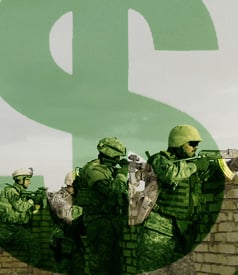
Here in the US, Rep. Bob Filner (D-California-51), chair of the House Veterans Affairs Committee, has proposed the creation of a “veterans trust fund” to pay for the long-term costs of war. The logic of this proposal is straightforward. The wars create a long-term liability for the government, because the government is obligated to pay for the medical care of veterans for the rest of their lives. The same logic that says that we ought to worry about the long-term liability of the government to pay Social Security benefits says that we ought to worry about the long-term liability of the government to pay veterans’ benefits. But in the case of Social Security, there is a dedicated tax and a dedicated trust fund. In the case of veterans’ benefits, there is no dedicated tax and no dedicated trust fund. So, we ought to feel more urgency about veterans’ benefits than about Social Security benefits, because no provision has been made for veterans’ benefits at all.
So far, about 600,000 Iraq and Afghanistan veterans have already sought medical treatment from the Department of Veterans Affairs, and 500,000 have applied for disability benefits. Economists Joseph Stiglitz and Linda Bilmes have estimated the cost of providing Iraq and Afghanistan vets with lifetime medical care and disability payments at between $589 billion and $934 billion, depending on how long the wars continue and how many troops remain deployed.
There’s a strong case to be made that the super rich should pay for this.
First, of course, there is the general fact that the super rich have more capacity to pay.
Second, there is the fact that the deaths and injuries suffered by US soldiers impose a burden disproportionately on the families of less privileged Americans, compared to the super rich. It’s not the sons and daughters of the super rich who are being blown up in Kandahar. America’s working families have already paid for the wars by sending their sons and daughters. They have also paid through the diversion of public resources from human needs to the military-industrial complex. Fairness suggests that it’s time for the super rich to pay.
Third, if we establish a mechanism for the super rich to pay for the wars, this will create a powerful disincentive for the wars to continue, and will create a powerful incentive to avoid future wars. When an administration and its supporters in the corporate media start to gin up a war fever, or insist that a current war must escalate or be continued, the super rich will say to themselves, “Whoa. We’re going to be expected to pay for this.” And the super rich will push back. Since the super rich have very disproportionate political influence in our current political system, that will exert powerful counterpressure against the permanent war party.
As good fortune would have it, the Stiglitz/Bilmes estimate for the cost of caring for veterans of the Iraq and Afghanistan wars is roughly the same order of magnitude as the savings to the government of allowing the Bush tax cuts on the richest Americans to expire: “deficits and debt will be about $1 trillion higher over the next ten years if the high-income tax cuts remain in place,” the Center on Budget and Policy Priorities reports.
So, instead of just saying that the Bush tax cuts for the richest Americans should be allowed to expire, let’s say that they should be allowed to expire and that the money saved shall be earmarked for the veterans trust fund. Note from the point of view of the public interest, it’s no loss to earmark the money, because we have to pay for veterans’ benefits no matter what we do. By dedicating the money from the super rich, we free up other resources for use elsewhere.
Would our super rich balk at paying for veterans’ care? Are our super rich not American Patriots? Would our super rich refuse to Support the Troops?
And let’s say further, that when the nation’s obligation to its veterans has been fully funded, we’ll consider restoring the Bush tax cuts for the super rich. This will give the super rich an incentive to help us end the wars and prevent new ones.
25 Years of Truthout: An important fundraising appeal
This September, Truthout is celebrating 25 years of publication. For over two decades, we have been a trusted source for fiercely independent journalism thanks to readers like you.
As we look to the next 25 years, we have launched a special fundraising campaign. Looking to a sustainable future for our publication, we have a fundraising goal of $100,000 in the next 10 days.
We are asking for your support at this juncture because we face greater threats than ever before in our organizational history. Trump and his MAGA allies are determined to control the information ecosystem, and movement-based organizations are subject to dangerous censorship and scrutiny.
If you can support Truthout with a one-time or monthly donation, you will make a significant impact on our work and our legacy. Anything you can do makes a difference!