Part of the Series
Despair and Disparity: The Uneven Burdens of COVID-19
Truthout is a vital news source and a living history of political struggle. If you think our work is valuable, support us with a donation of any size.
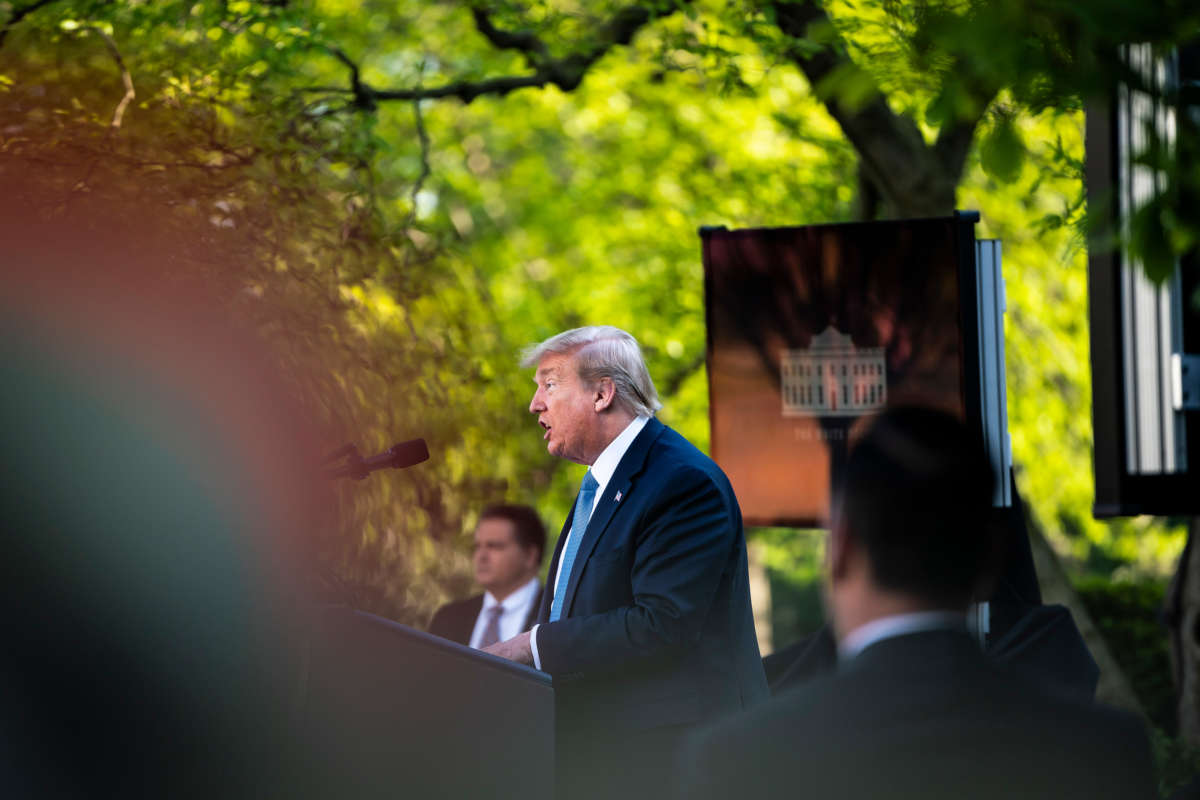
During a press event at the White House on Wednesday, President Donald Trump complained that Democrats were blocking many of his political appointments from consideration, in spite of the fact that hundreds of positions are vacant simply because he hasn’t actually nominated anyone to fill them yet.
Some individuals he’s tried to appoint have also been held up in Republican-controlled committees. Yet it’s Democrats, Trump insisted during the press briefing, who were to blame.
Regardless of whether his assertions were correct or not, the president threatened to use a little-known (and never tried) constitutional provision that would allow him to adjourn Congress and place his nominees in their positions through recess appointments.
Trump used the current coronavirus pandemic as justification for why he needed to act swiftly on the matter. “If they don’t act on getting these people approved — we need them anyway — but we especially need now because of the pandemic, we are going to do something,” he said.
The president recognized that the utilization of this power might be scrutinized and disputed. “We’ll probably be challenged in court, and we’ll see who wins,” Trump said.
Article II Section 3 of the U.S. Constitution indeed allows the president to adjourn either or both houses of Congress, but it stipulates that the House of Representatives and the Senate need to be in dispute “with respect to the time of adjournment.” No dispute currently exists, and the Constitution doesn’t explicitly say a president can use this power for any other purpose, let alone forcing through executive appointments.
Several legal minds weighed in on the matter as well, through social media or interviews on the subject after Trump announced his intended plans.
“Article II of the Constitution gives the President the power to adjourn Congress if — and only if — the House and Senate cannot agree on a date for ending the current session,” Stephen Vladeck, University of Texas School of Law professor, said in a tweet. “But they have agreed — January 3, 2021.”
Harvard Law School professor Laurence Tribe argued that Trump’s power move could cause real harm to the American people.
“These empty threats — first, to control the governors; then, to adjourn the Senate — are far from harmless,” Tribe wrote. “They divert and distract while testing the waters to see what he might be able to get away with. In the meantime, Americans suffer and die.”
Lawmakers in Congress also weighed in on the matter. Rep. Jamie Raskin, a Democrat from Maryland, explained to The Washington Post that Trump’s plan for “dissolving an assembly … comes out of a dictator’s handbook.”
“That’s banana republic stuff,” Raskin added.
On the opposite side of the spectrum, conservative Rep. Justin Amash (I-Michigan), also viewed Trump’s plans as unlawful.
“Without one chamber participating in this improper scheme, this action would be unconstitutional. The president has no general, unilateral power to adjourn Congress,” Amash wrote on Twitter.
Trump’s statements in recent days have become increasingly alarming to many, bordering, in some people’s minds, to behavior more fitting of a king than a democratically elected official. This past week, in fact, Trump claimed to have “total” authority on when to end stay-in-place orders across the country and restart closed aspects of the nation’s economy — a claim legal experts have refuted.
Important Message: Please Read
For 25 years, Truthout has survived by publishing impactful investigative journalism and analysis; distributing full editions 365 days a year; and building a community of readers who support us with small, hard-earned donations.
Eighty percent of our $3 million yearly budget comes from small donors alone. Of those, 8,000 readers support us with monthly donations. Back in 2018, when Facebook decided to suppress the circulation of posts made by organizations, thereby cutting readers off from seeing many articles shared by the news organizations they had intentionally decided to follow, Truthout’s total traffic declined by 40 percent, as nearly all of our traffic from that platform disappeared.
Now, Google has recently rolled out its AI search bar, providing AI summaries instead of directing readers to our site. Google Search is our single largest source of traffic; it’s the route by which nearly one third of our readers find us. Much like in 2018, a shocking 40 percent of our Google traffic has disappeared overnight.
It will not be easy for Truthout to shoulder this blow. Nor will it be easy for our peers and collaborators — news sites that depend on traffic and aren’t bankrolled by large corporations.
If you can support Truthout with a donation today, you can help us resist the AI onslaught. Please give today.