Support justice-driven, accurate and transparent news — make a quick donation to Truthout today!
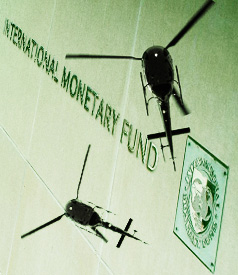
A few years back, there was a fear in some parts about black UN helicopters that were supposedly taking part in the planning of an invasion of the United States. While there was no foundation for this fear, there is basis for concern about the attack of another international organization, the International Monetary Fund (IMF).
Last week, the IMF told the United States that it needs to start getting its budget deficit down. It put cutting Social Security at the top of the steps that the country should take to achieve deficit reduction. This one is more than a bit outrageous for two reasons.
First, the IMF deserves a substantial share of the blame for the economic crisis that gave us big deficits in the first place. The IMF is supposed to oversee the operations of the international financial system. According to standard economic theory, capital is supposed to flow from rich countries like the United States to poor countries to finance their development. In other words, the United States should be having a trade surplus, which would correspond to the money that we are investing in poor countries to finance their development.
Let Truthout send our best stories to your inbox every day, for free.
However, the IMF messed up its management of financial crises so badly in the last 15 years that poor countries decided that they had to accumulate huge amounts of currency reserves in order to avoid ever being forced to deal with the IMF. This meant that capital was flowing in huge amounts in the wrong direction. One result of this reverse flow was that the United States ran a huge trade deficit instead of a trade surplus.
The trade deficit in the United States was a big part of the story of the housing bubble. The trade deficit cost millions of workers their jobs. This was one of the main reasons that economy was so weak coming out of the 2001 recession. This weakness led the Fed to keep interest rates at 50-year lows, until the growth of the housing bubble eventually began to generate jobs in the fall of 2003.
The IMF both bears much of the blame for the imbalances in the world economy and then for failing to clearly sound the alarms about the dangers of the bubble. While the IMF has no problem warning about retired workers getting too much in Social Security benefits, it apparently could not find its voice when the issue was the junk securities from Goldman Sachs or Citigroup that helped to fuel the housing bubble.
The collapse of this bubble has not only sunk the world economy, it also destroyed most of the savings of the near retirees for whom the IMF wants to cut Social Security. The vast majority of middle-income retirees have most of their wealth in their home equity. This home equity largely disappeared when the bubble burst. Maybe the IMF doesn’t have access to house price series and data on wealth, because if they did, it’s hard to believe that they would advocate further harm to some of the main victims of their policy failure.
The other reason that the IMF’s call for cutting Social Security benefits is infuriating is the incredible hypocrisy involved. The average Social Security benefit is just under $1,200 a month. No one can collect benefits until they reach the age of 62. By contrast, many IMF economists first qualify for benefits in their early 50s. They can begin drawing pensions at age 51 or 52 of more than $100,000 a year.
This means that we have IMF economists, who failed disastrously at their jobs, who can draw six-figure pensions at age 52, telling ordinary workers that they have to take a cut in their $14,000 a year Social Security benefits that they can’t start getting until age 62. Now that is real black helicopter material.
Media that fights fascism
Truthout is funded almost entirely by readers — that’s why we can speak truth to power and cut against the mainstream narrative. But independent journalists at Truthout face mounting political repression under Trump.
We rely on your support to survive McCarthyist censorship. Please make a tax-deductible one-time or monthly donation.