Truthout is an indispensable resource for activists, movement leaders and workers everywhere. Please make this work possible with a quick donation.
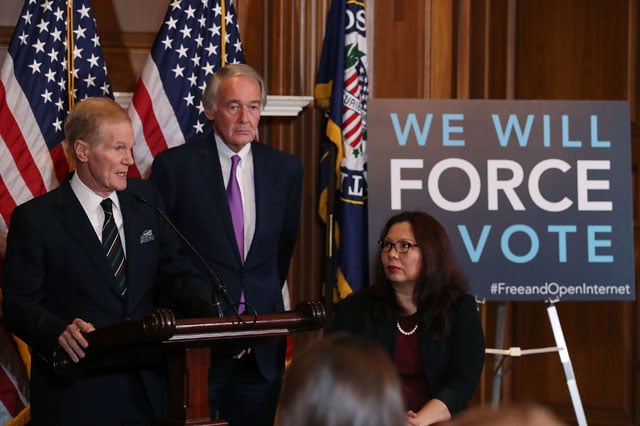 Sen. Bill Nelson (D-Florida) is flanked by Senators Ed Markey (D-Massachusetts) and Tammy Duckworth (D-Illinois) while speaking about a Congressional Review Act resolution that would undo the FCC’s action and restore the 2015 net neutrality rules, on Capitol Hill January 9, 2018, in Washington, DC. (Photo: Mark Wilson / Getty Images)
Open internet defenders are calling on Americans to continue “melting the phonelines” of their representatives following news on Monday that a bill aimed at overruling the Republican-controlled FCC’s order to kill net neutrality is just one Republican vote shy of the 51 needed for passage.
Introduced by Sen. Ed Markey (D-MA) in December, the legislation looks to make use of the Congressional Review Act (CRA), which allows lawmakers to pass a “resolution of disapproval” to nullify new regulations.
As Common Dreams has reported, more than a dozen Senate Democrats were slow to co-sponsor the legislation, but they ultimately signed on in the face of immense public pressure. Organizers are urging constituent voters nationwide to keep up the calls, letters, and emails urging members of Congress to support Markey’s bill and take a stand against the FCC’s attack on the open internet.
?????#NetNeutrality
We only need ONE MORE VOTE.
LIGHT ‘EM UP!
☎️?☎️?☎️
CALL SENATORS
(202) 224-3121Overturn the FCC Vote. Preserve Net Neutrality.
THIS IS EXTREMELY IMPORTANT
☎️?☎️?☎️ https://t.co/Zj7Vh21w6z
— Stone Cold Pillar (@KottiPillar) January 16, 2018
“With full caucus support, it’s clear that Democrats are committed to fighting to keep the internet from becoming the Wild West where [internet service providers] are free to offer premium service to only the wealthiest customers while average consumers are left with far inferior options,” Senate Majority Leader Chuck Schumer told the Washington Post on Monday.
Markey’s bill has also earned the support of Sen. Susan Collins (R-MN), who announced last week that she will vote for the legislation when it is eventually brought to the Senate floor. Democrats will now need to convince one more Republican to side with more than 80 percent of the American public — and 75 percent of Republican voters — over telecom giants and support Markey’s bill.
In an interview with Bloomberg last week, Markey expressed confidence that the bill will ultimately reach the necessary 51 votes.
“If we win in the Senate, there’s going to be big momentum on this,” Markey said. “It’s a voting issue for millennials; they care a lot about net neutrality. They want us to be on the side of ordinary people, not with the big special interests.”
However, immense challenges will remain even if the bill succeeds in the Senate. In the House, the legislation will need the support of every Democrat and more than 20 Republicans if it is to pass.
The bill will then reach the desk of President Donald Trump, who would have the ability to veto the legislation. Markey suggests that such a move would anger his base, much of which supports net neutrality protections.
“I’m willing to bet two-thirds of his Twitter followers support net neutrality,” Markey concluded.
Advocacy groups have warned lawmakers that refusal to support the effort to restore net neutrality protections will have immense electoral consequences. Such pressure appears to be having an effect, concluded Free Press president Craig Aaron in a tweet on Monday.
Your calls are working. Your pressure is working. Keep it up!
Now let’s get more Republicans on this bill. https://t.co/fkiX6jKSmZ
— Craig Aaron (@notaaroncraig) January 16, 2018
Please support movement journalism
Independent media is a pillar of democracy and a powerful force for justice. We rely on reader support. Please make a tax-deductible one-time or monthly donation to Truthout if you can.